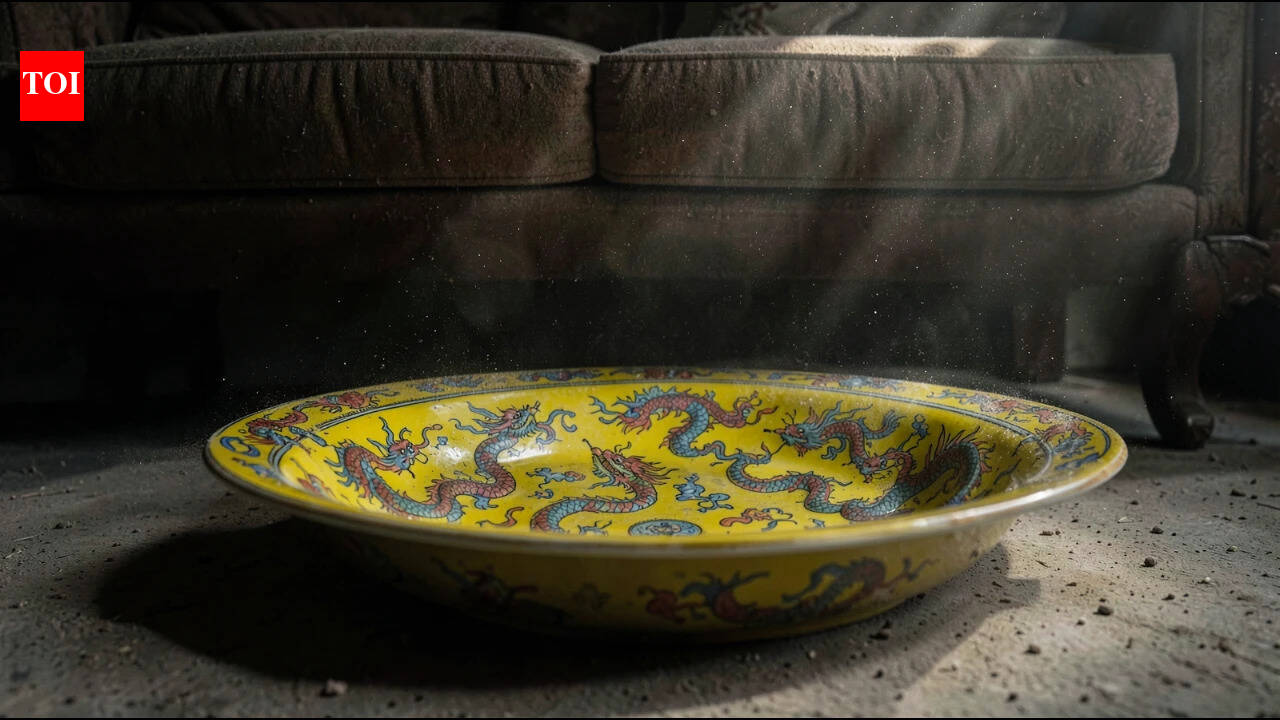
For decades, a large, dirt-covered porcelain dish lay beneath a sofa in a north London home, its significance unknown to the family who kept it.
asserted
who → cover → it
Now identified as a rare example of Chinese imperial porcelain associated with the court of Empress Dowager Cixi, the dish is expected to sell for £20,000 to £30,000 at auction.
asserted
dish → identify → auction
The 2ft-wide piece, which weighs about 30lb, was brought to Britain in the early 20th century by Chinese immigrant Wing Lung Goo and passed down through his family.
asserted
which → weigh → family
Asian art specialist John Axford of Salisbury auction house Woolley & Wallis identified a four-character seal mark on its base linking it to Chuxiu Palace in Beijing’s Forbidden City.
asserted
Axford → identify → City
Decorated in imperial yellow with green and aubergine enamels, the dish is scheduled to be offered for sale on 10 November 2026.
asserted
dish → decorate → November
Asian art specialist John Axford identified the four-character seal mark on its base, which links the dish to Chuxiu Palace in Beijing’s Forbidden City.
asserted
which → identify → City
Comparable dishes bearing the same mark provide further context for understanding the piece and its place within late Qing imperial porcelain.
asserted
dishes → bear → porcelain
Qing dynasty dish found under a sofa in Barnet: how the Goo family’s porcelain reached Woolley & Wallis
asserted
porcelain → find → Woolley
The discovery began when a relative of the family contacted Woolley & Wallis and sent photographs of the dish.
asserted
relative → begin → dish
It had spent decades beneath the living-room sofa in a Barnet townhouse, where it accumulated dirt.
asserted
it → spend → dirt
Axford, the auction house’s Asian art specialist, decided that the object’s unusual size warranted an in-person inspection.
asserted
size → decide → inspection
Examining the dish revealed a seal mark on its underside that helped establish its significance.
asserted
that → examine → significance
Axford said the family’s reason for storing the dish beneath the sofa was not known.
asserted
reason → say → sofa
He suggested that its size may have made it difficult to hang on a wall or display, although that explanation remains a possibility rather than an established account of the family’s decision.
uncertain
explanation → suggest → decision
After it was cleaned, the porcelain emerged in what the auction house described as near-pristine condition.
asserted
house → clean → condition
The discovery resembles other cases in which an ordinary-looking object has turned out to be more significant than its owners realised.
asserted
owners → resemble → which
In its article Charity Shop Finds, Woolley & Wallis recounts how a Chinese dish that was due to be priced at £2 in a Dorset charity shop was brought in for valuation and recognised by Axford.
asserted
that → recount → Axford
The Barnet dish, however, stands out for its monumental scale and its unusual base, which the auction house says is the only known example of this type to have a yellow glaze across the base as well.
asserted
house → stand → base
Chuxiugong zhi seal mark explained: how experts linked the dish to Empress Dowager Cixi
asserted
experts → explain → Cixi
It translates as “made for Chuxiu Palace”, also known as the Palace of Gathering Elegance.
asserted
It → translate → Elegance
The palace was one of the six Western palaces in Beijing’s Forbidden City and was closely associated with Empress Dowager Cixi.
asserted
palace → associate → Cixi
According to Sotheby’s catalogue notes for a related yellow-ground dragon charger, Chuxiu Palace was Cixi’s chief residence between 1856 and 1885.
uncertain
Palace → accord → 1856
She had it refurbished for her 50th birthday in 1884, with large decorative objects among the furnishings.
asserted
it → have → furnishings
Axford concluded that the Barnet dish was made in the 1880s to mark Cixi’s birthday.
asserted
dish → conclude → birthday
That dating places it in the late Qing dynasty, during the Guangxu period, which ran from 1875 to 1908.
asserted
which → place → 1908
The seal is significant because it associates the object with a specific imperial palace rather than identifying it merely as Chinese porcelain.
asserted
it → associate → porcelain
Its decoration provides further points of comparison with known palace wares.
asserted
decoration → provide → wares
A related dish offered by Woolley & Wallis in 2023, documented in lot 40 of its Fine Asian Art sale, measures 32cm across.
asserted
dish → offer → cm
It features two scaly dragons contesting a flaming pearl amid clouds, with four dragons on the underside.
asserted
It → feature → underside
Its recorded provenance includes Field Marshal Earl Kitchener and a 1938 Sotheby’s sale in London.
asserted
provenance → record → London
Another comparison appears in Sotheby’s 2016 catalogue for a large yellow-ground dragon charger.
asserted
comparison → appear → charger
That piece bears the same four-character mark and features two leaping dragons contesting a flaming pearl, with green and aubergine enamels against a yellow ground.
asserted
piece → bear → ground
Sotheby’s traces the design to a Kangxi-period prototype in the National Palace Museum in Taipei.
asserted
Sotheby → trace → Taipei
These parallels help specialists place the Barnet dish within a recognisable tradition of imperial porcelain, although each object has its own features and history.
asserted
object → help → features
Imperial Chinese porcelain at auction: what a £20,000 to £30,000 estimate says about the dish
asserted
estimate → say → dish
The Barnet dish has several features that distinguish it from smaller examples.
asserted
that → have → examples
It measures about 61cm across and weighs approximately 30lb.
asserted
It → measure → lb
Its decoration includes two confronting dragons contesting a flaming pearl, surrounded by clouds and flames.
asserted
decoration → include → clouds
A floral border features lotus, prunus, peony, chrysanthemum and hibiscus, while further dragons and flaming pearls decorate the rim.
asserted
dragons → feature → rim
The yellow ground, with green and aubergine enamel details, is characteristic of the group of imperial wares to which the dish has been linked.
asserted
dish → link → which
…and 11 more, not listed.
 The Aporia