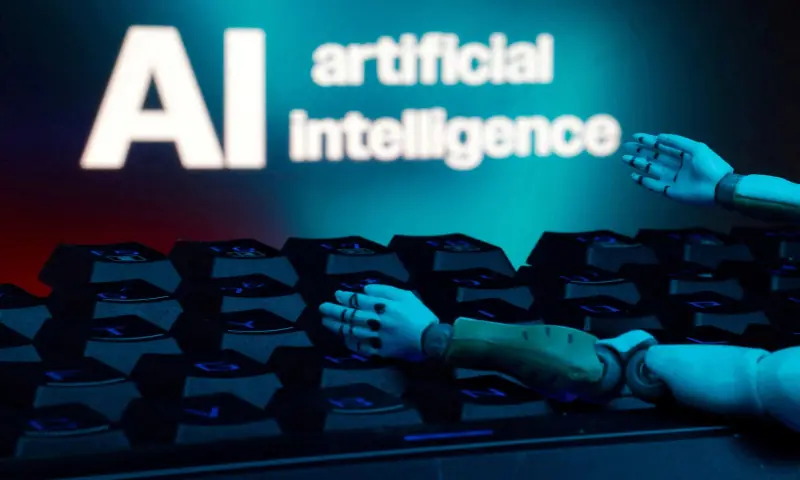
Startups like FutureSearch and Preseen are using AI to predict events such as stock market movements and music chart performances more accurately than human experts, sometimes even outperforming them in competitions. These companies claim their models can match or surpass the best human forecasters by analyzing vast amounts of data from public and private sources. For instance, in September, FutureSearch’s model won a prediction championship called the Metaculus Cup, highlighting AI's growing dominance over human forecasting abilities. The use of AI in predicting market trends is expected to increasingly automate financial decision-making processes, potentially leaving out retail investors who lack access to such advanced tools.
Written locally by qwen2.5:14b on 2026-10-12,
using this article's own text rather than the other coverage of the
same event (that is the story summary below).
Story summary
Start-ups like FutureSearch, Kalshi, and Mantic are developing artificial intelligence (AI) models that they claim can predict various outcomes more accurately than human experts. These predictions range from stock market movements to the performance of Shakira songs on music charts, or even geopolitical events such as the reopening of the Strait of Hormuz. In early September, AI models achieved top rankings in the Metaculus Cup, a competition for prediction champions. By 2030, it is predicted that reliance on traditional decision-making methods will seem outdated compared to AI forecasts. According to Dan Schwarz, co-founder of FutureSearch, AI forecasting models are already comparable to the best "superforecasters," individuals known for their superior predictive abilities, due to access to extensive data from public and private sources.
Written for “Startups and AI Predictions” on 2026-10-12,
grounded in this article and the 1 other(s) covering the same event.
Several startups are betting that they can leverage artificial intelligence (AI) to make better forecasts than even the most specialised experts when it comes to topics as varied as stock market movements, the reopening of the Strait of Hormuz, or how a Shakira song will perform on music charts.
asserted
song → bet → charts
By 2030, “we’re going to feel that what we were doing for our decision-making was complete Stone Age thinking,” Dan Schwarz, cofounder of the forecasting company FutureSearch, said.
asserted
Schwarz → go → company
AI forecasting models are already on par with the best “superforecasters” — gifted individuals whose estimates are markedly superior to those of ordinary people — thanks to troves of data acquired from both public and private sources.
asserted
estimates → acquire → sources
In early September, two AI models made history when they took the top spots in the Metaculus Cup, a competition among prediction champions, both human and nonhuman.
asserted
they → make → champions
FutureSearch’s in-house human wizard, superforecaster Tom Liptay, is aware that “he’s not secure in his job” in the medium term, Schwarz said.
asserted
Schwarz → ’ → term
“He knows that these things are going to surpass him.”
asserted
things → know → him
Theo Summer, who cofounded Preseen with Veniamin Veselovsky, used AI tools to turn $35 into $1.9 million in just seven months on the American prediction-making site Kalshi.
asserted
who → cofounde → site
The idea is not to guarantee a result but to define a probability of occurrence, with the ability to cross-check assumptions related to several interconnected events — for example, changes in the price of oil and the war in the Middle East.
asserted
idea → guarantee → East
“Right now, the quickest buyers are normally the hedge funds, just because if they think they can make money off something, they can move pretty fast,” Veselovsky said.
asserted
Veselovsky → think → something
Algorithms have shaped Wall Street for more than a decade, but the rise of AI forecasting is likely to further increase the automation of financial markets.
asserted
rise → shape → markets
“I think it’s probably already having a small impact because we already have customers who use it when making trading decisions,” said Toby Shevlane, the cofounder of another forecasting startup called Mantic.
asserted
Shevlane → think → startup
Now-famous prediction markets Kalshi and Polymarket, which are used by millions of Americans, are also becoming inundated by AI use.
asserted
which → use → use
It might soon be too late for retail investors, who don’t have access to expensive AI tools, to profit on those types of consumer-oriented trading sites because “they will soon just be dominated by AI forecasting systems,” Veselovsky said.
uncertain
Veselovsky → have → systems
The most advanced models no longer just predict events, either.
asserted
models → predict → events
They can also formulate their own questions about the future and then assign probabilities based on the different possible outcomes, Shevlane said.
asserted
Shevlane → formulate → outcomes
Their sphere of influence is beginning to extend beyond finance, as well, with potential applications in government policy, corporate decision-making, scientific research, and insurance risk assessments.
asserted
sphere → begin → policy
Mantic provides a large American company with likely scenarios of regulatory developments in its sector and has also worked for the British government.
asserted
Mantic → provide → government
Companies “are interested in risks and how to monitor them,” Shevlane said.
asserted
Shevlane → monitor → them
Meanwhile, other customers might be more interested in medical research, particularly to help make decisions around which types of treatments would be best to fund, Schwarz said.
uncertain
Schwarz → make → treatments
Widespread access to these types of tools can come with costs, though.
asserted
access → come → costs
“I think that good can be derived from this,” Veselovsky said, but “I’m also a little bit scared because, you know, maybe Russia or China has better systems.”
asserted
Russia → think → systems
 The Aporia