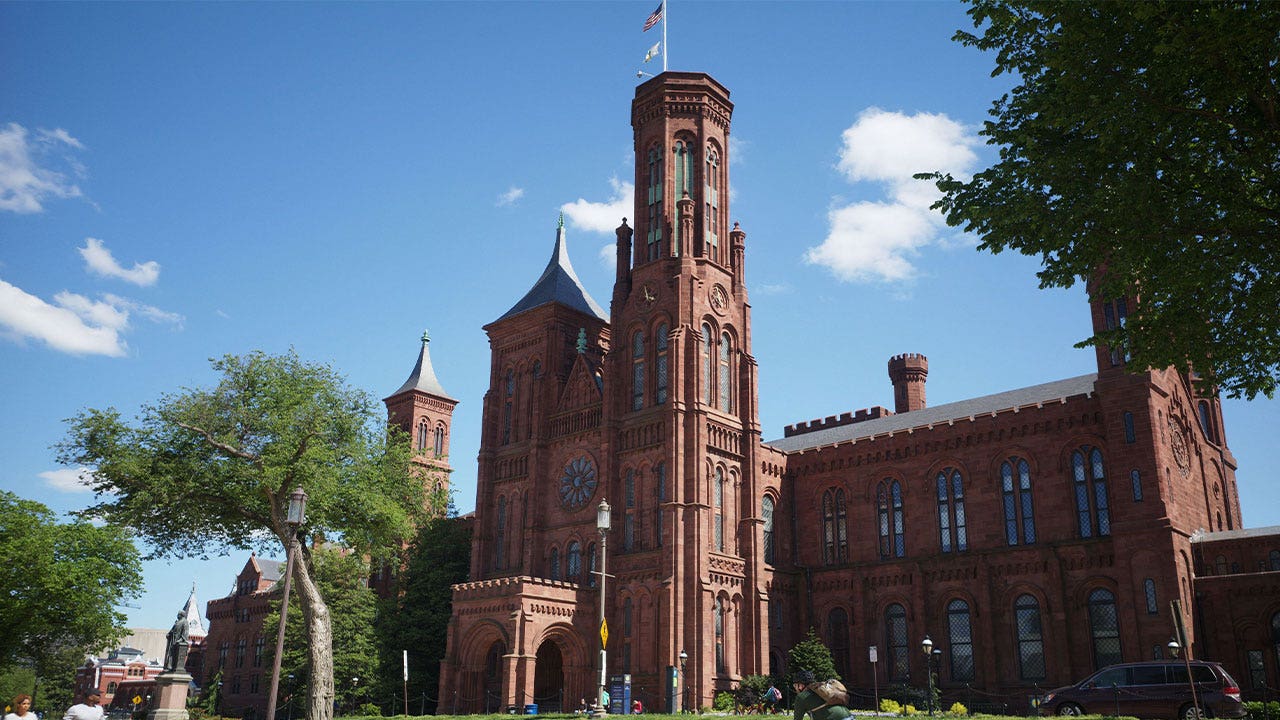
The Smithsonian Institution is sometimes called the nation’s attic.
asserted
Institution → call → ?
An attic stores things.
asserted
attic → store → things
The Smithsonian does something far more consequential: It helps Americans understand who we are.
asserted
we → do → something
That responsibility carries particular weight as the United States celebrates its 250th anniversary and the Smithsonian prepares for new leadership.
asserted
Smithsonian → carry → leadership
The transition comes amid an intense debate over how the Smithsonian presents American history.
asserted
Smithsonian → come → history
A White House review criticized the National Museum of American History, arguing that ideological concerns have displaced an understanding of history as a shared national inheritance.
asserted
concerns → criticize → inheritance
Smithsonian leaders and historians have defended the institution’s scholarly independence and warned against allowing political power to dictate how history is told.
asserted
history → defend → independence
The answer cannot be choosing one of those impulses and ignoring the other.
asserted
answer → choose → other
Outgoing Smithsonian Secretary Lonnie Bunch recently said the Smithsonian must show both the light and the dark.
asserted
Smithsonian → say → light
He has also described America as an ideal as much as a place — an aspiration toward liberty, fairness, justice and equality.
asserted
He → describe → liberty
But has the Smithsonian been telling the American story fairly?
asserted
Smithsonian → tell → story
The harder question is one of proportion: How should America’s national museums put the light and the dark together into an honest account of the country?
asserted
museums → put → country
I have spent much of the past quarter-century helping govern museums and historic institutions in Virginia.
asserted
I → spend → Virginia
That experience has convinced me that historical integrity requires more than factual accuracy.
asserted
integrity → convince → accuracy
It requires proportion, context and perspective.
asserted
It → require → proportion
America’s national museums should tell our history honestly, including our shortcomings, contradictions and occasions when Americans failed to live up to the principles proclaimed at the nation’s founding.
asserted
Americans → tell → founding
But those failures should not become the organizing principle through which the American experience is understood.
asserted
experience → become → which
Viewed in proportion, the American story is extraordinary.
asserted
story → view → proportion
A collection of colonies declared that human beings possess rights governments do not grant.
asserted
governments → declare → rights
Americans then built an enduring constitutional republic around representative government, individual liberty and the rule of law.
asserted
Americans → build → law
Those ideas changed human history.
asserted
ideas → change → history
The nation they produced survived civil war, expanded freedom and political participation, welcomed generations of immigrants, became an industrial and scientific power, defeated fascism and Soviet communism and put human beings on the moon.
asserted
they → produce → moon
America’s national museums should tell our history honestly, including our shortcomings, contradictions and occasions when Americans failed to live up to the principles proclaimed at the nation’s founding.
asserted
Americans → tell → founding
When America fell short of its founding principles, succeeding generations repeatedly returned to those principles to demand the nation do better.
asserted
nation → fall → principles
A great national museum should be capable of the former without succumbing to the latter.
asserted
museum → succumb → latter
Museums inevitably make choices: which objects to display, which stories to emphasize and which context visitors receive.
asserted
visitors → make → context
Individual facts can be accurate while their cumulative presentation leaves a distorted impression.
asserted
presentation → leave → impression
The Smithsonian should resist any interpretive approach that begins with contemporary political or ideological categories and works backward through history to validate them.
asserted
that → resist → them
History should illuminate today’s debates, but the past deserves to be encountered on its own terms.
asserted
past → illuminate → terms
Nor can the answer be replacing one political orthodoxy with another.
asserted
answer → replace → another
The Smithsonian has endured presidents and Congresses of both parties.
asserted
Smithsonian → endure → parties
Its credibility rests upon scholarship, independence and public trust.
asserted
credibility → rest → scholarship
Americans should never believe exhibits in their national museums are rewritten whenever political power changes hands.
asserted
power → believe → hands
James Smithson envisioned an institution devoted to the "increase and diffusion of knowledge."
Two centuries later, the Smithsonian holds objects that belong to all of us: General George Washington’s uniform.
asserted
that → envision → us
They tell a remarkable story of aspiration, struggle, achievement and progress.
asserted
They → tell → aspiration
No curator owns that story.
asserted
curator → own → story
Neither does a president, political party, academic movement — or generation.
asserted
president → do → ?
We hold it temporarily in trust.
asserted
We → hold → trust
That principle matters especially during America’s 250th anniversary.
asserted
principle → matter → anniversary
This milestone should invite reflection.
asserted
milestone → invite → reflection
…and 10 more, not listed.
 The Aporia