That is 0 articles you have read today.
The Aporia is free and carries no advertising, so readers are the only
thing paying for it. If you are getting this much out of it, a small
donation is what keeps it independent.
Daily limit reached
You have read 0 articles today.
That is more than the 15 a day The Aporia gives away,
and well past what it can carry on nothing. Your allowance resets at
midnight.
There is no advertising here and nothing about you is sold, so readers
are the only thing paying for it. If the site is worth this much of
your day, it is worth a few dollars.
Everything else stays open: the
maps, the
directory and
search do
not count against this, and neither does re-opening something you have
already read today.
Pakistan’s Finance Minister Muhammad Aurangzeb announced plans to privatize five to six government entities that could raise more than $1 billion. This move aims to bolster Pakistan's economy, which grew by over 4% this fiscal year despite high oil prices and regional conflicts affecting energy imports and remittances from the Gulf. The minister highlighted the importance of private sector leadership in economic recovery and mentioned ongoing negotiations with the United States for a proposed $10 billion exchange stabilisation facility to support Pakistan’s financial stability.
Written locally by qwen2.5:14b on 2026-10-12,
using this article's own text rather than the other coverage of the
same event (that is the story summary below).
Story summary
The Finance Minister Muhammad Aurangzeb announced on Monday that Pakistan plans to privatize five to six government entities to raise over $1 billion, as part of an effort to stabilize the economy. Despite facing elevated oil prices and inflation challenges, the minister expects the country's economic growth to exceed 4% this fiscal year. This push for privatization comes after severe economic turmoil exacerbated by the Covid-19 pandemic. Pakistan has secured sufficient fuel imports, avoiding shortages, and critical sectors like agriculture are performing well according to Aurangzeb. The country’s economy remains highly vulnerable due to its dependence on Gulf energy imports and financing support from the region. Pakistan is currently benefiting from a $7 billion IMF loan program, initiated in 2024, which includes measures such as raising taxes on farm income.
Written for “Pakistan Privatization Push” on 2026-10-12,
grounded in this article and the 0 other(s) covering the same event.
Why this leaning score
The model judged this article politically coded and scored it +0.35, but all 2 of its quote(s) are attributed speech - words the article quotes from someone, not the article's own narration, so the score is not published.
Written under an earlier scoring contract, which gave a paragraph
rather than checkable quotes. Re-analysing this article replaces it.
Leaning score withheld for article 73414: attributed speech only · logged 2026-10-12
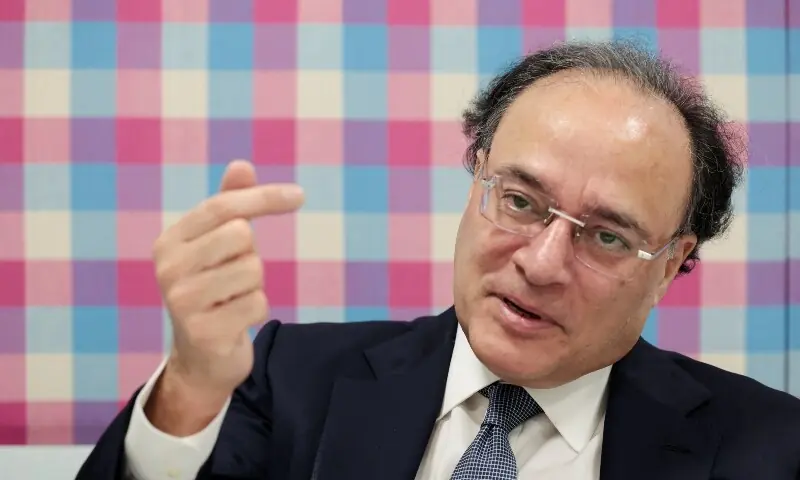
The government is looking to push for the privatisation of five to six entities that could raise upwards of $1 billion, Finance Minister Muhammad Aurangzeb told Reuters on Monday, stating that he expected the economy to grow by more than 4 per cent this fiscal year despite elevated oil prices.
uncertain
economy → look → prices
Pakistan’s economy is considered to be highly vulnerable to a prolonged Middle East conflict given its dependence on Gulf energy imports, remittances and financing support from the region, even as it remains reliant on external financing to bolster foreign exchange reserves and meet debt repayments.
asserted
it → consider → repayments
Pakistan has been able to procure adequate quantities of fuel, successfully avoiding any shortages, and critical sectors such as agriculture were holding up, Aurangzeb said.
asserted
Aurangzeb → procure → agriculture
“So I’m still quite clear that we should clock north of 4pc,” he said in an interview on the sidelines of the annual meetings of the International Monetary Fund and World Bank in Bangkok.
asserted
he → ’m → Bangkok
“And on the inflation side, obviously, we are keeping a very close eye because it does have a knock-on impact in terms of the commodity prices.”
Following a period of severe economic turmoil exacerbated by the Covid-19 pandemic, the cash-strapped economy has recovered some of its footing, supported by a $7bn, 37-month IMF loan program known as the Extended Fund Facility signed in 2024 that includes some tough measures such as raising tax revenue on farm income.
asserted
that → keep → income
Following the privatisation of flag carrier Pakistan International Airlines last year, Aurangzeb said the government has around another dozen entities in the pipeline, including state-owned power distribution companies and the outsourcing of airport operations.
asserted
government → follow → operations
“I expect about five or six of these to go through during this fiscal year,” he said, adding that they could raise more than $1bn.
uncertain
they → expect → 1bn
Privatisation has been seen as a key test of Pakistan’s reform credibility with the IMF, with officials previously underlining that failure to offload loss-making state firms risked renewed pressure on public finances.
asserted
failure → see → finances
“We are quite clear that we want the private sector to lead the country,” said Aurangzeb.
asserted
Aurangzeb → want → country
“So our role is to help support, assist any way we can in terms of the ecosystem.”
asserted
we → help → ecosystem
Exchange stabilisation facility
The US-Israeli-led war with Iran, now in its eighth month, and the inflation and hardship it has caused, will dominate the agenda and sideline conversations during the meetings that are being held outside Washington for the first time in three years.
asserted
that → lead → years
Pakistan, which reached a staff-level agreement with the IMF last week, potentially unlocking about $1.21bn in financing under the Extended Fund Facility and a climate program, is continuing discussions with the United States for a proposed $10bn exchange stabilisation facility, Aurangzeb said.
asserted
Aurangzeb → reach → facility
But he declined to provide a time frame for the conclusion of negotiations.
asserted
he → decline → negotiations
“If it comes through, this will be a great help for us,” he said, referring to the facility, which is in addition to ongoing talks with the Export-Import Bank of the United States and the US International Development Finance Corporation.
“If it doesn’t come through, this does not, you know, create any problem for us in terms of access to market.”
asserted
you → come → market
 The Aporia