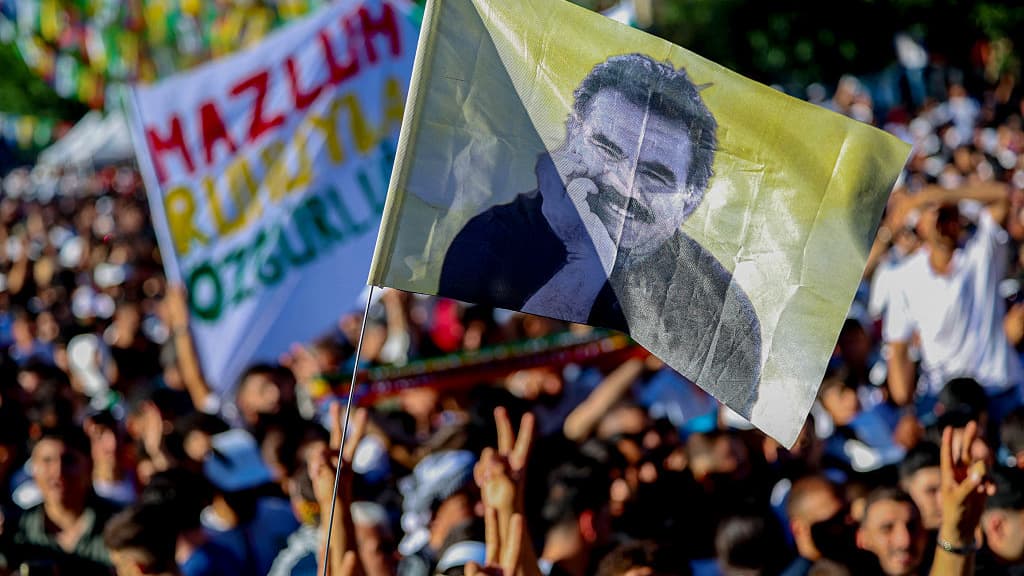
August brought some truly transformative good news for Turkey, the Kurds, and Turkey’s immediate neighborhood in the Middle East.
asserted
August → bring → East
On Aug. 10, the Turkish Parliament passed a law establishing a legal framework for the dissolution of the Kurdistan Workers Party (PKK), the Kurdish militant group, and creating a phased pathway for reintegration of its members into society.
asserted
Parliament → pass → society
For more than four decades, the Kurdish issue has run like an electrified barbed wire through conversations in Turkey.
asserted
issue → run → Turkey
The armed conflict between the PKK and the Turkish government has killed around 40,000 militants, soldiers, and civilians, and cost Turkey losses estimated to be around $2 trillion since 1984.
asserted
conflict → kill → 1984
Following peace talks, in July 2025, the PKK held a symbolic weapon-burning ceremony, starting a process of disarmament and moving toward ending the armed conflict.
asserted
PKK → follow → conflict
The law offers legal protections to former PKK militants who have not committed specific crimes and helps suspend prison sentences for some members of the group.
asserted
who → offer → group
Thousands of sympathizers, activists affiliated with the PKK, and Kurdish politicians have been living in exile in Europe and elsewhere to escape legal prosecution.
asserted
Thousands → affiliate → prosecution
The law opens a path for them to return to Turkey.
asserted
them → open → Turkey
And the passage of this law in the Turkish parliament with broad support is a transformative step toward lasting peace and the creation of a new social contract between Turkey and the Kurds, domestically and regionally.
asserted
passage → last → Turkey
How to make peace
In the past decade, Turkey established clear military dominance in the fight against the PKK.
asserted
Turkey → make → PKK
Changes in military technology, intelligence, and surveillance systems, especially the rise of Turkish drones, strengthened the country’s counter-insurgency efforts.
asserted
Changes → strengthen → efforts
Yet Turkey’s military capacity to suppress an insurgency was not the sole factor in persuading the PKK to give up arms.
asserted
capacity → suppress → arms
Turkey did suppress waves of Kurdish rebellions in the past without creating space for Kurdish aspirations, and each suppression was followed by a more formidable and more violent rebellion.
asserted
suppression → suppress → rebellion
Turkey’s embrace of a political process—instead of simply pursuing a decisive military path—to end the conflict made it more acceptable to the PKK leadership and the Kurdish movement.
asserted
it → pursue → leadership
Abdullah Ocalan, the leader of the PKK, had to persuade his comrades to dissolve their organization, abandon the armed struggle, and choose political struggle.
asserted
Ocalan → have → struggle
Unfavorable broader regional trends against armed militancy may have helped convince Ocalan and his comrades to make that consequential choice.
uncertain
trends → help → choice
The legitimacy of the political solution, in the eyes of the Kurds, determines its sustainability and transformative impact.
asserted
legitimacy → determine → sustainability
The current peace process seeks to end the insurgency and transform the struggle for Kurdish rights and aspirations into a nonviolent political one.
asserted
process → seek → one
It could transform Turkey’s relations with its own Kurdish community and the Kurdish communities in Iraq, Syria, and Iran.
uncertain
It → transform → Iraq
Leaders of the Kurdish movement believe that they can achieve more through politics than through armed struggle, and that it isn’t only they who are transforming, but that the state, political, and legal systems in Turkey can also change.
asserted
systems → believe → Turkey
The Turks and the Kurds managed it without relying on foreign peacemakers or mediation.
asserted
Turks → manage → peacemakers
The disarmament and demobilization process for the PKK was designed, executed, and monitored domestically, without involving any foreign mediators.
asserted
process → design → mediators
The talks were held between Turkey’s National Intelligence Organization, Ocalan, and several other leaders of his group based in the Qandil Mountains in Iraqi Kurdistan and across Europe.
asserted
talks → hold → Europe
The process involved the Turkish parliament and political parties through a Parliamentary Committee, formed in Aug. 2025 to work on legal and political dimensions of the PKK’s dissolution, which helped garner broad support for the peace process across political divides in Turkey.
asserted
which → involve → Turkey
Turkey and the Kurds have entered a new phase that demands greater buy-in for the peace process from politicians, lawmakers, ordinary people, and from the institutions that will implement the new law.
asserted
that → enter → law
To ensure the peace process has broader societal support, the political class will need to make clear why it matters and what it promises.
asserted
it → ensure → what
The stakes of getting that right are high for Turkey and extend beyond its borders.
asserted
that → get → borders
Seeing like a state
The nation-state in the 20th century largely adopted a conception of nationhood based on a single identity and was intolerant, assimilationist, or exclusionary toward other identities.
asserted
state → see → identities
The effect was to politicize and mobilize the very groups it sought to submerge.
asserted
it → politicize → groups
The Turkish Republic was based on a single identity and an overly centralized state with its own insecurities, largely stemming from the traumatic experience during the collapse of the Ottoman Empire.
asserted
Republic → base → Empire
Today, Turkey needs a new conception of the nation-state that is inclusive of different identity groups, and a new idea of a strong state that is premised on broader societal legitimacy.
asserted
that → need → legitimacy
Centralization coupled with exclusion is a recipe for societal discontent, which weakens, rather than strengthens, the state.
asserted
which → couple → state
Turkey’s real challenge is building an inclusive national identity that recognizes distinct identity groups without losing the thread of what binds them together.
asserted
what → build → them
The task of the ongoing Kurdish peace process, and the Kurdish politics that will follow it, will be to achieve exactly this: an inclusive notion of national identity capacious enough to accommodate Kurdish identity and aspirations.
asserted
that → follow → identity
The broader trend runs toward their integration into state structures or their disarmament and demobilization.
asserted
trend → run → structures
How these processes of demobilization and integration are carried out will be highly consequential.
asserted
carried → carry → demobilization
If they rely solely on coercion, rather than embracing persuasion and the prospect of mutual transformation, disarmament risks being a prelude to the next cycle of violence, waged under new names and banners.
asserted
disarmament → rely → names
Demobilization of insurgent groups succeeds when it rests on the prospect of mutual transformation.
asserted
it → succeed → transformation
The armed groups dissolve themselves and remake themselves as political actors, who cease to be adversaries of the state and work as agents of its transformation.
asserted
who → dissolve → transformation
The state and the polity, in turn, must transform alongside them, arriving at a more inclusive conception of national and geopolitical identity.
asserted
state → transform → identity
…and 30 more, not listed.
 The Aporia