The Sydney Morning Herald
· collected 2026-10-11 · by Danielle Demetriou
I am sitting on a bullet train somewhere between Kyoto and Tokyo, watching rice fields, small towns and misty mountains whizz past the window.
asserted
fields → sit → window
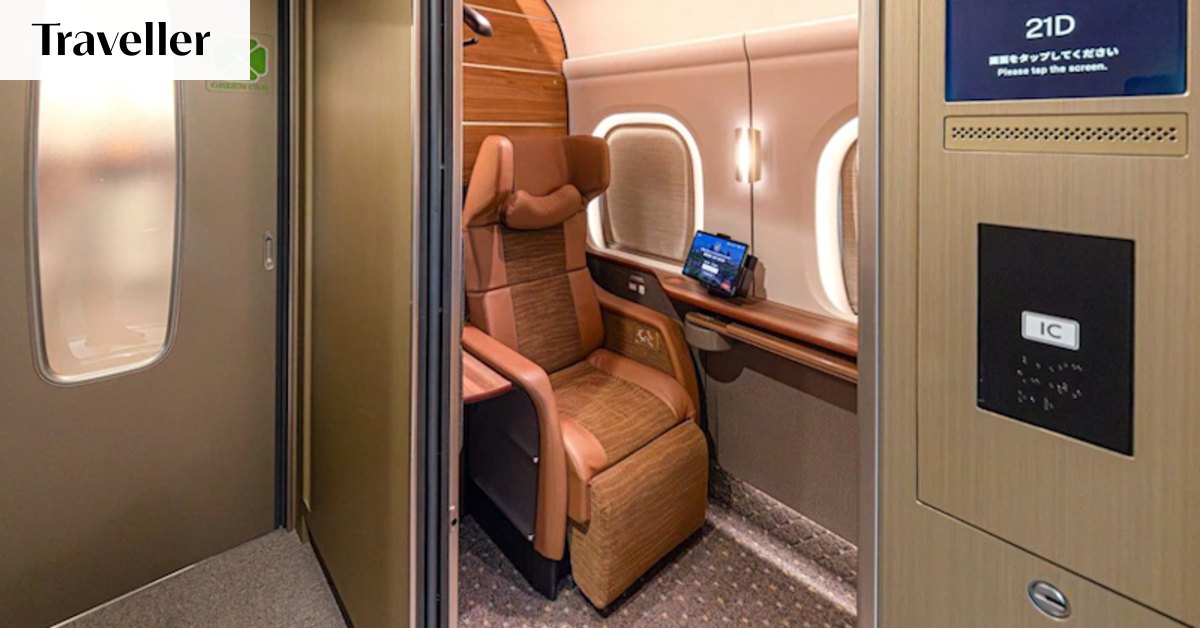
My Shinkansen (Japan’s high-speed rail network) journey, however, is far from ordinary: I am completely alone, with no other salarymen, families or tourists in sight, enjoying a taste of solitude inside a curved capsule, decorated in shades of caramel and gold, a handcrafted ceramic ornament on the wall and the door firmly closed.
asserted
I → enjoy → wall
My seat, reclining and heated, is accessorised with silken cushions, while a matcha cake from Kyoto sits on a side table alongside a high-tech tablet that traces the train’s journey across the country, similar to flight maps on planes.
asserted
that → recline → planes
As I lean back and soak up the views, the melodic strains of a Ryuichi Sakamoto track from my Spotify playlist drift out of my Personalised Sound Zone, which is built into the headrest that curves around my head.
asserted
that → lean → head
Japan’s legendary bullet trains need little introduction.
asserted
trains → need → introduction
Since launching in a blaze of post-war recovery glory in 1964, just ahead of the Tokyo Olympic Games, the nation’s high-speed trains have been consistently lauded as fast, punctual and clean.
asserted
trains → launch → Games
Six decades later, Shinkansen trains can now add another adjective to the list: luxurious.
asserted
trains → add → list
Last week, Japan launched its shiny new Supreme Class Cabin, which offers the opportunity to travel in five-star style, cocooned inside an exclusive private cabin.
asserted
which → launch → cabin
The new cabins are a step up from the existing premium option, the Green Car, where large seats with a deeper recline are arranged in a more spacious configuration than ordinary carriages.
asserted
seats → exist → carriages
Initially debuting on board N700S 16-car trains, the new service has begun with around 24 cabins operating on roughly 12 services a day between Tokyo and Hakata, stopping off in Nagoya, Kyoto and Osaka along the way, but numbers will steadily expand over the coming months.
asserted
numbers → debut → months
Drawn by the idea of experiencing the ultimate rail omotenashi (a specifically Japanese style of hospitality), I was one of the first to travel on board the new Supreme Class Cabin, on a taster journey between Kyoto and Tokyo, shortly before the official launch.
asserted
I → draw → launch
Living in Kyoto, I often take the bullet train back and forth to Tokyo, and it is a comfortable, if conventional, experience.
asserted
it → live → Tokyo
An occasional glimpse of Mount Fuji on clear days lights up the journey.
asserted
glimpse → light → journey
This time, however, things unfolded a little differently.
asserted
things → unfold → ?
As I step on board, instead of turning right into an existing carriage, I’m ushered left – where a corridor leads to a sliding door (unlockable with a QR ticket or IC card) that opens to reveal my private cabin.
asserted
that → step → cabin
Converted from an operational space previously used by train staff, it’s one of two Supreme Class Cabins on the train.
asserted
it → convert → train
With passing Kyoto city scenery framed through the cabin’s two windows, the door slides closed – and I’m left to explore my cabin.
asserted
I → pass → cabin
It is elegantly appointed, the wall adorned with a small round ceramic Mino-yaki (a style of pottery) artwork, crafted by artisans in Gifu.
asserted
wall → appoint → Gifu
Swathes of curved wood-grain-patterned materials create a capsule-like cocoon, which includes a rounded sofa seat with plumped cushions in gold and peach tones on the right-hand side – and on the left, a spacious reclining chair in light brown synthetic leather that would not look out of place on a business-class flight.
asserted
that → pattern → flight
Tucking my small suitcase into a dedicated space by the wall, I sink into my throne-like seat.
asserted
I → tuck → seat
It’s surprisingly comfortable, and adjustable using the tablet by my side.
asserted
It → ’ → side
It allows me to recline, add lumbar support and raise my legs, while the heated seat option is a nice touch.
asserted
option → allow → legs
Flicking through the tablet, I spend several minutes playing with the controls, adjusting the airflow and the lighting, before logging into a high-speed Supreme Class 5G-compatible Wi-Fi network (fast when it works, but a bit iffy inside mountain tunnels).
asserted
it → flick → tunnels
Next, I tuck into a complimentary treat: a small golden paper box contains a circular cake made from Uji matcha, alongside a paper cup of coffee.
asserted
box → tuck → coffee
Additional snacks and drinks (purchasable at the press of a button) ranged from dried scallops to a premium sake, via coffee, green tea and beer (full meals are not served on board, so a station bento box is recommended).
asserted
box → range → board
The built-in Personalised Sound Zone connects via Bluetooth to personal devices, and the technology ensures sound stays around my ears and does not travel further – making it ideal for playing music, watching films or having an online meeting without being overheard.
asserted
it → build → meeting
The skies are grey and rainy, so I don’t mind that my cabin is not on the side train that will face Mount Fuji.
asserted
that → mind → Fuji
The second cabin, in Car 10, is on the train’s other side, so it’s worth planning a trip carefully to give yourself a shot at seeing Japan’s most iconic peak.
asserted
it → ’ → peak
Some might also note that as the Supreme Cabin seats are fixed in place, passengers will sometimes be required to travel facing backwards (seats elsewhere on bullet trains typically rotate to face the direction of travel).
uncertain
seats → note → travel
The experience doesn’t come cheap.
asserted
experience → come → ?
for travel between Tokyo and Shin-Osaka, a cabin for two costs ¥60,790 yen ($552) – it’s ¥42,390 ($385) for a single cabin – compared to around ¥14,520 ($132) for ordinary seats, or ¥19,390 ($176) for Green Car.
asserted
it → cost → Car
But it is likely to be a big draw for senior executives as well as well-heeled couples and travellers.
asserted
it → heel → executives
Wandering into a nearby Green Car, I ask a few travellers about their thoughts on the new cabins.
asserted
I → wander → cabins
Brothers Chris, 31, and Steven, 27, on holiday from New York, had not heard of Supreme Class: “It sounds very cool.
asserted
It → hear → Class
Maybe in the future it’s something to try,” says Chris.
asserted
Chris → ’ → future
“Although it’s a bit pricey – Green Car is maybe a good in-between place.”
asserted
Car → ’ → ?
Naoki Osaka, a Japanese journalist specialising in trains, was also on board.
asserted
Osaka → specialise → board
“Overseas travellers already know that bullet trains are safe and speedy – and now they are also luxurious.
asserted
they → know → ?
In France and Italy, train companies already have private cabins.
asserted
companies → have → cabins
It’s a good next step for Japan.
asserted
It → ’ → Japan
…and 2 more, not listed.
 The Aporia