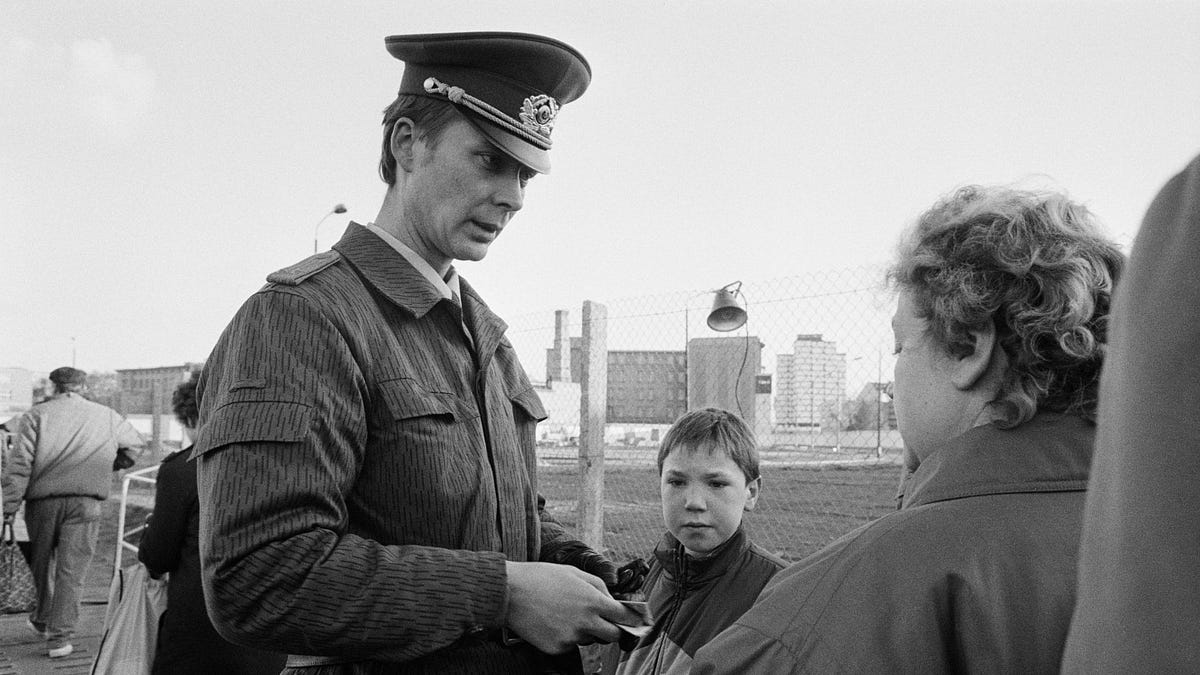
Today marks the publication of Francis Fukuyama’s new memoir In the Realm of the Last Man.
asserted
Today → mark → Man
I composed my essay “The End of History?” sitting in my in-laws’ house in Las Vegas in the winter of 1988–89.
asserted
I → compose → 1988–89
I was preparing for a lecture at the University of Chicago organized by Allan Bloom and Nathan Tarcov at the Committee on Social Thought.
asserted
I → prepare → Thought
Bloom was habitually pessimistic about the ability of Western liberal democracies to defend themselves, and the overall rubric of the lecture series was “The Decline of the West.”
asserted
rubric → defend → West
I told Bloom I was happy to participate, but that I would have a more optimistic take on what was going on in the world.
asserted
what → tell → world
He said that was fine, and I gave my talk a year before the fall of the Berlin Wall.
asserted
I → say → Wall
Owen Harries, an Australian former ambassador, was the new editor of a small magazine founded by Irving Kristol called The National Interest.
asserted
Harries → found → Kristol
He had lunch with me at the Beverly Hills Hotel that winter and asked whether I had anything to contribute.
asserted
I → have → anything
I told him about my upcoming lecture, and he promised to publish the written version, which came out in the summer of 1989.
asserted
which → tell → 1989
Hegel was the first explicitly historicist philosopher; that is, a philosopher who argued that human thought and institutions were not fixed but evolved over historical time, and that the “truth” of a particular assertion needed to be judged in relation to the historical era in which it was articulated.
asserted
it → argue → which
We may not believe in the legitimacy of monarchy or slavery today, but there were certainly times in the past when many people did support such ideas.
uncertain
people → believe → ideas
The fact that we believe in democracy and equal rights today is testimony to the reality of “History” in Hegel’s sense.
asserted
we → believe → sense
The idea that human societies evolved over time was something that took root only in modern times.
asserted
that → evolve → times
Both Plato and Aristotle argued that there was a cycle of regimes that succeeded one another, but this led to cyclical change that simply reproduced previous forms of government in succession.
asserted
that → argue → succession
The idea that history was progressive, that it had a beginning point in primitive societies but moved toward more complex and advanced ones, was adumbrated by Jean-Jacques Rousseau in his Discourse on the Origin of Inequality under the heading of “perfectibility.”
asserted
it → have → perfectibility
His description of “man in the state of nature” was not simply a thought exercise, as it was for Thomas Hobbes, but an actual effort to describe human behavior that drew on what Europeans at that time knew about non-Western societies.
asserted
Europeans → describe → societies
Europeans were aware of the existence of other sophisticated societies, such as those of Islam and China, but the opening up of the New World suggested societies differed in what we would today call their level of development.
uncertain
we → suggest → development
Hegel simply systematized the idea of History and provided an intellectual structure for understanding what drove that evolution.
asserted
what → systematize → evolution
The notion that societies evolve over historical time in a progressive fashion is tacitly accepted by almost everyone today, whether they self-consciously understand that fact or not.
asserted
they → evolve → fact
The idea of a Hegelian history is embedded in our words “development” and “modernization.”
asserted
idea → embed → words
Organizations such as the former US Agency for International Development (USAID) and the International Bank for Reconstruction and Development (i.e., the World Bank) were both dedicated not to simply helping poor countries become rich, but to helping them create modern institutions that make life more secure and predictable.
asserted
life → dedicate → institutions
The most important intellectual to accept and then modify Hegel’s concept of history was Karl Marx.
asserted
intellectual → accept → history
Hegel argued that history had evolved into the modern liberal state in the wake of the French Revolution.
asserted
history → argue → Revolution
Marx criticized Hegel’s understanding of the end of history and argued that the true end of the human development story would be a Communist utopia.
asserted
end → criticize → story
This would come only after the working class rose up and displaced the bourgeoisie, establishing a dictatorship of the proletariat.
asserted
class → come → proletariat
At the Marxist end of history, the alienation brought on by the capitalist division of labor would be abolished and human beings would be able, as Marx said in The German Ideology, “to hunt in the morning, fish in the afternoon, rear cattle in the evening, criticize after dinner.”
asserted
Marx → bring → dinner
My particular understanding of Hegel did not come directly from Hegel but from Hegel’s twentieth-century interpreter, the Russian-French philosopher Alexandre Kojève.
asserted
understanding → come → interpreter
Kojève taught an extremely influential seminar on Hegel’s Phenomenology of Spirit in Paris in the late 1930s that was attended by many luminaries who would go on to become major figures in the French postwar intellectual firmament: Georges Bataille, Raymond Queneau, Jacques Lacan, André Breton, Éric Weil, Maurice Merleau-Ponty, and Raymond Aron.
asserted
who → teach → Bataille
He had an extended dialogue with Leo Strauss on philosophy and tyranny, and got to know Allan Bloom as well.
asserted
He → have → Bloom
Kojève’s lectures were later transcribed and published as Introduction to the Reading of Hegel.
asserted
lectures → transcribe → Hegel
Kojève of course accepted Hegel’s historicism, but he made historical progress revolve around a critical human characteristic: the desire for recognition.
asserted
progress → accept → recognition
Human beings do not simply desire material resources such as food, clothing, and shelter; they also crave the respect or recognition of other human beings.
asserted
they → desire → beings
This struggle for recognition results in bloody battles at the beginning of history as individuals seek dominance; those who achieve it become masters, while the losers become slaves.
asserted
losers → result → it
But neither the master nor the slave finds his desire for recognition fully satisfied: the slave for obvious reasons, but the master as well because he is recognized not by another master but by a slave.
asserted
he → find → slave
In Kojève’s account, human beings are unique insofar as they seek recognition for their willingness to risk their lives in a bloody battle.
asserted
they → seek → battle
Other creatures in nature are instinctively programmed to preserve their own lives or the lives of their offspring; only human beings are willing to risk their biological lives for the sake of recognition alone, as opposed to, say, the material spoils that come as a result of victory in war.
asserted
that → program → war
Kant believed that what made human beings distinctive was their possession of moral will, an ability to choose right or wrong that was ultimately not subject to the laws of physics.
asserted
that → believe → physics
Human beings therefore had to be treated as ends in themselves rather than as a means to other ends.
asserted
beings → have → ends
But in Kojève’s interpretation of Hegel, masters cannot achieve the satisfaction of recognition until they realize that this will come only with the equal and mutual recognition by fellow citizens.
asserted
this → achieve → citizens
My particular gloss on Kojève/Hegel was that this could only come about in a modern liberal state, where the equal and mutual recognition of all citizens was guaranteed by a rule of law that granted them basic rights.
uncertain
that → come → rights
…and 34 more, not listed.
 The Aporia