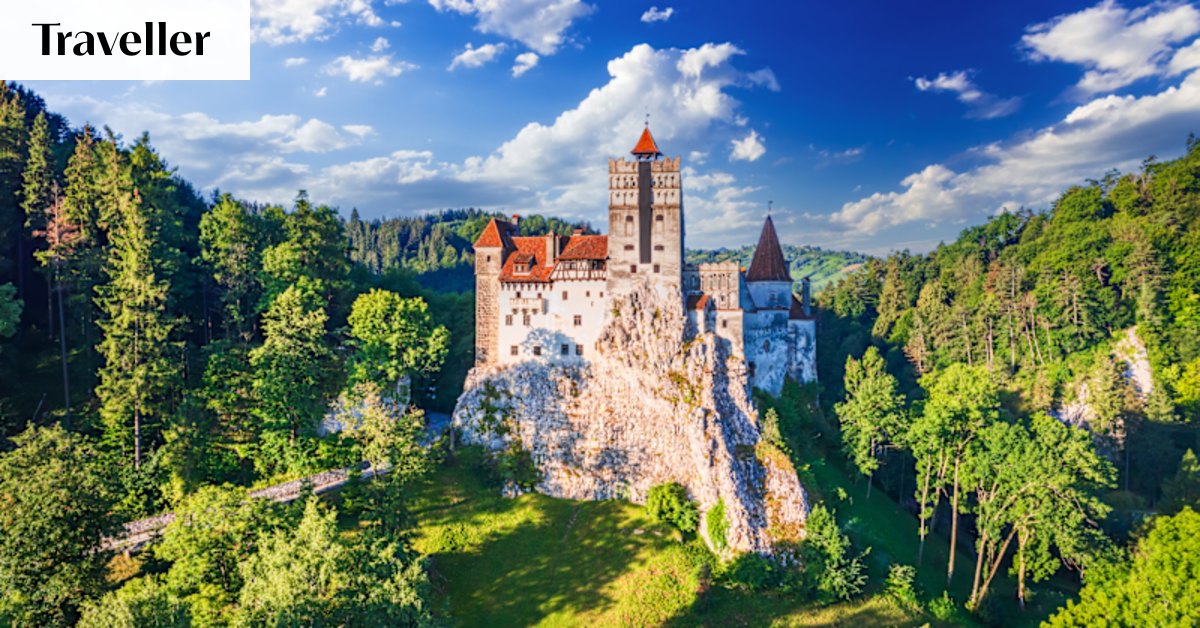
“I hate to disappoint you,” says Peter Suciu, our guide, gesturing towards the house where it’s claimed Vlad the Impaler was born.
asserted
Impaler → hate → house
“But we have no birth certificate or baptism record.
asserted
we → have → certificate
We know his father was here, but that is all.”
asserted
that → know → ?
Scholars have long debated who inspired Bram Stoker’s famous novel about a Transylvanian vampire living in the Carpathian Mountains.
asserted
who → debate → Mountains
And while Vlad the Impaler (also known as Vlad Dracula), a 15th-century prince with a penchant for impaling his enemies, certainly fits the bill, no one is sure.
asserted
one → know → bill
Which essentially means that Romania’s best-known legend, an association that has spawned an entire tourism industry, is tenuous at best.
asserted
that → mean → industry
While that might disappoint some, the good news is that this perennially overlooked nation has a saga-filled history that’s more gripping than any novel.
uncertain
that → disappoint → novel
It’s a rollicking tale with a Hollywood-worthy cast, from conquering Romans and marauding Ottomans to medieval knights and megalomaniacal dictators.
asserted
It → ’ → knights
Throw in 11 UNESCO World Heritage sites, a unique fusion of ethnic influences and a wide range of unexpected attractions and you’ve got one of the most compelling destinations in Eastern Europe.
asserted
you → throw → Europe
As we follow Suciu around Sighisoara, a remarkably well-preserved UNESCO World Heritage-listed medieval citadel in Transylvania, in the centre of the country, it soon becomes clear that Vlad’s alleged birthplace is the town’s least impressive attraction.
asserted
birthplace → follow → country
Much more captivating is its tangle of cobbled laneways lined with centuries-old houses, soaring defensive towers and photogenic squares framed by al fresco restaurants.
asserted
tangle → line → restaurants
If this were anywhere else in Europe in September, it would be overrun with selfie-snapping tourists.
asserted
it → overrun → tourists
“We don’t have mass tourism yet,” says Suciu.
asserted
Suciu → have → tourism
“In fact, we have months when there’s nobody here.”
asserted
we → have → months
Sighisoara is one of many unheralded destinations on this 11-day Intrepid Travel Premium tour from Belgrade to Bucharest that takes in places I’d never heard of, but which all boast intriguing histories, beautiful architecture and rewarding attractions.
asserted
which → take → histories
Like Sibiu, the largest and wealthiest of seven walled citadels founded in the 12th century by German settlers known as Saxons (even though most didn’t come from Saxony).
asserted
most → found → Saxony
Today, the city’s Old Town is a maze of meandering passageways lined with 17th-century homes whose steep roofs are dotted with distinctive ventilation holes that look uncannily like sets of eyes.
asserted
that → line → eyes
During our visit, there’s a festival of traditional Roma culture in one of the squares – a boisterous celebration with singing, dancing and circus-like endurance feats, including a bull-chested, shirtless man lying on a bed of broken glass beer bottles (not something you see every day).
asserted
you → ’ → bottles
In Timisoara, a city near Romania’s western borders with Hungary and Serbia, we encounter another festival celebrating the region’s rich ethnic diversity, with youngsters in traditional clothing singing and dancing in the main square.
asserted
youngsters → encounter → square
Our local guide, Alexandra Irimia, explains that the city is home to 13 ethnic communities and everyone joins in everyone else’s celebrations.
asserted
everyone → explain → celebrations
Because different religious denominations use different calendars, that means two Christmases and an Easter fair that sometimes lasts six weeks.
asserted
that → use → Christmases
And then there are archaeological treasures like Sarmizegetusa Regia, the former capital of the Dacian kingdom, a political state that controlled most of eastern and southern Romania from about 1 BC to AD 106, when the Romans invaded.
asserted
Romans → be → AD
Concealed within a towering beech forest, the UNESCO World Heritage site contains remnants of temples, homes and fortifications, including a ceremonial paved limestone road from the first century AD.
asserted
site → conceal → AD
During an hour-long visit with one of the site’s lead archaeologists, we pass just a handful of other visitors.
asserted
we → pass → visitors
It’s a similar experience at the ASTRA Museum, a sprawling 96-hectare attraction near Sibiu that aims to preserve and celebrate Romanian folk culture.
asserted
that → ’ → culture
Claiming to be Europe’s largest open-air museum, it contains more than 300 original buildings, from historic windmills and watermills to churches, farmhouses and workshops.
asserted
it → claim → churches
During a private tour, our guide points out details we might have missed, such as a decorated wooden cart used to deliver a bride’s dowry to her new household – a practice that was common in many traditional communities until the early 20th century.
uncertain
that → point → century
Again, we practically have the place to ourselves.
asserted
we → have → ourselves
A nation shaped by conflict
Getting your head around Romania’s convoluted history is no easy endeavour.
asserted
Getting → shape → history
After the Romans left, nomadic tribes of Goths, Huns and Slavs moved in.
asserted
tribes → leave → Goths
Then came the Ottomans.
asserted
Ottomans → come → ?
In 1867, several regions (including Transylvania) fell under Austro-Hungarian control.
asserted
regions → include → control
Finally, in 1918, King Ferdinand I unified the country and modern-day Romania was born.
asserted
Romania → unify → country
The setting for this pivotal event was Alba Iulia, a UNESCO World Heritage site first settled about 5000 BC.
asserted
setting → settle → event
It’s still home to one of Europe’s largest fortresses: an impressive seven-cornered defensive citadel started by the Romans and later expanded by the Austro-Hungarian Empire into a 110-hectare stronghold in the 18th century.
asserted
It → ’ → century
Inside are structures spanning almost 1800 years, from second-century Roman ruins to an imposing Orthodox cathedral built for the coronation of King Ferdinand I and Queen Marie in 1922.
asserted
structures → span → 1922
By comparison, the building in which the unification took place is a relatively modest two-storey former military casino.
asserted
unification → take → place
Inside are a handful of artefacts and a screen showing black-and-white footage from the event on a freezing December morning in 1918.
asserted
handful → show → 1918
Still, according to our local guide, Cristian Kalanyos, it hosted “the greatest event in our history”.
uncertain
it → accord → history
Fast forward 47 years and few people would use such glowing terms to describe Nicolae Ceausescu’s rule from 1965 to 1989.
asserted
people → use → 1989
…and 67 more, not listed.
 The Aporia