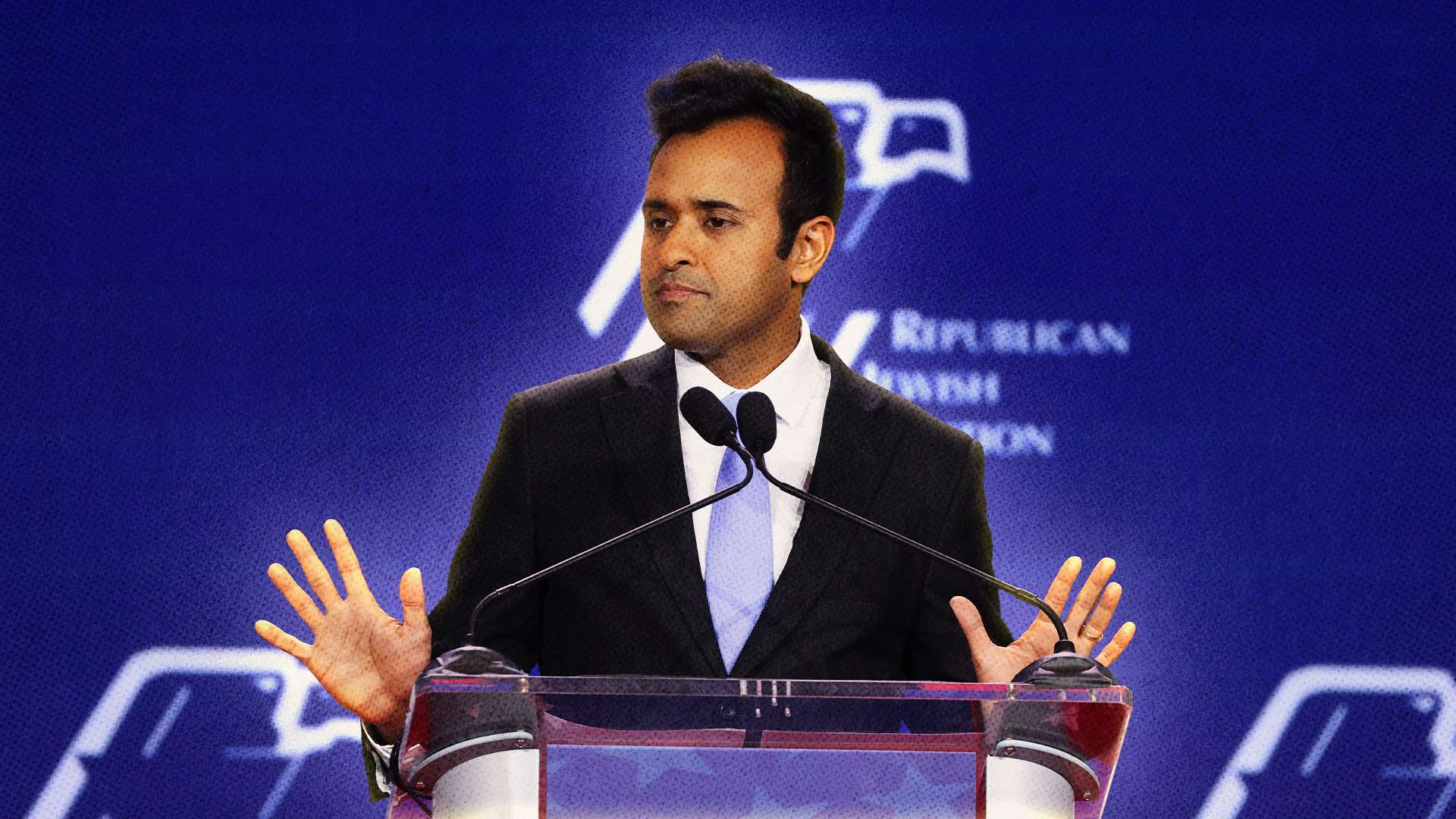
The first time I saw Vivek Ramaswamy in person was at a January 2026 meet-and-greet with Republican movers and shakers in southwest Ohio.
asserted
I → see → Ohio
It was held at the home of one of them—a mini-mansion in the city of Mason.
asserted
It → hold → Mason
The event was organized as an open forum where attendees could talk about their biggest political concerns and ask Ramaswamy, the Republican candidate for governor of Ohio, about his policy ideas.
uncertain
attendees → organize → ideas
Finger foods were spread out over a long table in the corner while some sat on couches or chairs and others crowded around the would-be governor.
asserted
others → spread → governor
Security was provided by middle-aged men in leather vests bearing the insignia of their group, Bikers for Trump.
asserted
Security → provide → Trump
Each participant was encouraged to introduce themselves and mention an issue they cared deeply about.
asserted
they → encourage → issue
Early introductions focused on property taxes and school choice, and Ramaswamy responded to each with directness and warmth.
asserted
Ramaswamy → focus → directness
A question about the "woke left" gave him an opportunity to mention his books about identity politics and put forward his solution to such identity-based divisions: stop talking about race and sexuality so much and stand on our shared values as Americans.
asserted
question → wake → Americans
This garnered some applause and nods of agreement.
asserted
This → garner → agreement
But after seemingly dispensing with identity politics, it came back for another round.
asserted
it → dispense → round
The warm and affable tone that had marked the early part of the proceedings shifted when one man charged, "Your HB1 [sic] visa is scaring a lot of people"—a reference to Ramaswamy's stance on immigration, which would lower the number of new arrivals while easing the path for skilled workers, particularly in tech.
asserted
which → mark → tech
This sparked a flood of comments and turned the event into a free-for-all.
asserted
This → spark → all
One attendee complained that "too much housing is going to immigrants" who will always vote Democrat over Republican "because they want to bring their family over."
asserted
they → complain → family
Another participant pleaded for "limiting preferential treatment for foreigners over real Americans" and spoke gravely of "rapid demographic change."
A female attendee took strong exception to a New York Times op-ed Ramaswamy had penned about Groypers.
asserted
Ramaswamy → plead → Groypers
In it, he noted that, "There are two competing visions now emerging on the American right, and they are incompatible.
asserted
they → note → right
One vision of American identity is based on lineage, blood and soil: Inherited attributes matter most.
asserted
attributes → base → lineage
The purest form of an American is a so-called heritage American — one whose ancestry traces back to the founding of the United States or earlier….The
asserted
ancestry → call → States
alternative (and, in my view, correct) vision of American identity is based on ideals."
asserted
vision → base → ideals
In short, Ramaswamy had rejected the claim that "heritage Americans" were more American than recent immigrants, essentially calling their pride of lineage a form of "blood and soil" racism.
uncertain
Americans → reject → racism
The female attendee charged that Ramaswamy was "losing heritage Americans" with his ideals-based view of American identity.
asserted
Ramaswamy → charge → identity
Ramaswamy pushed back, clearly but perhaps a bit timidly, arguing that when he had rejected "woke" identity politics on the left, that rejection applied just as much to identitarianism on the right.
asserted
rejection → push → right
People were now fidgeting and shaking their heads.
asserted
People → fidget → heads
Ramaswamy, despite his eloquence, had lost the room.
asserted
Ramaswamy → lose → room
What had become apparent from this interaction was that many Republicans in southwest Ohio—who had spent 10 years accommodating their deeply held religious beliefs to unswerving support for a president who is a big-government populist and prolific philanderer with little interest in Jesus Christ—were now struggling to to bring themselves to vote for a more traditional conservative because he was a Hindu, the son of Indian immigrants, and a moderate among immigration hawks.
asserted
he → become → hawks
They could see their way to welcoming a small number of nonwhite immigrants so long as the United States could remain a normatively white and Christian country.
uncertain
States → see → immigrants
They could maybe even vote for an Indian for governor.
uncertain
They → vote → governor
But they had to know that he was on their side.
asserted
he → have → side
Not on their side when it comes to balanced budgets, limited government, or decreased spending, but on the issue they cared about most: their identity.
Ramaswamy, by most measures a fairly traditional conservative and even a Trump sycophant when necessary, had unfortunately launched a campaign within a party that sees him with suspicion because he is a Hindu from an Indian immigrant family and (perhaps, and more subtly), because he is not white.
asserted
he → come → family
His New York Times op-ed evinced that he understood this reality; nevertheless, his task was to win them over.
asserted
task → evince → them
The second time I saw Vivek Ramaswamy in person was on August 17, 2026, at the Ohio Faith & Freedom Forum, an event spearheaded by Warren County Republican Party leader Pete Mengel (incidentally, my second cousin, with whom I've had a working relationship unrelated to his political activism).
asserted
I → see → activism
I expected the event to go about as well as the one I had attended in January, and all the signs pointed in that direction.
asserted
signs → expect → direction
The emcee was Ruth Edmonds, a black conservative woman who was the Christian Engagement Ambassador for the Center for Christian Virtue—an Ohio-based lobbying group affiliated with Focus on the Family whose previous efforts included banning pornography from video stores and hotel rooms, as well as a successful 2004 campaign to make gay marriage unconstitutional in Ohio.
asserted
marriage → base → Ohio
The event was held at The Altar, a church in Vice President J. D. Vance's old stomping ground of Middletown, Ohio, pastored by Lawrence Bishop II.
asserted
event → hold → II
Bishop's parents had founded Solid Rock Church in Monroe, Ohio.
asserted
parents → found → Monroe
Solid Rock was famous for its enormous "Touchdown Jesus" statue before what insurance companies would call an act of God resulted in the statue being struck by lightning and burning to the ground.
asserted
statue → call → ground
While still pastor at Solid Rock, Bishop II drew attention and raised eyebrows for turning a Wednesday night service into a rodeo.
asserted
II → draw → rodeo
A conflict with church leadership allegedly led to Bishop leaving Solid Rock and starting The Altar.
uncertain
Bishop → lead → Altar
At the time, the bull-riding cowboy pastor seemingly sniped at Solid Rock's current leadership with public comments that some churches are more concerned with "Christians entertaining Christians" than serving their communities.
asserted
Christians → rid → communities
When I arrived at Bishop's new church—a remodeled movie theater—I noticed the Bikers for Trump chatting in the lobby.
asserted
Bikers → arrive → lobby
I also saw a number of cowboy hats, the occasional suit and tie, one mohawk, and a T-shirt that read, "Jesus is my savior, Trump is my president."
asserted
Trump → see → hats
…and 43 more, not listed.
 The Aporia