Has the economy gone C-shaped?
asserted
economy → go → ?
Today's economy is brought to you by… the letter K!
asserted
economy → bring → letter
Or … well, it depends on who you talk to about how the rich and poor are doing these days.
asserted
rich → depend → who
You've probably heard about "the K-shaped economy."
asserted
You → hear → economy
When people talk about it, they generally mean that inequality is widening (and the fortunes of the rich and poor are diverging, so it looks like the right side of the K).
asserted
it → talk → K
Recently, Treasury Secretary Scott Bessent said he was "sick of hearing about this K-shaped economy."
asserted
he → say → economy
And, he said, he believed the better letter to describe it was a C, which is, shall we say, a more optimistic letter for how lower- and middle-class Americans are faring in today's economy.
asserted
Americans → say → economy
This desire to Sesame Street the economy isn't a surprise: we're always looking for ways to shorthand or telegraph the essence of what's going on in the economy at any given time.
asserted
what → look → time
But assigning something as basic as a letter to something as complicated as the economy seems way too reductive.
asserted
assigning → assign → economy
So how did we get here?
asserted
we → get → ?
The Indicator from Planet Money
C is for C-shaped economy
The story begins back during Covid.
asserted
story → shape → Covid
Mike Strain of the American Enterprise Institute says people started talking about a K-shaped economy around 2020, when the effects of the pandemic — and the government's response — began to show through.
asserted
effects → say → pandemic
" The original usage of the term K-shape meant that the poor were getting poorer at the same time that the rich were getting richer."
asserted
rich → mean → time
Initially, the term didn't get much play.
asserted
term → get → play
Temporary federal relief programs were pumping money into the economy, offsetting a lot of the damage being done by lockdowns and layoffs and business closures.
asserted
programs → pump → lockdowns
All of which affected poorer Americans most.
asserted
All → affect → Americans
So while people at the bottom end of the economy were hit hard during Covid, it wasn't so obvious at first.
asserted
it → hit → Covid
But as the government's stimulus programs began to end, those less wealthy Americans began to feel the pain.
asserted
Americans → begin → pain
Poverty rates cranked up, from 7.8% in 2021 to 12.4% in 2022.
asserted
rates → crank → 2022
At the same time, the richest 10 percent of Americans were getting richer.
asserted
percent → get → Americans
Government stimulus and interest rate cuts juiced the stock market, which benefited the people who owned most of those stocks: the wealthy.
asserted
who → juice → stocks
To a lot of econ watchers, this bifurcation in the fortunes of the haves and the haves-less looked like the letter K.
asserted
bifurcation → look → letter
And before long, we started to hear about the K-shaped economy everywhere.
asserted
we → start → economy
But Mike Strain says almost as soon as 'K-shaped' became a relevant term to describe what was happening in the economy, people began abusing it.
asserted
people → say → it
"Over the last few years, different people are using the term in different ways, and some people are using it as just another way of describing inequality, which is different than its original usage," Strain says.
asserted
Strain → use → usage
"Inequality can be increasing even if both more affluent and less affluent Americans are seeing their outcomes improve in an absolute sense.
asserted
outcomes → increase → sense
In other words, it's possible for poor people to acquire more wealth, and for the gap between rich and poor to widen at the same time.
asserted
gap → acquire → time
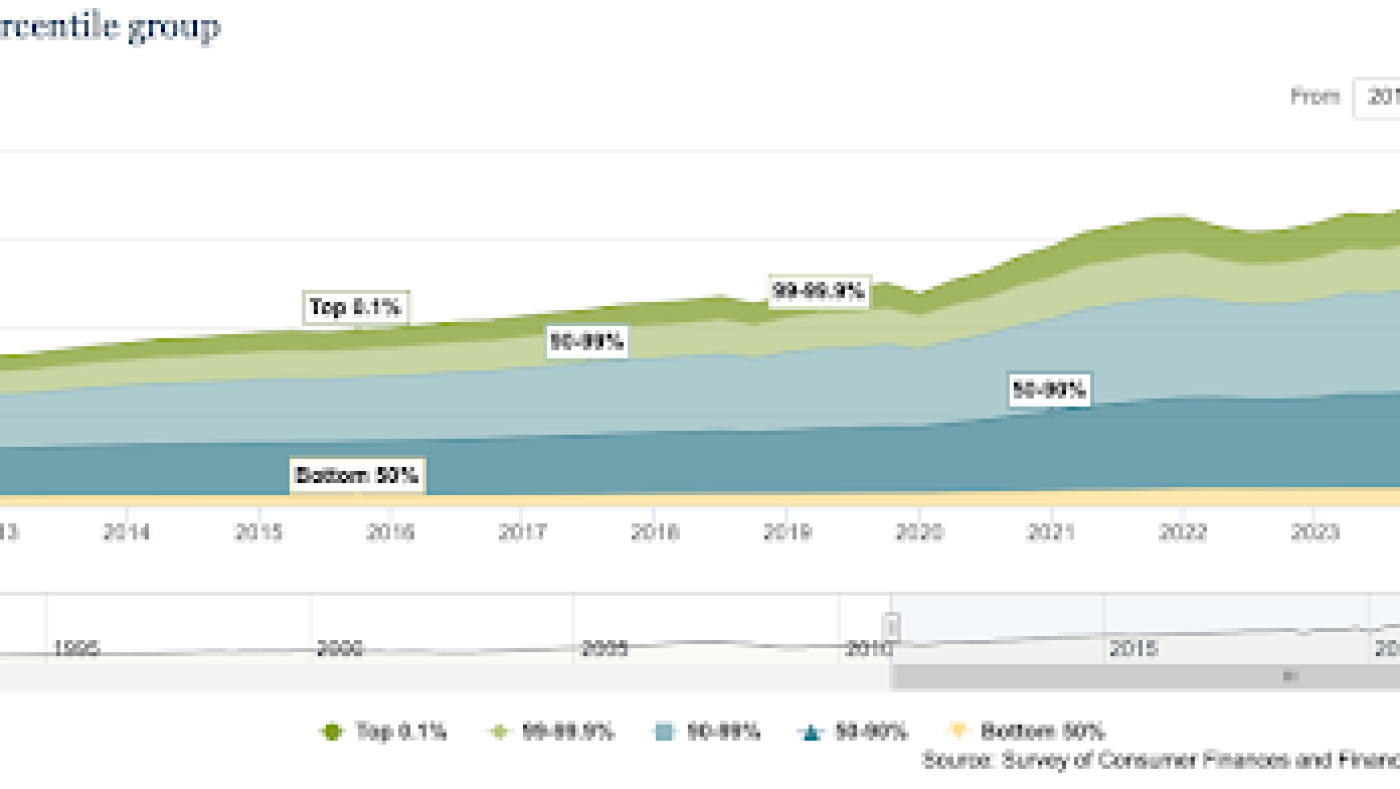
Which is what the trajectory of the wealth gap has been — for the most part —- since at least 1989, as tracked by the Federal Reserve.
asserted
trajectory → track → Reserve
Claudia Sahm, an economist at New Century Advisors, says if you focus on incremental movements at the top and bottom ends of a K or whatever you're missing the forest for the trees.
asserted
you → say → trees
The forest being the chasm between rich and poor that's clearly shown on that chart.
asserted
that → show → chart
Claudia points out that the top one percent of Americans own fully one third of all the wealth in the country.
asserted
percent → point → country
But the bottom half of all Americans own less than three percent of the wealth.
asserted
half → own → wealth
It's a massive gap that doesn't change much from cycle to cycle.
asserted
that → change → cycle
But the K is here to stay, it seems.
asserted
it → stay → ?
Recently Christopher Nassetta, the head of Hilton Hotels, said he sees a C-shaped economy now.
asserted
he → say → economy
Never mind that he was referring to the middle class, who are not at the bottom of the economy, but rather in the middle of it.
asserted
who → mind → it
Nonetheless, his letter was snapped up and repeated by none other than Treasury Secretary Bessent.
asserted
letter → snap → Bessent
To be fair to Bessent, one recent measure does look a little C-shaped: after accounting for inflation, weekly earnings rose at the lower end of the wage scale but fell at the upper end.
asserted
earnings → look → end
"You look at the average wage of a worker whose highest degree was a high school diploma and the average wage of a worker whose highest degree was a college degree, I think you do see their wage growth converging," Strain says.
asserted
Strain → look → worker
"And so you see wage inequality narrowing.
asserted
inequality → see → ?
…and 18 more, not listed.
 The Aporia