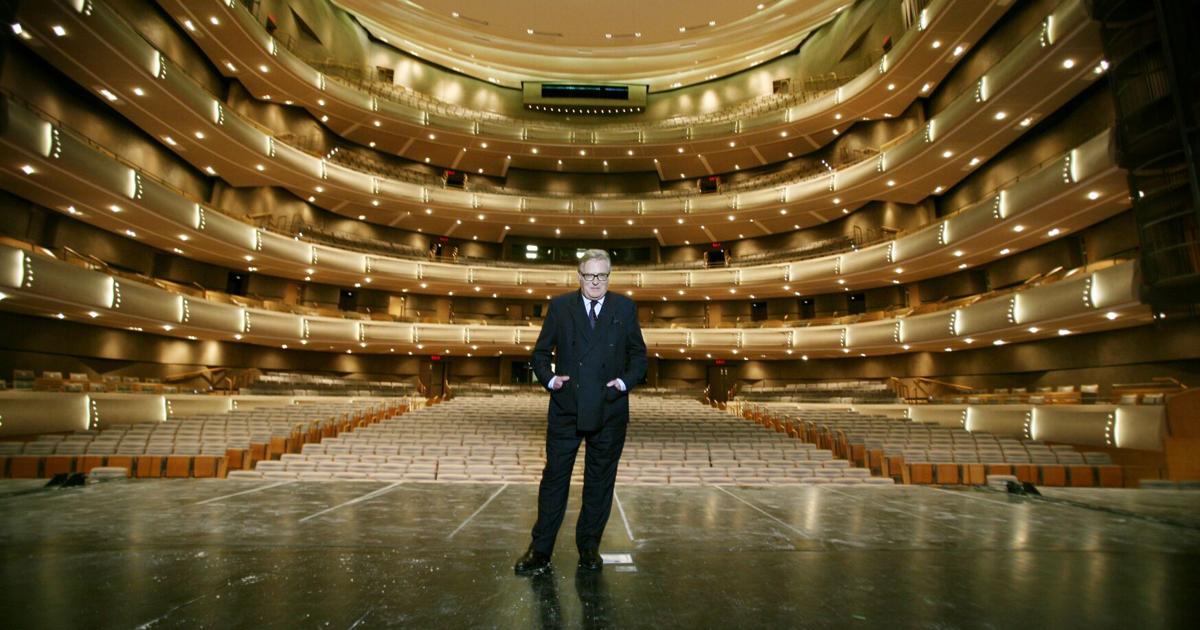
As every Wagner fan well knows, “Das Rheingold,” the first part of the German composer’s operatic epic, the Ring Cycle, begins with a sustained E-flat whisper of double basses.
asserted
Rheingold → know → basses
In the Canadian Opera Company’s former O’Keefe Centre home — today’s Meridian Hall — that sound would have been devoured by the 3,200-seat theatre’s cavernous volume.
asserted
sound → devour → volume
Twenty years ago, on Sept. 12, 2006, as conductor Richard Bradshaw’s baton signalled the launch of the COC’s first season in the newly opened Four Seasons Centre for the Performing Arts, those opening bars resonated throughout the hall with spine-tingling effect.
asserted
bars → signal → effect
A miracle had happened.
asserted
miracle → happen → ?
After years of broken promises, political wrangling and false starts, the COC had fulfilled its long-held dream to have a purpose-built home of its own.
asserted
COC → fulfil → own
Now, 20 years later, we almost take for granted that Toronto has an opera house that — while not as flamboyantly eye-catching as, say, the Sydney Opera House or the Palais Garnier in Paris — can rival the best in the world.
asserted
that → take → world
“A glorious setting for opera,” wrote Richard Ouzounian in Variety.
asserted
Ouzounian → write → Variety
“A splendid auditorium,” concurred the New York Times’ Anthony Tomassini.
asserted
Tomassini → concur → ?
“Astonishing,” declared Arthur Kaptainis in the Montreal Gazette.
asserted
Kaptainis → declare → Gazette
In search of exceptional acoustics
The COC and National Ballet of Canada both recognized that the O’Keefe Centre, where both had been principal tenants since the mid-1960s, was less than ideal.
asserted
both → recognize → mid-1960s
By the late 1970s they’d co-commissioned a feasibility study to investigate building a more suitable home.
asserted
they → co → home
In the late 1980s it looked as if the dream might come true in the form of an opulent shared complex at the corner of Bay and Wellesley designed by star-architect Moshe Safdie.
uncertain
dream → look → Safdie
Even at the time, there were supporters of the project who considered the proposed Ballet Opera House overly lavish and, in the context of a troubled economy, a bad fit for public funding.
asserted
House → be → funding
In 1990, Bob Rae’s incoming NDP Ontario government scuttled the project.
asserted
government → scuttle → project
Yet the artistic achievements of the COC, notably its now famous 1993 Robert Lepage-directed double bill of Bartók’s “Bluebeard’s Castle” and Schoenberg’s “Erwartung,” underlined the company’s need for a purpose-built hall.
asserted
achievements → direct → hall
The pessimists and told-you-so skeptics thought the collapse of the Bay/Wellesley project had permanently shattered any hope for a new hall, but the COC’s chief conductor Richard Bradshaw begged to differ.
asserted
conductor → tell → hall
Although he privately confided that he considered that project “too ambitious,” he was still determined to keep the dream alive.
asserted
he → confide → dream
And he did.
asserted
he → do → ?
Without Bradshaw’s indefatigable leadership, Toronto would not now have a world-class opera house; nor would Bradshaw have stepped onto the conductor’s podium at the new Four Seasons Centre in 2006 to a deafening ovation.
asserted
Bradshaw → have → ovation
The British-born Bradshaw had arrived in Toronto with his family in 1989 after more than a decade as chorus director and resident conductor at San Francisco Opera.
asserted
Bradshaw → bear → Opera
Before that, Bradshaw had worked at England’s renowned Glyndebourne Festival Opera where he met Diana Hepburne-Scott, the future Mrs. Bradshaw.
asserted
he → work → Scott
In Bradshaw, then COC general director Brian Dickie saw someone who could elevate the company’s orchestra to international standards.
uncertain
who → see → standards
When Dickie left in 1993, Bradshaw began a steady ascent to the COC’s top job, all along insisting that a hall of its own was within the company’s grasp.
asserted
hall → leave → grasp
Few believed him.
asserted
Few → believe → him
“There were people who thought I must be smoking something or had gone completely mad or was merely grandstanding,” Bradshaw said at the time.
asserted
Bradshaw → be → time
I really believed it.”
asserted
I → believe → it
Despite his ebullient, larger-than-life personality, Bradshaw was wise enough to know that he needed to muster a team of fellow believers.
asserted
he → know → believers
That was no easy task when funding prospects were grim and his idea of a hall built from the inside out — function before glamour — was not exactly an inspirational message to sell.
asserted
idea → build → glamour
Bradshaw was always quick to emphasize that he was part of a team, not some lone hero.
asserted
he → emphasize → team
Interviewed shortly before the hall’s opening, Bradshaw described Diana, his ever-supportive wife, as “my rock.”
asserted
Bradshaw → interview → rock
“I simply couldn’t have done it without her,” he said.
asserted
he → do → her
With what by international standards was a ludicrously tight all-in budget —$180 million — lead architect Jack Diamond not only had to endure the carping of critics who deemed his design too plain but also keep trimming his design along the way to save money.
asserted
design → have → money
Out went a suspended gondola-shaped bar in the “City Room” atrium-lobby along with plans for a roof garden and glass canopy.
asserted
bar → go → garden
Although Diamond’s design, despite a very tight 1.7-acre site, managed to accommodate two full side-stages that could house ready-to-roll-in sets, they did not come with isolating soundproof doors.
uncertain
they → manage → doors
Scenery was “flown” the old-fashioned way, by hand.
asserted
Scenery → fly → hand
Bradshaw had asked renowned American director Peter Sellers if these limitations would be a serious impediment.
asserted
limitations → ask → Sellers
“If they are there we’ll use them.
asserted
we → use → them
If they’re not, we’ll find another way,” Bradshaw recalled Sellars telling him.
asserted
Sellars → ’re → him
The one thing that wasn’t skimped on was the sound.
asserted
that → skimp → ?
After studying a number of successful halls internationally, the design team settled on a traditional horseshoe-shaped auditorium comprising 2,000 seats distributed over five levels.
asserted
team → study → levels
…and 60 more, not listed.
 The Aporia