The Met puts a modern artist front and center (and there's some Jackson Pollock, too)
asserted
Met → put → artist
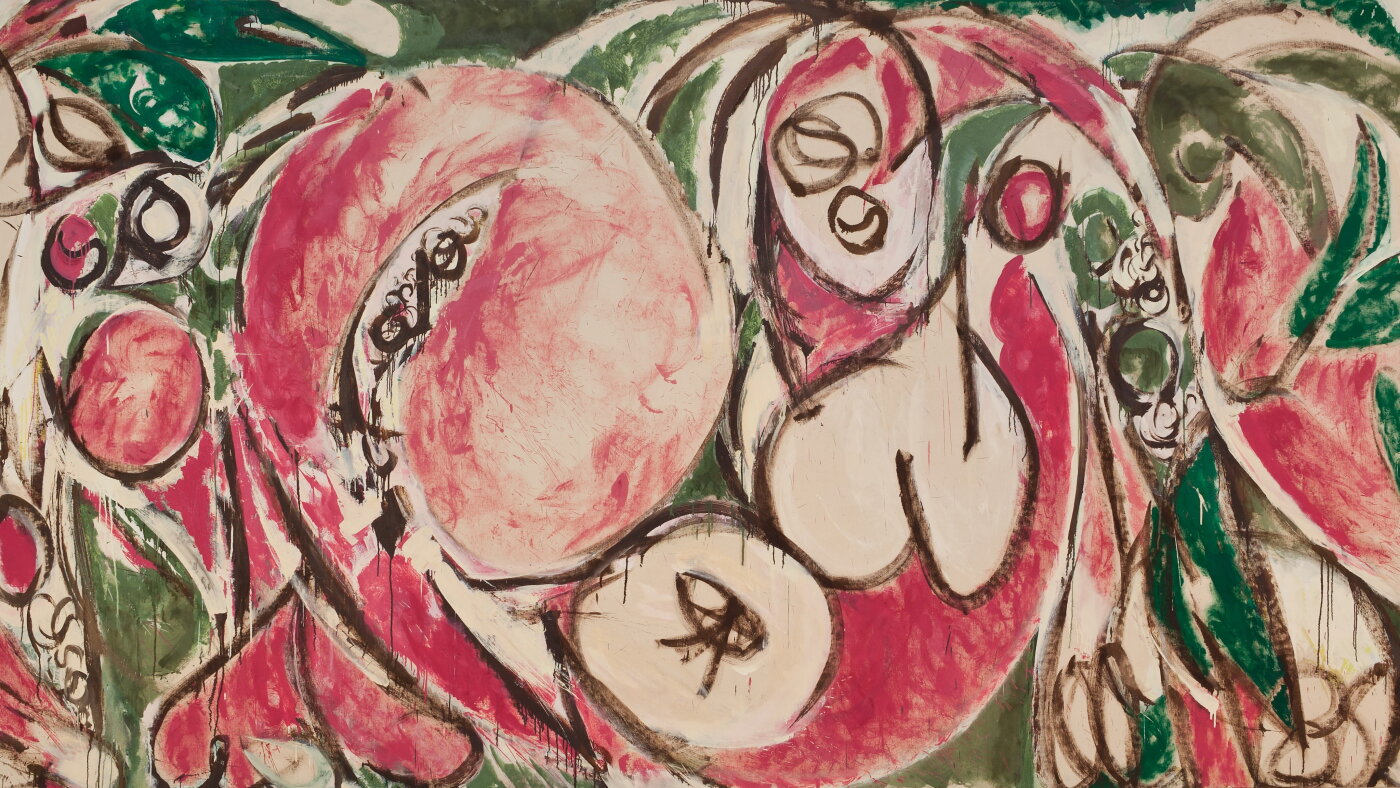
Past Continuous features two artists: Jackson Pollock, with many of his instantly recognizable "drip" paintings, and Lee Krasner, an artist often overshadowed by Pollock, who was her husband.
asserted
who → feature → Pollock
But in this major exhibition, Krasner is finally getting her due — and on her own terms.
asserted
Krasner → get → terms
This gargantuan show is replete with Pollock's greatest hits, the giant, frozen dances of paint splashed on canvas that have become iconic.
asserted
that → splash → canvas
But this exhibition of more than 120 works (74 from Krasner, and 48 from Pollock) reveals Krasner as an Abstract Expressionist titan, too.
asserted
exhibition → reveal → titan
One of the first works that catches your eye is a 1955 Krasner collage.
asserted
that → catch → eye
"Collage was very catalytic for her at these crucial moments in her life," said Brinda Kumar, one of the two Met curators who put together this exhibition.
asserted
who → say → exhibition
"She was literally sometimes tearing up older bodies of work to create a new chapter."
asserted
She → tear → chapter
And right in the middle is a cutout whose shape evokes the head of a bald eagle — and that's the name that Krasner gave to this collage.
asserted
Krasner → evoke → collage
Pollock's rejects were the source material for Bald Eagle, according to Kumar.
uncertain
rejects → accord → Kumar
"Krasner has very intentionally and deliberately cut up discarded Pollock works from this era in the 1950s, where you can see his distinctive drip still evident," she said.
asserted
she → cut → 1950s
When you put Krasner's collages next to Pollock's drip paintings, we see something new in the juxtaposition, said another Met curator, David Breslin.
asserted
curator → put → juxtaposition
"But that doesn't mean that the individual parts forgo their histories or their pasts," Breslin said.
asserted
Breslin → mean → histories
"We see that almost as a metaphor for couples in relationships as well.
asserted
We → see → relationships
You form a unit, yet you also have all the things in your head, in your mind, in your heart that are your own, that don't change.
asserted
that → form → heart
And sure enough, just past these collages, a visitor will see one of Pollock's classic drip paintings — 1952's Convergence, with neon orange and electric yellow so bright and bold that they foreshadow 1980s subway graffiti.
asserted
they → see → graffiti
The curators have put Convergence on a freestanding wall near windows, with daylight shining through — evoking the energy of a contemporary gallery.
asserted
daylight → put → gallery
The unspoken challenge of this show is to invite comparisons between wife-and-husband artists.
asserted
challenge → invite → artists
In popular imagination, Pollock is often the troubled genius and hero, and Krasner is sidelined as a helpmate.
asserted
Krasner → sideline → helpmate
She knew what people thought — but she didn't care.
asserted
she → know → what
In a 1978 interview on a television program called Inside New York's Art World, the interviewer asked Krasner what she was doing while Pollock was becoming so famous.
asserted
Pollock → call → what
"I was working all the time," Krasner replied.
asserted
Krasner → work → ?
"I doubt our relationship could have existed at all if I weren't working.
uncertain
I → doubt → ?
In terms of what other people think, I can't do anything about that.
asserted
I → think → that
You know, that's not my preoccupation anyway.
asserted
that → know → ?
As long as I was able to work, I went about my business.
asserted
I → work → business
"
That's true, but Krasner was also very savvy about her market value as a female artist, said curator Brinda Kumar.
asserted
Kumar → say → artist
To that end, she made certain calculations.
asserted
she → make → calculations
They made their home in Springs, N.Y., a small fishing community on the far side of Long Island — a location Krasner chose specifically to get Pollock away from the business and booze of Manhattan.
asserted
Krasner → make → Manhattan
Pollock used a barn on the property to work on his enormous canvases, while Krasner painted first in the kitchen and then in a small, upstairs bedroom.
asserted
Krasner → use → bedroom
Charting her own course
Lee Krasner was all about reinvention — both artistic and personal.
asserted
Krasner → chart → reinvention
Born Lena Krassner in Brooklyn, she was the child of Orthodox Jewish parents who came from a shtetl in what is now Ukraine.
asserted
what → bear → shtetl
Nobody in her family knew anything about art.
asserted
Nobody → know → art
She gave herself a series of new names: first Lenore, then Lee Krasner.
asserted
She → give → names
She sculpted a new life as a young, bold artist.
asserted
She → sculpt → artist
And she became a quintessential networker who knew everybody in New York's art scene.
asserted
who → become → scene
Journalist Mary Gabriel has written extensively about Krasner, including in her 2018 book Ninth Street Women: Lee Krasner, Elaine de Kooning, Grace Hartigan, Joan Mitchell, and Helen Frankenthaler: Five Painters and the Movement that Changed Modern Art.
asserted
that → write → Art
Gabriel says that unlike her husband, Krasner kept reinventing her style.
asserted
Krasner → say → style
"Krasner was so fascinating because she changed, not even by the decade.
asserted
she → change → decade
Every few years, she tries something new," Gabriel said.
asserted
Gabriel → try → something
…and 14 more, not listed.
 The Aporia