IN THE WEEKS LEADING UP to the release of The Odyssey, and then in the weeks after, I noticed a weird thing.
asserted
I → lead → thing
Whenever I tweeted something about Christopher Nolan’s film, it would rack up huge numbers.
asserted
it → tweet → numbers
It was getting sucked into the algorithm like few topics I regularly tweeted about.
asserted
I → suck → topics
It quickly became obvious that The Odyssey had been juiced by Elon’s algo because it had become a vector of anger and disinformation.
asserted
it → become → anger
Arguments raged over the nature of the translation by Emily Wilson that Nolan referenced in interviews about the film, whether it was woke or wrong or whatever.
asserted
it → rag → film
(Many obscure experts in ancient Greek were uncovered during those months, I tell you.)
asserted
I → uncover → you
Racists were apoplectic that a beautiful black woman would dare be cast as Helen of Troy and her twin sister Clytemnestra.
asserted
woman → dare → Troy
And false rumors swirled around the character being played by Elliot Page.
asserted
rumors → swirl → Page
When did he stop being the masculine ideal?”)
asserted
he → stop → ?
Now, the South African émigré who now owns Twitter undoubtedly had an ideological reason for hyping rage about the race of Helen of Troy and the genitals of the actor (not) playing Achilles.
asserted
who → own → Achilles
(Turns out Page was playing Sinon.
asserted
Page → turn → Sinon
The angrier people were and the angrier they got—either because of the casting or the blatant misinformation surrounding the casting—the more time they spent on the platform.
asserted
they → get → platform
The more they shared tweets.
asserted
they → share → tweets
The more traffic they drove to the site.
asserted
they → drive → site
The more advertising revenue was generated.
asserted
revenue → generate → ?
The more usage Grok got.
asserted
Grok → get → usage
The Social Reckoning, Aaron Sorkin’s sequel to The Social Network, asks how we got here.
asserted
we → ask → Network
It’s about Facebook and how it fueled the January 6th insurrection that attempted to disrupt the peaceful transfer of power from Donald Trump to Joe Biden.
asserted
that → ’ → Biden
These are, arguably, higher stakes than what trolls think about Lupita Nyong’o’s acting choices.
asserted
trolls → think → choices
TO SET THE ARTISTIC STAKES, first and foremost: The Social Reckoning is not as good as The Social Network, simply on a visual level.
asserted
Reckoning → set → level
And that’s because Aaron Sorkin, a massively talented writer of screenplays and play-plays and teleplays, is not a massively talented visual filmmaker.
asserted
Sorkin → ’ → screenplays
But The Social Network was directed by David Fincher, meaning that it had his painterly eye for composition and was lit in a way that felt both dramatic and real.
asserted
that → direct → way
Just one quick example: There’s this great sequence of a regatta in The Social Network that uses tilt-shift photography to make the whole thing look like a miniature recreation, a toy for the wealthy to amuse themselves.
asserted
wealthy → ’ → themselves
Aaron Sorkin does not even attempt something as interesting as this image.
asserted
Sorkin → attempt → image
It’s not his skillset.
asserted
It → ’ → ?
He’s a writer of words, not a painter of pictures.
asserted
He → ’ → pictures
This is a pretty locked-down movie, for the most part, occasionally veering into handheld black and white during flashback scenes or vivid action during the storming of the Capitol by the goons supporting Donald J. Trump’s efforts to overturn the 2020 election.
asserted
This → lock → election
The Social Network was a piece of psychoanalysis and everything Fincher did was designed to demonstrate that Mark Zuckerberg had a hole in his soul he hoped to fill with love and admiration.
asserted
he → do → love
He desired acceptance.
asserted
He → desire → acceptance
The detective story involves Frances Haugen’s (Mikey Madison) effort to uncover why one of her friends—whom she knew as a San Francisco progressive taking spin classes—filmed herself getting into a racist confrontation with cops and then posted it to Facebook as if it made her look good.
asserted
her → involve → Facebook
She is on Facebook’s Civic Integrity Team: a true believer in the power of social media, albeit one who occasionally puts the ethics of connecting the world ahead of pure engagement.
asserted
who → put → engagement
The journalism procedural follows Jeff Horwitz’s (Jeremy Allen White) effort to uncover how Facebook is manipulating the discourse.
asserted
Facebook → follow → discourse
He gets in touch with Frances after discerning that the company is censoring comments on Mark Zuckerberg’s (Jeremy Strong) posts.
asserted
company → get → posts
The real issue, she says, is that 64 percent of people who join extremist groups on Facebook do so directly due to algorithmic prodding by the platform.
asserted
who → say → platform
They are recommended membership in QAnon, militias, and other degenerate groups by Facebook itself.
asserted
They → recommend → Facebook
When Horwitz and his interns set up a test profile, the number of days it takes to get a recommendation to join a white-power group is just ten.
asserted
it → set → group
And this is where the courtroom drama kicks in.
asserted
drama → kick → ?
Not technically a trial, though, as Zuckerberg is preparing for congressional testimony in early January 2021.
asserted
Zuckerberg → prepare → January
The morning of January 6, 2021, as it happens.
asserted
it → happen → January
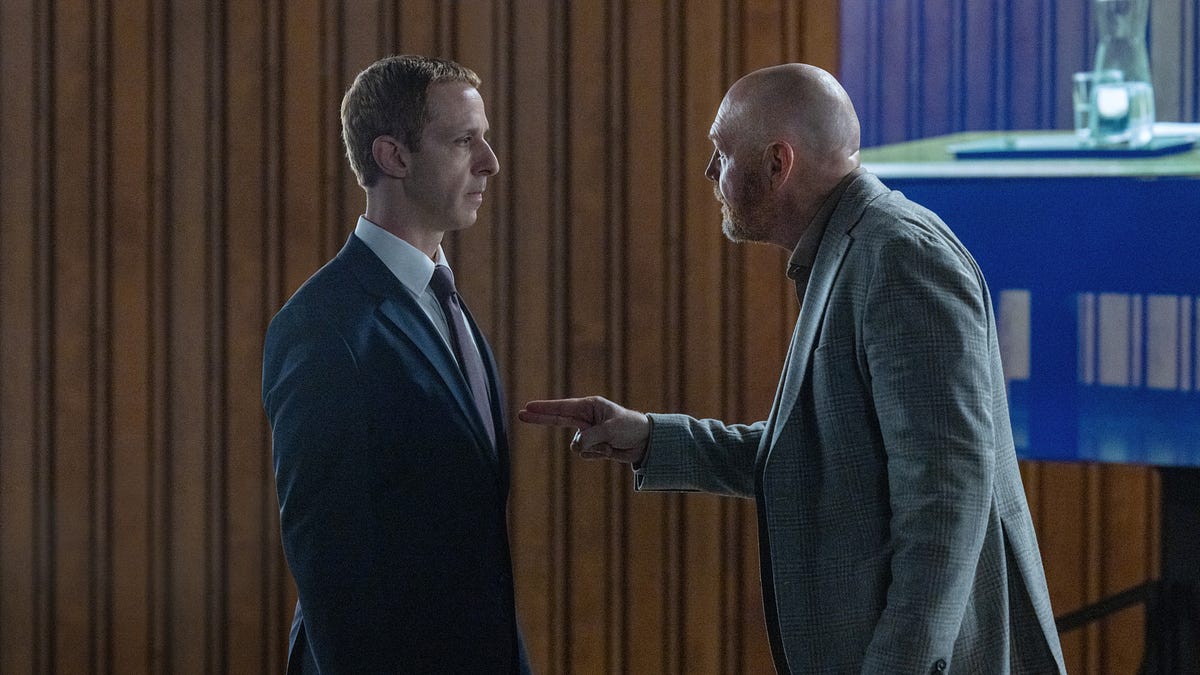
He’s peppered with questions by Raya (Wunmi Mosaku), a crisis-comms professional who wants to make sure he understands how to react in a polite and semi-human manner to the senators asking him why his platforms are so bad for society.
asserted
platforms → pepper → society
…and 38 more, not listed.
 The Aporia