That is 0 articles you have read today.
The Aporia is free and carries no advertising, so readers are the only
thing paying for it. If you are getting this much out of it, a small
donation is what keeps it independent.
Daily limit reached
You have read 0 articles today.
That is more than the 15 a day The Aporia gives away,
and well past what it can carry on nothing. Your allowance resets at
midnight.
There is no advertising here and nothing about you is sold, so readers
are the only thing paying for it. If the site is worth this much of
your day, it is worth a few dollars.
Everything else stays open: the
maps, the
directory and
search do
not count against this, and neither does re-opening something you have
already read today.
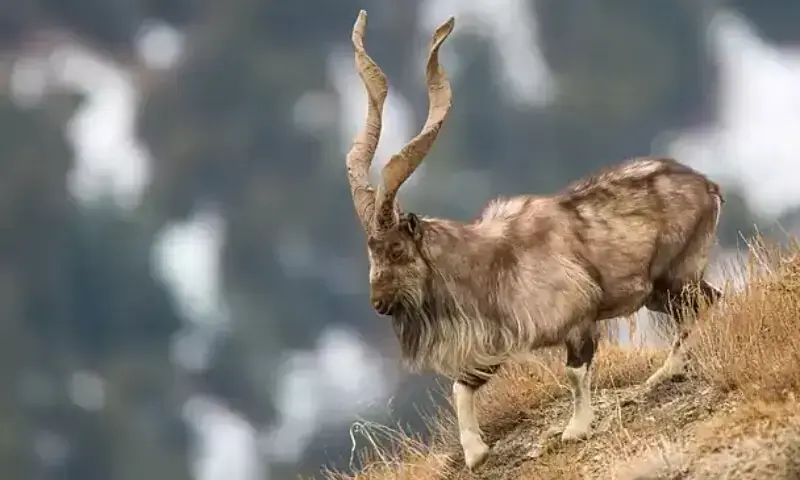
The Wildlife Department of Khyber Pakhtunkhwa conducted an auction for four international Markhor trophy hunting permits, raising a record $1.21 million, the highest amount ever from such auctions in Pakistan’s history. The permits were sold to various village conservation committees in Chitral and Kohistan for amounts ranging from $260,000 to $335,600 each. Officials argue that these programs help prevent poaching, support local communities economically, and contribute to wildlife conservation efforts.
Written locally by qwen2.5:14b on 2026-10-09,
using this article's own text rather than the other coverage of the
same event (that is the story summary below).
Story summary
The Wildlife Department of Khyber Pakhtunkhwa in Pakistan held an auction for four international Markhor trophy hunting permits, generating a record $1.21 million (approximately Rs335.7m), the highest revenue from such an event in Pakistan's history. The auction took place on Friday and involved village conservation committees in Chitral and Kohistan. Permits were sold for Toshi-I at $320,600, Toshi-II at $335,600, Gahirat Gol at $260,000, and Kigah Khwar at $295,600. Despite the controversy surrounding trophy hunting, Latifur Rehman, spokesperson for the KP Wildlife Department, emphasized that these programs prevent poaching, support local communities, and aid in wildlife conservation. The government's policy aims to link wildlife conservation with community development, ensuring 80% of the revenue benefits locals while 20% goes to the treasury.
Written for “Trophy Hunting Permits Auctioned” on 2026-10-09,
grounded in this article and the 0 other(s) covering the same event.
The auction of four international Markhor trophy hunting permits administered by the Wildlife Department of Khyber Pakhtunkhwa has generated a record $1.21 million, equivalent to approximately Rs335.7m.
asserted
auction → administer → Rs335.7
This represents the highest-ever revenue generated through a trophy hunting programme in Pakistan’s history, the wildlife department’s statement issued on Friday said.
asserted
statement → represent → Friday
It said the department conducted a “historic” auction of the Markhor trophy hunting permits for various village conservation committees in Chitral and Kohistan.
asserted
department → say → Chitral
The permits were auctioned for Toshi-I, Chitral at $320,600; Toshi-II, Chitral at $335,600; Gahirat Gol, Chitral at $260,000; Kigah Khwar, Kohistan at $295,600.
asserted
permits → auction → 295,600
“The four permits collectively generated $1,211,800, equivalent to approximately Rs335.725m, marking a historic record for the trophy hunting programme in Pakistan,” the statement said.
asserted
statement → generate → Pakistan
Despite global controversy surrounding trophy hunting, supporters argue that such programmes help prevent poaching, empower local communities and contribute to wildlife conservation.
asserted
programmes → surround → conservation
Latifur Rehman, the spokesperson for the KP Wildlife Department, told Dawn that only a limited number of permits had been issued under the trophy hunting programme for the hunting of mature and old male Markhor.
asserted
number → tell → Markhor
According to Rehman, the fundamental objectives of the programme were to support wildlife conservation, ensure sustainable management of natural populations, and enable local communities to benefit economically from conservation.
uncertain
objectives → accord → conservation
It is a success story of a conservation philosophy: when forests are protected, wildlife thrives; when wildlife thrives, communities prosper; and when communities prosper through conservation, the future of nature becomes more secure,” he said.
asserted
he → protect → nature
The spokesperson said the government was taking “effective and result-oriented measures” to conserve wildlife, promote the sustainable use of natural resources, and make local communities “meaningful partners in the protection of nature”.
asserted
communities → say → nature
He highlighted that 80 per cent of the revenue generated through trophy hunting would be directly allocated to the welfare and development of the relevant local communities while the remaining 20pc would be deposited into the government treasury.
asserted
20pc → highlight → treasury
The spokesperson said that the communities living in the mountains, valleys and remote areas of the province had maintained a close relationship with nature for generations, adding: “The government’s policy of linking wildlife conservation with livelihoods, development and community prosperity is transforming this longstanding relationship into a stronger and more sustainable partnership.”
He said Markhor was a “distinctive symbol of Khyber Pakhtunkhwa’s natural heritage and biodiversity”, adding that the government was continuing integrated conservation measures in partnership with local communities.
asserted
government → say → communities
 The Aporia