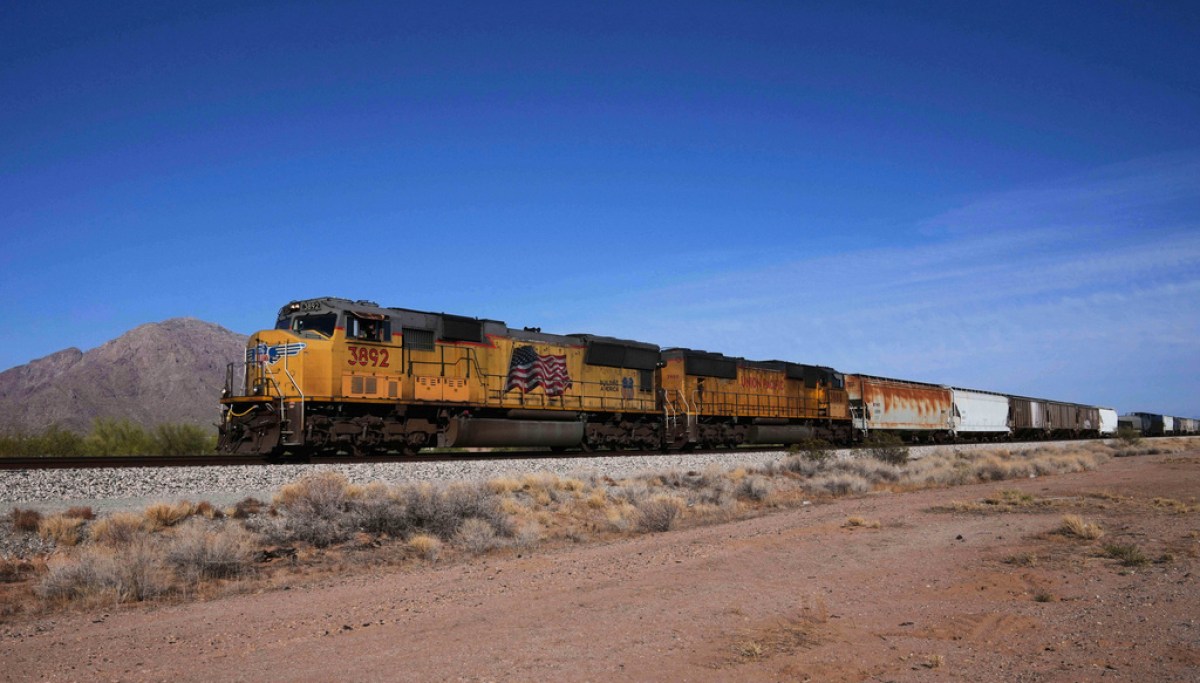
America’s first transcontinental railroad was completed in 1869, born of the Pacific Railway Act that President Abraham Lincoln signed into law seven years earlier.
asserted
Lincoln → complete → law
It was meant to knit the country together, coast to coast, on steel rails.
asserted
It → mean → rails
So why, more than 150 years later, can’t a shipper move a single load from one ocean to the other without changing railroads partway across the country?
asserted
shipper → move → country
Somewhere in the middle, the train is forced to stop.
asserted
train → force → middle
The freight gets handed off to another carrier, crews change, paperwork piles up, and the customer absorbs longer wait times and higher costs.
asserted
customer → hand → times
A century and a half after the golden spike, America still moves freight with a seam running down its middle.
asserted
America → move → middle
That seam is a structural weakness for the American economy, and the proposed combination of Union Pacific and Norfolk Southern is a chance to close it.
asserted
combination → propose → it
The Surface Transportation Board accepted the companies’ revised application for consideration in May and, on Aug. 18, adopted a schedule for reviewing its merits.
uncertain
Board → accept → merits
That decision lifted the proceeding from abeyance and set out the next steps for public comment and review; it was not a ruling on whether the merger should be approved.
asserted
merger → lift → comment
The board has since denied several motions seeking summary denial of the application, allowing the review to continue under that schedule.
asserted
review → deny → schedule
The board has not yet set a date for its public hearing.
asserted
board → set → hearing
This is how a rigorous review should work: build a complete record, test the claims against it, and decide whether the transaction serves the public interest.
uncertain
transaction → work → interest
America’s rail network remains patchworked between eastern and western carriers.
asserted
network → remain → carriers
When freight crosses from one system to another, railcars can sit for days while the receiving railroad works the shipment into its network.
asserted
railroad → cross → network
Companies shipping cross-country face separate pricing, separate tracking, and another opportunity for delay.
asserted
Companies → ship → delay
A truck has none of those problems, since it can leave a factory and arrive at a customer’s door under one operator and one schedule.
asserted
it → have → operator
That simplicity helps explain why trucking carries roughly two-thirds of the nation’s freight by weight, even though rail moves larger volumes with less congestion, road wear, and carbon emissions.
asserted
rail → help → congestion
The merger would give more shippers a comparable rail option, one carrier and one price from origin to destination, with the interchange in the middle removed.
asserted
interchange → give → middle
That puts positive pressure across the freight market because a more capable railroad is a stronger competitor for long-haul truck traffic.
asserted
railroad → put → traffic
During my time leading the Virginia Department of Transportation, I saw how the costs imposed by heavy truck traffic consistently weighed on taxpayers.
asserted
costs → lead → taxpayers
More trucks mean roads that wear out faster, higher maintenance costs, worse congestion, and more dangerous, large vehicles sharing the pavement with motorists.
asserted
that → mean → motorists
Federal forecasters expect truck tonnage to keep growing faster than any other mode through 2050, which points toward more of that strain, not less, if freight stays on the road.
asserted
freight → expect → road
Railroads, by contrast, invest billions of private dollars in the tracks, bridges, terminals, and signals they use.
asserted
they → invest → tracks
The companies’ own analysis, the first in rail merger history to use complete traffic data from all six Class I railroads, estimates the shift could take roughly 2.1 million trucks off the road and save shippers about $3.5 billion a year, with those savings expected to reach consumers.
uncertain
savings → use → consumers
Moving that freight by rail instead of trucks also cuts greenhouse gas emissions by up to 75%.
asserted
Moving → move → %
The strongest objection remains the risk that some shippers could lose competitive rail options.
uncertain
shippers → remain → options
Those concerns are narrow and specific, and the companies have addressed them with enforceable conditions that go beyond any prior rail merger.
asserted
that → address → merger
In the companies’ July supplemental information filing, they have expanded competitive gateway pricing, offered protections for customers whose Class I options could narrow, provided for temporary alternative service if integration disrupts performance, and established a rate-relief process if promised benefits are delayed.
uncertain
benefits → expand → process
A separate agreement with Canadian National would preserve access in affected markets by transferring Norfolk Southern’s shares of both the Terminal Railroad Association of St. Louis and Kansas City Terminal Railway to CN.
asserted
agreement → preserve → CN
All of this sits on top of a pledge that every employee holding a railroad union job at the time of approval will keep one for life.
asserted
employee → sit → life
Taken together, the supplemental filing, CN agreement, and labor commitments show these companies are serious about improving railroad infrastructure and service while protecting rail industry stakeholders.
asserted
companies → take → stakeholders
They have made concrete commitments to enhance competition while creating a stronger alternative to trucking.
asserted
They → make → trucking
The board’s job is to determine whether a proposed transaction serves the public interest under demanding modern merger review rules.
asserted
transaction → determine → rules
To date, everything the board has asked for, the companies have provided.
asserted
companies → ask → everything
The board should approve the Union Pacific-Norfolk Southern merger with the strong, enforceable protections in place and let the country’s freight network finally catch up with the transcontinental vision Lincoln set in motion more than 150 years ago.
asserted
Lincoln → approve → motion
He was appointed to the STB by President George W. Bush.
asserted
He → appoint → Bush
 The Aporia