That is 0 articles you have read today.
The Aporia is free and carries no advertising, so readers are the only
thing paying for it. If you are getting this much out of it, a small
donation is what keeps it independent.
Daily limit reached
You have read 0 articles today.
That is more than the 15 a day The Aporia gives away,
and well past what it can carry on nothing. Your allowance resets at
midnight.
There is no advertising here and nothing about you is sold, so readers
are the only thing paying for it. If the site is worth this much of
your day, it is worth a few dollars.
Everything else stays open: the
maps, the
directory and
search do
not count against this, and neither does re-opening something you have
already read today.
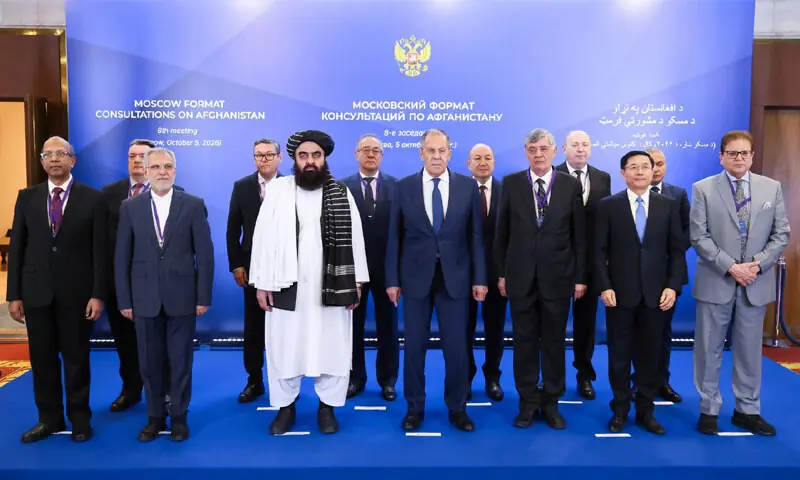
At a recent Moscow Format meeting attended by Afghanistan’s neighbors including Pakistan and representatives from the Taliban regime, participants failed to reach an agreement over how to address terrorism originating from Afghanistan. The main disagreement was between the Taliban and Pakistan; while Pakistan emphasized the need to tackle “the menace of terrorism emanating from Afghan soil,” the Taliban objected to framing their country within a “terrorist context.” Russia offered to mediate tensions but noted that the forum is not designed for bilateral disputes resolution, highlighting broader regional concerns about terrorist groups operating from Afghanistan under Taliban rule.
Written locally by qwen2.5:14b on 2026-10-09,
using this article's own text rather than the other coverage of the
same event (that is the story summary below).
Story summary
The eighth Moscow Format regional consultations on Afghanistan ended without a joint statement due to disagreements between Pakistan and Afghanistan over cross-border terror attacks. Russian Foreign Minister Sergey Lavrov endorsed the Taliban's performance but warned against NATO establishing military infrastructure in or near Afghanistan. The meeting, which included representatives from Afghanistan, China, India, Iran, Kazakhstan, Kyrgyzstan, Pakistan, Russia, Tajikistan, and Uzbekistan, failed to produce a consensus on how to address terrorism originating in Taliban-controlled Afghanistan. Russia proposed its good offices to ease tensions between Kabul and Islamabad but noted that the Moscow Format is not intended for resolving bilateral disputes. The absence of agreement highlights the divergence between regional stakeholders over the nature of terrorist threats emanating from Afghanistan, underscoring the challenges in coordinating a unified response to terrorism in the region.
Written for “Moscow Disagreement” on 2026-10-09,
grounded in this article and the 1 other(s) covering the same event.
Why this leaning score
The model judged this article politically coded and scored it -0.65, but every quote it verified points right, so the score is not published.
Written under an earlier scoring contract, which gave a paragraph
rather than checkable quotes. Re-analysing this article replaces it.
Leaning score withheld for article 68266: score contradicts its own evidence · logged 2026-10-09
THE fact that a consensus on how to deal with terrorism originating in Taliban-ruled Afghanistan eludes regional states was made clear at the recently held Moscow Format moot.
asserted
consensus → deal → moot
The event was attended by nearly all of Afghanistan’s neighbours, including Pakistan.
asserted
event → attend → Pakistan
However, there was no joint statement issued because, in the words of the Russian envoy for Afghanistan, “our Afghan and Pakistani colleagues didn’t see eye to eye”.
asserted
colleagues → be → eye
The Taliban regime had also sent its representatives.
asserted
regime → send → representatives
The main sticking point was the Taliban’s objection to including Afghanistan in a “terrorist context”.
asserted
point → include → context
However, as Pakistan’s envoy put it, it was essential to address “the menace of terrorism emanating from Afghan soil”.
asserted
it → put → soil
Russia offered its good offices to help de-escalate matters between Kabul and Islamabad, though it noted that the Moscow Format was not a forum for resolving bilateral disputes.
asserted
Format → offer → disputes
Groups that find shelter in Afghanistan under the Taliban threaten the entire region.
asserted
that → find → region
Thus, all of Afghanistan’s neighbours need to speak with one voice regarding the ‘export’ of terrorism.
asserted
all → need → terrorism
Russia is the only state that recognises the Taliban regime.
asserted
that → recognise → regime
Moscow has its own reasons for indulging the Taliban; these include the need to fight IS-K, which is a common enemy of Russia and the Taliban rulers, as well as to check US and Western influence in Afghanistan.
asserted
which → have → Afghanistan
But engagement with Kabul must not be allowed to obscure the fact that some of the deadliest terrorist groups in the world find refuge on Afghan soil.
asserted
some → allow → soil
Other regional forums, such as the SCO and the ECO, have highlighted the need to address the terrorist threat emanating from Afghanistan.
asserted
forums → highlight → Afghanistan
China, which has significant economic interests in Afghanistan, has also pointed to this terrorist threat.
asserted
which → have → threat
The UN Security Council, too, has frequently noted that Afghanistan under Taliban rule has once again become a haven for various terrorist groups.
asserted
Afghanistan → note → groups
Pakistan’s insistence, therefore, that Afghanistan’s terrorism problem be highlighted reflects the reality of the situation.
asserted
problem → highlight → situation
If Kabul addresses the issue sincerely and restrains terrorist groups, it will benefit not only the Afghan people but the entire region.
asserted
it → address → people
 The Aporia