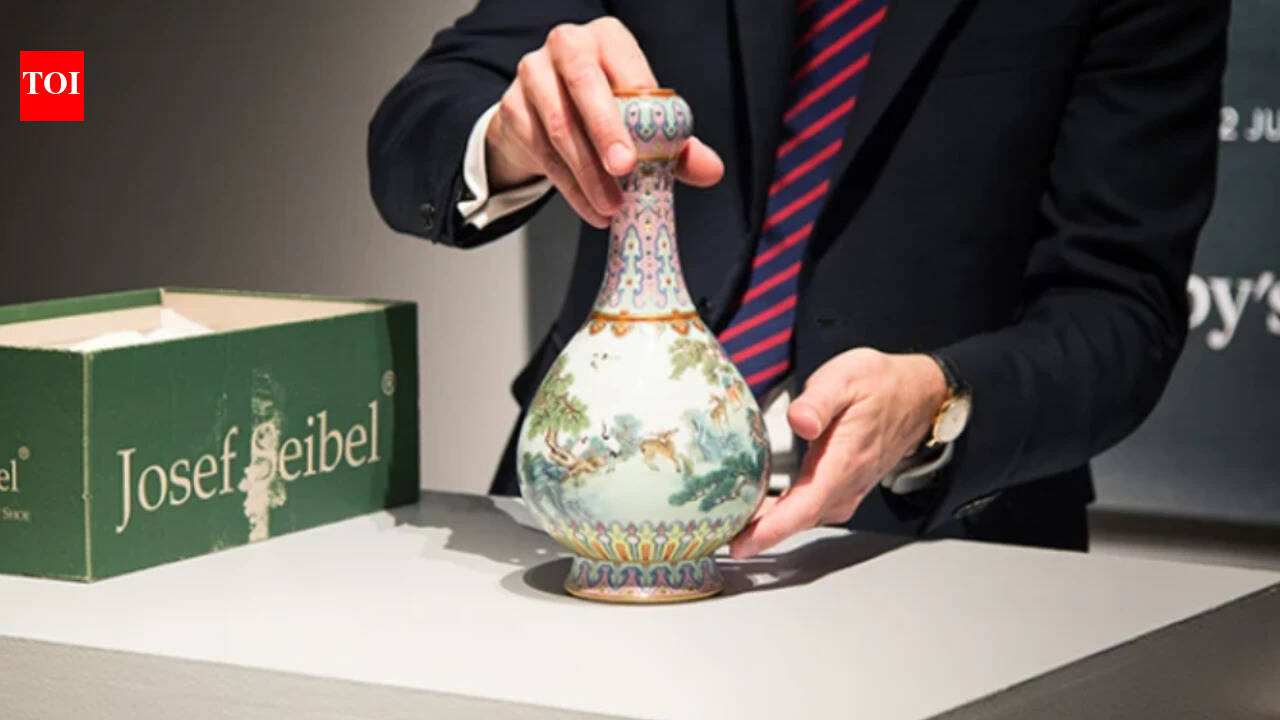
An 18th-century Chinese porcelain vase that had been kept in the attic of a French family home was sold for €16.18 million at a Sotheby’s auction in Paris.
asserted
that → keep → Paris
The family had no idea how valuable the vase was when they brought it to the auction house wrapped in newspaper and placed inside an old shoebox.
asserted
they → have → shoebox
Experts later identified it as a rare piece made for the court of China's Qianlong Emperor.
asserted
Experts → identify → Emperor
The vase had remained in the family for generations.
asserted
vase → remain → generations
According to Sotheby’s, it was among several Asian objects inherited from a relative who died in 1947.
uncertain
who → accord → 1947
Although the family had preserved it, they did not particularly like its appearance.
asserted
they → preserve → appearance
The owners reportedly considered it "too pink" and had left it in a box in the attic.
uncertain
it → consider → attic
Its value came to light when a woman contacted Sotheby’s Paris in March 2018.
asserted
woman → come → March
She had recently lost her husband and was preparing to move to the countryside.
asserted
She → lose → countryside
While clearing the house, she came across several objects of Asian origin and decided to ask whether they were worth examining.
asserted
they → clear → origin
What followed was an unexpected discovery for the family.
asserted
followed → follow → family
The vase, initially estimated at €700,000, eventually fetched €16,182,800 after a 20-minute bidding contest, setting a record at the time for Chinese porcelain sold at auction in France.
asserted
vase → estimate → France
From attic to Sotheby’s
The woman first spoke to Olivier Valmier, an Asian art specialist at Sotheby’s Paris, over the telephone.
asserted
woman → speak → telephone
She described several objects in her possession, including a dragon robe, a censer, a mirror kept inside a lacquer box and a porcelain vase decorated with animals.
asserted
She → describe → animals
She could not send photographs of the objects.
uncertain
She → send → objects
However, Valmier became interested when she mentioned that the censer had an invoice connected to the 1867 Universal Exhibition in Paris.
asserted
censer → become → Paris
He asked her to bring the objects to Sotheby’s for examination.
asserted
He → ask → examination
Initially, she hesitated because of the distance involved and worried that the journey might waste his time.
uncertain
journey → hesitate → time
Eventually, she agreed to bring one item, and Valmier selected the vase.
asserted
Valmier → agree → vase
Despite delays caused by train strikes, the woman arrived at the Paris office carrying the vase wrapped in crumpled newspaper, placed inside an old shoebox and covered with a plastic bag.
asserted
woman → cause → bag
When Valmier and his colleagues examined it, they immediately recognised its exceptional quality.
asserted
they → examine → quality
Even if it had been a late 19th- or early 20th-century copy, they believed it could have been worth around €100,000.
uncertain
it → believe → ?
Further examination confirmed that it was an authentic 18th-century imperial porcelain vase, produced by the Jingdezhen workshops for the Qianlong Emperor's court.
asserted
it → confirm → court
Describing the discovery, Valmier said, “It was as if we had just discovered a Caravaggio.”
asserted
we → describe → Caravaggio
The vase belonged to a rare category of Chinese porcelain known as Famille-Rose, or yangcai.
asserted
vase → belong → Rose
These pieces are recognised for their detailed paintings, rich colours and complex production techniques.
asserted
pieces → recognise → paintings
The vase, officially described as an Imperial 'Yangcai Crane and Deer Ruyi Vase', features a landscape painted around its body.
asserted
vase → describe → body
The decoration includes nine fallow deer, five cranes, pine trees, rocky mountains and a waterfall.
asserted
decoration → include → deer
The vase, officially described as an Imperial 'Yangcai Crane and Deer Ruyi Vase', features a landscape painted around its body
According
asserted
vase → describe → body
to Sotheby’s, the deer, cranes and pine trees represent health and longevity in Chinese art.
asserted
deer → represent → art
The landscape may also depict the vegetation of an imperial pleasure garden.
uncertain
landscape → depict → garden
Producing such porcelain required considerable skill and time.
asserted
Producing → produce → skill
The detailed painting involved multiple layers of decoration, making these pieces particularly difficult to manufacture.
asserted
pieces → involve → decoration
Their rarity also contributed to their value.
asserted
rarity → contribute → value
Sotheby’s explained that this type of porcelain was produced in extremely limited quantities, with most surviving examples now held in museums.
asserted
examples → explain → museums
Only one other vase of a comparable shape and design is known.
asserted
vase → know → shape
That piece, which has different decorative details, belongs to the Musée Guimet in Paris.
asserted
which → have → Paris
Connection with the Qianlong Emperor
Sotheby’s specialists also examined historical imperial records to understand the vase's origins.
asserted
specialists → examine → origins
They found that an 18th-century imperial inventory listed two pairs of vases with designs matching the newly discovered piece.
asserted
inventory → find → piece
One pair had been commissioned in 1765 for a Buddha Hall, a space used for the emperor's private worship.
asserted
pair → commission → worship
…and 12 more, not listed.
 The Aporia