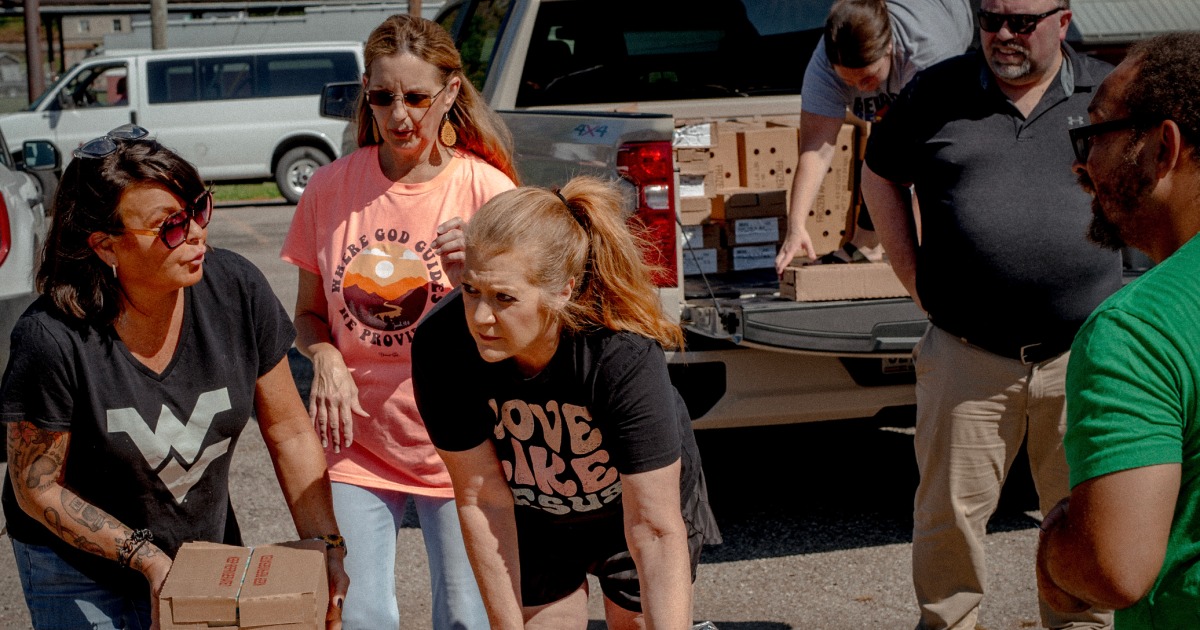
Bill Likens stared down a half-mile-long line of cars that started forming before the sun came up over the Appalachian Mountains.
asserted
sun → star → Mountains
He had one job: figure out how to feed them all.
asserted
He → have → them
Some had driven more than 30 miles in aging cars and trucks that wheezed down flood-prone roads through the steep hills.
asserted
that → drive → hills
They sat silently as the temperature rose into the 80s, their vehicles turned off with no air conditioning to preserve gas, waiting hours for a few boxes of food.
asserted
vehicles → sit → food
Aided by a cane, Likens, 51, surveyed the pallets being unloaded off a semitruck that arrived that morning.
asserted
that → aid → semitruck
He counted cartons of eggs and sacks of potatoes to calculate how much each waiting car could get — an algorithm of hunger he is constantly trying to solve.
uncertain
he → count → hunger
“There’s a decent chance we could run out,” said Likens, who runs the food pantry in Dunlow as director of community outreach for Cabwaylingo Presbyterian Chapel, a small brick church he attended growing up.
uncertain
he → ’ → Chapel
“I don’t want them to sit in that line and not get anything,” he said.
asserted
he → want → anything
“But I don’t have a lot of extra food these days.”
asserted
I → have → food
Increasingly, the job of feeding the nation’s hungry is falling on the shoulders of everyday Americans like Likens, who have become the last bulwark against hunger in a land of plenty.
asserted
who → feed → plenty
Likens and others on the front lines of feeding their neighbors say they face unprecedented challenges brought on by Washington.
asserted
they → feed → Washington
Food distribution programs are getting less food from federal programs to feed the hungry after cuts by the Trump administration.
asserted
programs → get → administration
At the same time, restrictions on food stamps from the Republicans’ “big, beautiful bill” have driven up demand, while rising gas prices because of the Iran war have cut into the budgets of households and food banks alike.
asserted
prices → drive → households
The challenges extend far beyond Appalachia.
asserted
challenges → extend → Appalachia
An NBC News survey of 48 of the largest food banks across 35 states and Washington, D.C., found that nearly three-quarters said more people are showing up at their doors over the past year, from workers on their lunch breaks to older adults overwhelmed with medical expenses.
asserted
people → find → expenses
At the same time, more than 80% said the food and funding they received through the U.S. Department of Agriculture had dropped and they were struggling with higher fuel costs for transporting food.
asserted
they → say → food
In Maine, Good Shepherd Food Bank said the USDA cut the amount of food it received from 13 million pounds to 9 million pounds in one year.
asserted
it → say → year
A Michigan food bank, Forgotten Harvest, said it’s handing out less food to make sure there is enough to go around: one bag of potatoes instead of two, two tubs of yogurt as opposed to six.
asserted
it → say → six
“People are facing multiple hits to their budgets,” said Poonam Gupta, a senior research associate at the Urban Institute, a think tank that researches social and economic issues.
asserted
that → face → issues
“It is really difficult to find a way to continue affording a healthy and nutritious and balanced diet when you just have these constant hits.
asserted
you → find → hits
Food banks’ struggles started in the early days of President Donald Trump’s second term when officials cut a $400 million Covid-era program to supply food banks with food from local farmers and paused an estimated $500 million in other planned food purchases by the USDA.
asserted
officials → start → USDA
Funding from Congress for a separate decades-old program to supply food banks with emergency food assistance has increased over the past several years, but many food bank leaders said they’re still getting less overall than during the Biden administration.
asserted
they → supply → administration
Trump also signed into law the new restrictions on who can receive Supplemental Nutrition Assistance Program benefits, or food stamps, requiring nearly all able-bodied adults not caring for young children to work, volunteer or go to school at least 80 hours a month.
asserted
who → sign → school
Since the law was enacted, more than 5 million people, including at least 1 million children, have lost their food benefits.
asserted
people → enact → benefits
White House spokesperson Anna Kelly defended the administration’s policies, saying Trump is “uplifting every American’s financial situation” through tax cuts and efforts to increase jobs and business investments.
asserted
Trump → defend → jobs
“President Trump is strengthening SNAP for the Americans who need it by ensuring these programs are sustainable for future generations,” Kelly said, including measures to “crack down on waste, fraud and abuse.”
asserted
Kelly → strengthen → waste
The USDA said it hasn’t reduced the amount of food it provides.
asserted
it → say → food
“Every day, the Food and Nutrition Administration invests $340 million in low-income communities and people in need of nutrition assistance, including millions of school children, elderly, and the disabled,” a USDA spokesperson said.
asserted
spokesperson → invest → children
“The mission to help those in need has not changed.
asserted
mission → help → need
While those on the ground say they are thankful for everything they get, they are struggling to do more with less.
asserted
they → say → less
Facing Hunger Foodbank, which supplies Likens’ pantry and others across Appalachia, has seen a 25% increase in the number of people seeking help over the past year, while the amount of food the federal government supplies has fallen by a third, CEO Cyndi Kirkhart said.
asserted
Kirkhart → supply → third
Those forces have hit especially hard in areas that were already struggling economically, like West Virginia’s once-flourishing coal mining communities.
asserted
that → hit → communities
The spike in gas costs means a 45-minute drive to the nearest grocery store can set residents back more than $15.
asserted
drive → mean → 15
And West Virginians who must comply with the new work requirements to receive food benefits are confronting a lack of jobs and training programs.
asserted
who → comply → jobs
Since last summer, about 24,000 people, including 8,000 children, have lost food stamps, according to the West Virginia Department of Human Services.
uncertain
people → include → Services
“It’s like the pandemic on steroids without funds,” Kirkhart said.
asserted
Kirkhart → ’ → funds
“I don’t believe the government needs to provide everything, but if you’re going to ask us to, please help.”
asserted
you → believe → us
Keeping neighbors fed
Likens learned the tricks of how to battle an aching emptiness in his stomach early in life.
asserted
Likens → keep → life
When he was 12, his father, a construction supervisor for a coal mine, was injured by a falling piece of equipment.
asserted
father → injure → equipment
Suddenly, his family of seven had to live off of just $350 a month in government assistance.
asserted
family → have → assistance
…and 93 more, not listed.
 The Aporia