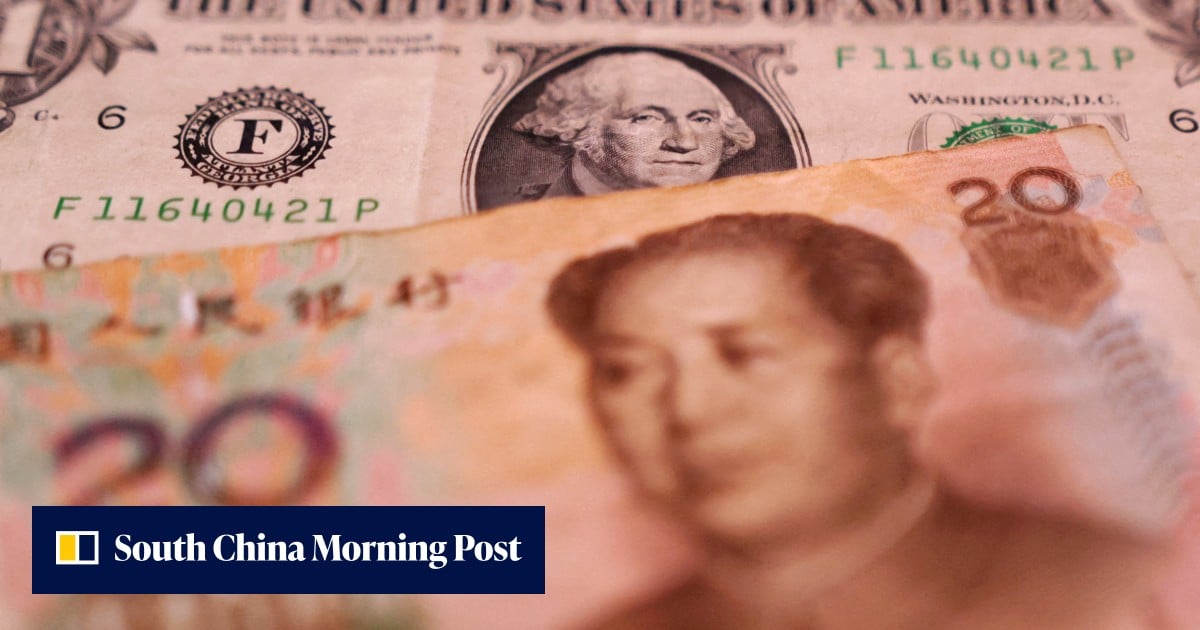
Can China use widening yield gap between the US dollar and yuan to boost global role?

Read the original at South China Morning Post ↗
South China Morning Post · collected 2026-10-09 · by Daisy Wu

Quick Summary

An expert suggests that China could enhance the global use of its currency by taking advantage of the widening gap between US Treasury yields and Chinese government bond rates. As of Thursday, the 10-year US Treasury yield was at 5.22%, while Chinese bonds yielded only 1.69%, creating a significant differential of about 3.5 percentage points. According to Jiang Zhenlong from the Chinese Academy of Social Sciences’ Institute of Finance and Banking, this yield inversion affects asset allocation negatively for yuan but positively for financing in dollar terms.
Written locally by qwen2.5:14b on 2026-10-09, using this article's own text rather than the other coverage of the same event (that is the story summary below).

AI analysis runs on qwen2.5:14b, locally

Story summary

The 10-year US Treasury yield was at 5.22% on Thursday, while Chinese government bonds were at 1.69%, creating a gap of about 3.5 percentage points between the two currencies. This significant difference has led an expert to suggest that Beijing could potentially leverage the low interest rates in China to boost the global use of the yuan. Jiang Zhenlong, an associate research fellow from the Chinese Academy of Social Sciences’ Institute of Finance and Banking, noted this trend in a recent issue of China Money Market, a central bank-affiliated magazine. He argues that although higher US yields weaken the attractiveness of yuan assets and put pressure on capital flows, they also increase dollar funding costs for global borrowers. Thus, China might capitalize on these dynamics to enhance its currency's international role.

Written for “Chinese Currency Strategy” on 2026-10-09, grounded in this article and the 0 other(s) covering the same event.
Why this leaning score
This article does not take a side on a contested political question, so it has no leaning score. That is an answer rather than a gap: a match report or a rescue can be warmly or critically written without being left or right, and scoring it anyway is how approval of a subject gets recorded as a political position.
No political leaning scored for article 67489 · logged 2026-10-09

Signals How these are calculated →

Claims extracted
3
claim-shaped sentences
Uncertain
33%
1 of 3 hedged
Leaning
not political
takes no side on a contested political question
Correction & hedging signals
66.7
corrections and hedging in what we collected; not a measure of accuracy
Outlets on this story
1
Economy/Business
Narrative spread
1
articles carrying this framing
Analyzed 2026-10-09 · how these are computed

Story

📰 Chinese Currency Strategy
Economy/Business · 1 article(s) covering the same event.

How this is being covered How these are calculated →

Article leaning vs. publisher reliability
Source leaning vs. consistency

Compared with similar articles

Nothing to compare against. No article is close enough to this one for the pipeline to have linked or judged the pair.

Publisher

South China Morning Post · 1914 article(s) · 4 correction(s) detected
Running correction rate · 4 correction(s)
2026-10-04
Flight to Okinawa diverts back to Hong Kong after suspected landing gear fault
2026-10-04
Tennessee prisons chief resigning after botched execution of Christa Pike
2026-09-29
Indonesian prison chief suspended over secret VIP compound for inmates
2026-09-28
Trump ‘arms offer’ to China jolts Washington into moves to contain the fallout

Who wrote this

Daisy Wu
10 article(s) here · 1 carrying a prediction
🔮 Beijing could leverage the yuan’s low interest rate to increase the currency’s worldwide use, an expert says The 10-year US Treasury yield was 5.22 per cent on Thursday, compared with 1.69 per cent for Chinese government bonds on their first trading day after the National Day holiday – a gap of about 3.5 percentage points, compared with a record 3.7 percentage points on September 9. Jiang Zhenlong, an associate research fellow at the Chinese Academy of Social Sciences’ Institute of Finance and Banking, argued that higher US yields weaken the appeal of yuan assets and add pressure on the exchange rate and capital flows, but also raise dollar funding costs.
🔮 Zou, a former vice-minister of finance in China, said member states increasingly viewed modern infrastructure as a “force of transformation” that could strengthen their economies over the long term rather than simply as physical assets.
🔮 Chinese regulators push patient capital, reshape US$4.5 trillion mutual fund industry towards long-term holdings as foreign investors weigh risks against thin IPO pipelines China is betting that patient capital, rather than quick trades, will define its next phase of growth – a wager that has taken on new resonance since Warren Buffett stepped down last week after growing Berkshire Hathaway into a US$1 trillion empire over six decades.
🔮 The local exchange is set to study looser listing rules – including adjusted market-capitalisation thresholds – for technology companies of “strategic importance” while broadening secondary listing channels by adding the Kazakhstan Stock Exchange to its recognised-bourse list.
🔮 Brokerages will be required to establish clawback mechanisms to recover bonuses and performance pay from employees who violate ethical standards or regulatory rules.
🔮 Based in Shanghai, she will oversee institutional sales coverage across rates, spread products, foreign exchange, commodities and equity derivatives.
🔮 “There will not be any cap to it,” Yue said, adding that the facility’s quota could be expanded as demand increased and existing capacity was well used.
🔮 Bank beats forecast with HK$23.74 billion profit, helped by reduced credit costs and stronger fee income from wealth and insurance Profit attributable to shareholders came to HK$23.74 billion (US$3 billion) for the six months to June 30, or HK$2.2453 per share, according to a stock exchange filing on Friday.
Also by Daisy Wu
Nothing else under this byline is closely related to this article, so these are simply their most recent.

All 10 articles by Daisy Wu →

Topics

Beijing China Chinese National Day US Treasury

Subjects

China GPE · 2× Beijing GPE · 1× China Money Market ORG · 1× Chinese NORP · 1× Institute of Finance and Banking ORG · 1× Jiang Zhenlong PERSON · 1× US Treasury ORG · 1× the Chinese Academy of Social Sciences’ ORG · 1×

Narrative

“The China-US yield inversion presents an asymmetric effect: pressure on the asset allocation side and benefit on the financing side,” he wrote in the latest issue of China Money Market, a central bank-affiliated magazine.
framing: mixed · carried by 1 article(s) · first seen 2026-10-09
🔮 Beijing could leverage the yuan’s low interest rate to increase the currency’s worldwide use, an expert says The 10-year US Treasury yield was 5.22 per cent on Thursday, compared with 1.69 per cent for Chinese government bonds on their first trading day after the National Day holiday – a gap of about 3.5 percentage points, compared with a record 3.7 percentage points on September 9. Jiang Zhenlong, an associate research fellow at the Chinese Academy of Social Sciences’ Institute of Finance and Banking, argued that higher US yields weaken the appeal of yuan assets and add pressure on the exchange rate and capital flows, but also raise dollar funding costs.
2026-10-09 · South China Morning Post
Can China use widening yield gap between the US dollar and yuan to boost global role? · mixed framing

Claims (3 extracted, 1 hedged)

Can China use widening yield gap between the US dollar and yuan to boost global role? asserted
China → use → role
Beijing could leverage the yuan’s low interest rate to increase the currency’s worldwide use, an expert says The 10-year US Treasury yield was 5.22 per cent on Thursday, compared with 1.69 per cent for Chinese government bonds on their first trading day after the National Day holiday – a gap of about 3.5 percentage points, compared with a record 3.7 percentage points on September 9. Jiang Zhenlong, an associate research fellow at the Chinese Academy of Social Sciences’ Institute of Finance and Banking, argued that higher US yields weaken the appeal of yuan assets and add pressure on the exchange rate and capital flows, but also raise dollar funding costs. uncertain
yields → leverage → costs
“The China-US yield inversion presents an asymmetric effect: pressure on the asset allocation side and benefit on the financing side,” he wrote in the latest issue of China Money Market, a central bank-affiliated magazine. asserted
he → present → Market
💬Give feedback
🕘History 🎫Support