That is 0 articles you have read today.
The Aporia is free and carries no advertising, so readers are the only
thing paying for it. If you are getting this much out of it, a small
donation is what keeps it independent.
Daily limit reached
You have read 0 articles today.
That is more than the 15 a day The Aporia gives away,
and well past what it can carry on nothing. Your allowance resets at
midnight.
There is no advertising here and nothing about you is sold, so readers
are the only thing paying for it. If the site is worth this much of
your day, it is worth a few dollars.
Everything else stays open: the
maps, the
directory and
search do
not count against this, and neither does re-opening something you have
already read today.
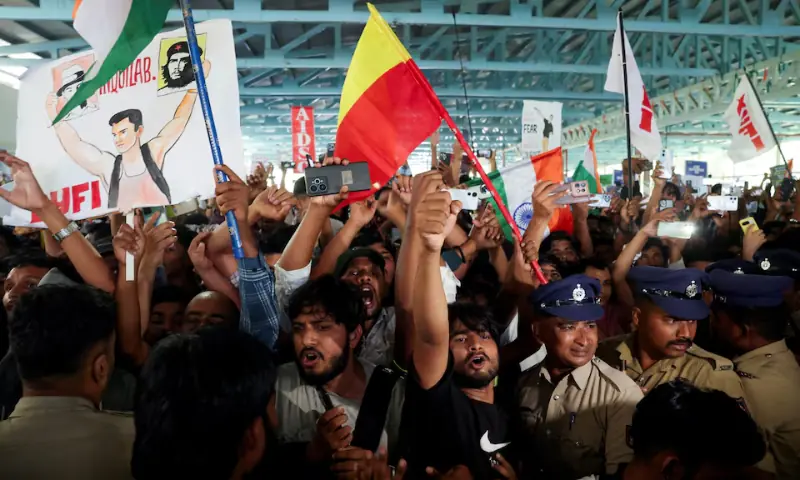
On October 8, 2026, anti-migrant protests in Johannesburg's Soweto township and Durban turned violent, with looting and burning of vehicles and businesses owned by migrants. South African government spokesperson William Baloyi attributed the unrest to disinformation regarding a July constitutional court ruling that clarified asylum seekers' rights but did not grant them automatic legal status. Police reported at least 14 vehicles set alight in Durban and are increasing security presence in both cities.
Written locally by qwen2.5:14b on 2026-10-09,
using this article's own text rather than the other coverage of the
same event (that is the story summary below).
Story summary
On October 8, 2026, anti-migrant protests turned violent in two South African cities: Durban and Johannesburg’s Soweto township. In Durban, five cars were set on fire, and foreign-owned shops were looted. In Soweto, residents chased away a Somali shop owner and stole groceries from his store before police intervened to disperse the crowd.
The unrest was sparked by a protest demanding that an asylum center stop processing applications. Government spokesperson William Baloyi attributed the violence to false information spreading about a constitutional court ruling in July, which stated that asylum seekers could not be denied access to South Africa’s asylum system based on procedural reasons like illegal entry. However, this ruling does not grant automatic refugee status or permanent residence.
The protests and ensuing violence highlight tensions over migration policies and misinformation affecting public perception of the legal rights of asylum seekers in South Africa.
Written for “South Africa Anti Migrant Protests” on 2026-10-09,
grounded in this article and the 0 other(s) covering the same event.
Why this leaning score
The article's own words the score was based on. Each is quoted
verbatim and was checked against the article text before being
stored, so you can find it in the original.
Leaning: leans left for article 67202 (high confidence, 1 verified quote) · logged 2026-10-09
Claims extracted
16
claim-shaped sentences
Uncertain
6%
1 of 16 hedged
Leaning
Leans left
of the writing, not the subject · beta estimate
Correction & hedging signals
96.2
corrections and hedging in what we collected;
not a measure of accuracy
Outlets on this story
1
Politics
Narrative spread
1
articles carrying this framing
Anti-migrant protests in two South African cities including Johannesburg’s Soweto township turned violent on Thursday (October 8, 2026), with the government blaming disinformation over a court ruling on asylum seekers.
asserted
government → include → seekers
In coastal Durban, the second city hit by protests, a Reuters reporter saw five cars in flames in the urban centre, where foreign-owned shops were also looted.
asserted
shops → hit → centre
The unrest followed a protest by a group demanding that a refugee centre stop processing asylum applications.
asserted
centre → follow → applications
In Soweto, a Reuters reporter saw residents carrying groceries out of a shop that they said was owned by a person from Somalia, whom they chased away.
asserted
they → see → whom
The looters fled after police arrived and made them disperse.
asserted
them → flee → ?
Government spokesperson William Baloyi said the violence was triggered by people spreading deliberately false information about a constitutional court ruling in July.
asserted
violence → say → July
The country’s highest court ruled that asylum seekers cannot be denied access to South Africa’s asylum system solely for procedural reasons such as having entered the country illegally.
asserted
seekers → rule → country
Mr. Baloyi said the ruling had been widely misrepresented and did not automatically grant refugee status, permanent residence or other legal rights to undocumented migrants.
asserted
ruling → say → migrants
“We are deeply concerned by what is going on now,” he added.
asserted
he → concern → ?
Police said in a statement that they had mobilised more officers in Durban, where they said at least 14 vehicles had been set alight while a guest house and warehouse were partially burned.
asserted
house → say → Durban
A top police official, Lieutenant General Puleng Dimpane, planned to hold a press conference in Soweto on efforts to maintain law and order there.
asserted
official → plan → law
South Africa has seen months of anti-migrant marches this year that have drawn international criticism.
asserted
that → see → criticism
Some of the marches have descended into violence and looting, and thousands of African foreign nationals have fled the country.
asserted
thousands → descend → country
Migrants are often blamed for taking jobs, fuelling crime and straining public services, claims that social scientists say are not supported by evidence.
uncertain
scientists → blame → evidence
Three decades since apartheid ended, South Africa remains deeply unequal and about a third of people are out of work.
asserted
third → end → work
Despite this, it remains Africa’s largest economy and continues to draw migrants.
asserted
it → remain → migrants
 The Aporia