ON SEPTEMBER 6, 1936, THE EVE OF LABOR DAY, President Franklin Roosevelt delivered his eighth “Fireside Chat.”
asserted
Roosevelt → deliver → Chat
Although his New Deal program had seen some policy successes—including the passage in 1935 of the Social Security Act—the Great Depression was still far from over, the unemployment rate remained above 20 percent, and millions of Americans were suffering.
asserted
millions → see → Americans
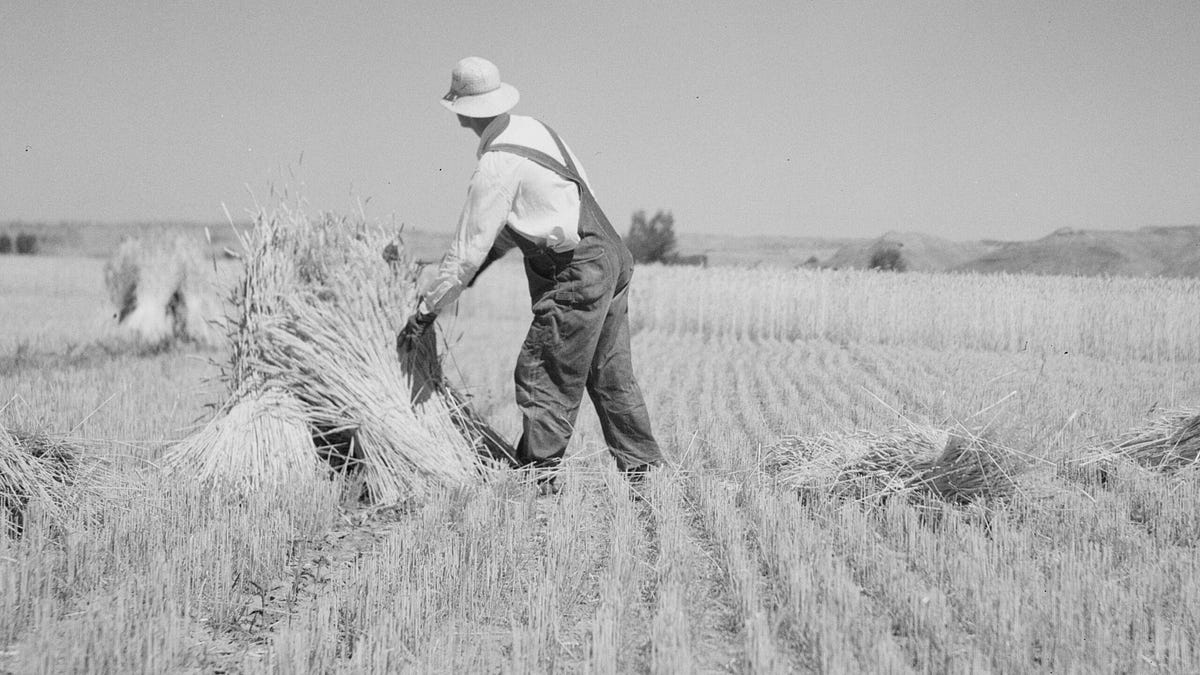
FDR began this address by movingly describing what he saw on a just-completed tour of nine states affected by “drought devastation”:
asserted
he → begin → devastation
I shall never forget the fields of wheat so blasted by heat that they cannot be harvested.
asserted
they → forget → heat
I shall never forget field after field of corn stunted, earless and stripped of leaves, for what the sun left the grasshoppers took.
asserted
left → forget → grasshoppers
I saw brown pastures which would not keep a cow on fifty acres.
asserted
which → see → acres
After discussing his administration’s plans to help the drought-stricken states, and then more general plans for getting people back to work, Roosevelt concluded with these remarks (beginning at 22:15 in this audio recording1) about the meaning of Labor Day:
Tomorrow is Labor Day.
asserted
Tomorrow → discuss → Day
It has never had more significance as a national holiday than it has now.
asserted
it → have → holiday
In other countries the relationship of employer and employee has been more or less accepted as a class relationship not readily to be broken through.
asserted
relationship → accept → relationship
In this country we insist, as an essential of the American way of life, that the employer-employee relationship should be one between free men and equals.
asserted
relationship → insist → men
We refuse to regard those who work with hand or brain as different from or inferior to those who live from their own property.
asserted
who → refuse → property
We insist that labor is entitled to as much respect as property.
asserted
labor → insist → property
But our workers with hand and brain deserve more than respect for their labor.
asserted
workers → deserve → labor
They deserve practical protection in the opportunity to use their labor at a return adequate to support them at a decent and constantly rising standard of living, and to accumulate a margin of security against the inevitable vicissitudes of life.
asserted
They → deserve → life
The average man must have that twofold opportunity if we are to avoid the growth of a class-conscious society in this country.
asserted
we → have → country
There are those who fail to read both the signs of the times and American history.
asserted
who → be → times
They would try to refuse the worker any effective power to bargain collectively, to earn a decent livelihood and to acquire security.
asserted
They → try → security
It is those shortsighted ones, not labor, who threaten this country with that class dissension which in other countries has led to dictatorship and the establishment of fear and hatred as the dominant emotions in human life.
asserted
which → threaten → life
All American workers, brain workers and manual workers alike, and all the rest of us whose well-being depends on theirs, know that our needs are one in building an orderly economic democracy in which all can profit and in which all can be secure from the kind of faulty economic direction which brought us to the brink of common ruin seven years ago.
asserted
which → depend → ruin
Tomorrow, Labor Day, belongs to all of us.
asserted
Tomorrow → belong → us
Tomorrow, Labor Day, symbolizes the hope of all Americans.
asserted
Tomorrow → symbolize → Americans
Anyone who calls it a class holiday challenges the whole concept of American democracy.
asserted
who → call → democracy
The Fourth of July commemorates our political freedom—a freedom which without economic freedom is meaningless indeed.
asserted
which → commemorate → freedom
Labor Day symbolizes our determination to achieve an economic freedom for the average man which will give his political freedom reality.
asserted
which → symbolize → reality
The text has been edited to match the president’s verbal delivery, and so differs very slightly from the text as printed in the fifth volume of The Public Papers and Addresses of Franklin D. Roosevelt.
asserted
text → edit → Roosevelt
 The Aporia