I Was a Workaholic. Quitting Changed My Life.

The Free Press · collected 2026-09-07 · by Lindsay Crouse
Read the original at The Free Press ↗

Summary

Lindsay Crouse, a former workaholic and New York Times writer, shares her personal experience with overwork in an essay excerpted from her book "The Case for Quitting: The Surprising Benefits of Opting Out". Crouse describes how she felt pressured to constantly work, even when exhausted and pregnant, until she hit a dead end. She reflects on the toll it took on her mental health, saying that the harder she worked, the duller she became. Crouse now advocates for reevaluating the idea of "never quitting" as a way to seek something better in life.
Written by the local model on 2026-09-07, using this article's own text rather than the other coverage of the same event (that is the story summary below).

Signals How these are calculated →

Claims extracted
22
claim-shaped sentences
Uncertain
5%
1 of 22 hedged
Leaning
Leans left
of the writing, not the subject
Publisher trust
96.3
red-flag proxy, not a credibility rating
Outlets on this story
1
Health
Narrative spread
1
articles carrying this framing
Analyzed 2026-09-07 · how these are computed

AI analysis (generated at analysis time, not now)

Story summary

Lindsay Crouse, a writer for The New York Times, used to be a workaholic who gave up her nights and weekends to write about perseverance and success. However, she started to notice that her relentless drive was not only affecting her mental health but also contributing to a "darker trend" in society. In her new book, The Case for Quitting: The Surprising Benefits of Opting Out, Crouse argues that quitting can be a courageous step towards something better, rather than a sign of failure or laziness. She reflects on her own experience of reevaluating her priorities and finding meaning in her work-life balance. This essay is published on Labor Day as part of The Front Page series, which explores the importance of making work meaningful and determining how much is too much.

Written for “Benefits of Reducing Workload” on 2026-09-07, grounded in this article and the 0 other(s) covering the same event.
Why this leaning score
The article's own words the score was based on. Each is quoted verbatim and was checked against the article text before being stored, so you can find it in the original.
Score -0.35 Confidence high
Leaning score -0.35 for article 6689 (high confidence, 1 verified quote) · logged 2026-09-07

Story

📰 Benefits of Reducing Workload
Health · 1 article(s) covering the same event. This is the one the site leads with.

How this is being covered How these are calculated →

Article leaning vs. publisher reliability
Source leaning vs. consistency

Compared with similar articles

Nothing to compare against. No article is close enough to this one for the pipeline to have linked or judged the pair.

Publisher

The Free Press · 56 article(s) · 0 correction(s) detected
No corrections detected for this publisher. That may mean careful reporting, or simply that nothing has been checked.

Who wrote this

Lindsay Crouse
1 article(s) here · 1 carrying a prediction
🔮 For some, it’s because the machines might be coming for their jobs.
2026-09-07 · assertive framing · I Was a Workaholic. Quitting Changed My Life.
The only article under this byline in the corpus.

Topics

Americans The Front Page The New York Times

Subjects

The New York Times ORG · 2× Americans NORP · 1× Lindsay Crouse PERSON · 1× The Front Page ORG · 1×

Narrative

She once gave up nights and weekends writing for The New York Times about how perseverance makes successful people—until she “started to recognize another, darker trend in this relentless compulsion to stay and strive.”
framing: assertive · carried by 1 article(s) · first seen 2026-09-07
🔮 For some, it’s because the machines might be coming for their jobs.
2026-09-07 · The Free Press
I Was a Workaholic. Quitting Changed My Life. · assertive framing

Claims (22 extracted, 1 hedged)

For some, it’s because the machines might be coming for their jobs. uncertain
machines → ’ → jobs
For others, 40 years of the 9-to-5 with a gold watch at the end seems like a quaint fantasy from a bygone era. asserted
years → seem → era
When anyone can strike it rich as an influencer or prediction markets bettor, is the grind even worth it? asserted
grind → strike → influencer
It’s Labor Day, and work is on our minds. asserted
work → ’ → minds
How do we make our work meaningful? asserted
work → make → ?
The Front Page will be back tomorrow, but today we’re publishing an essay by reformed workaholic Lindsay Crouse. asserted
we → publish → Crouse
She once gave up nights and weekends writing for The New York Times about how perseverance makes successful people—until she “started to recognize another, darker trend in this relentless compulsion to stay and strive.” asserted
she → give → compulsion
In an excerpt of her new book, The Case for Quitting: The Surprising Benefits of Opting Out, she argues for a new way of thinking that all of us would do well to consider—workaholics, slackers, and everyone in between. asserted
us → quit → that
“Quitting is not simply a failure of resolve or easy way out,” she writes. asserted
she → write → resolve
“Often, it’s the courageous first step to something better.” asserted
it → ’ → something
One night, I hit a dead end. asserted
I → hit → end
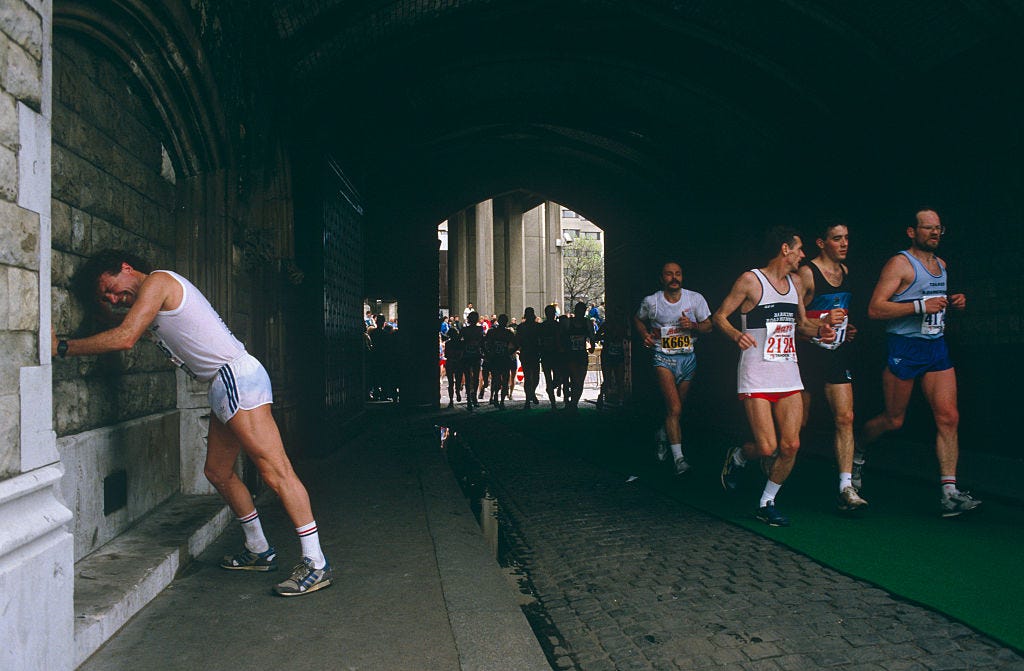
I had just run a marathon, because I’d registered and paid and I don’t quit, but I hadn’t trained enough and days later, my legs still felt like stilts. asserted
legs → run → stilts
It was midnight, Thanksgiving weekend, and I was still working. asserted
I → work → ?
I was nearly 40, and yet I related to how students at pressure-cooker universities sometimes describe themselves: like ducks, gliding along on the surface while my legs churned furiously below. asserted
legs → relate → surface
It wasn’t that I was failing, at least not if you asked the internet. asserted
you → fail → internet
I had a good job at The New York Times, and raced marathons on the weekends, for fun. asserted
I → have → fun
Every spring break, students would send messages asking how to be like me, and I’d usually shoot back the same advice I told myself: Keep showing up. asserted
I → send → myself
But it was starting to feel a little like a lobotomy. asserted
it → start → lobotomy
The harder I worked, the duller I grew. asserted
I → work → ?
Instead of moving forward, I was spinning and stuck. asserted
I → move → ?
I desperately wanted to stop. asserted
I → want → ?
I needed to stop. asserted
I → need → ?

💬 Give feedback
🕘 History 🎫 Support