That is 0 articles you have read today.
The Aporia is free and carries no advertising, so readers are the only
thing paying for it. If you are getting this much out of it, a small
donation is what keeps it independent.
Daily limit reached
You have read 0 articles today.
That is more than the 15 a day The Aporia gives away,
and well past what it can carry on nothing. Your allowance resets at
midnight.
There is no advertising here and nothing about you is sold, so readers
are the only thing paying for it. If the site is worth this much of
your day, it is worth a few dollars.
Everything else stays open: the
maps, the
directory and
search do
not count against this, and neither does re-opening something you have
already read today.
ABC News (US)
· collected 2026-10-08 · by Matthew Glasser, Mason Leib
Solar eruptions associated with a moderate solar flare are expected to cause auroras visible in northern parts of the United States starting Thursday night into Friday morning, October 9. The National Oceanic and Atmospheric Administration's Space Weather Prediction Center has issued a moderate Geomagnetic Storm Watch due to a coronal mass ejection (CME) departing the sun on Tuesday. While the impacts are mainly manageable, there could be periods of moderate storm activity with minor technological disruptions. Aurora borealis may be visible in areas as far south as New York, Wisconsin, and Washington state during this period.
Written locally by qwen2.5:14b on 2026-10-08,
using this article's own text rather than the other coverage of the
same event (that is the story summary below).
Story summary
A coronal mass ejection (CME) linked to an M1.4-class solar flare from active region AR4549 on the Sun is heading toward Earth, potentially causing auroras across parts of the United States and Canada around October 8-9. NOAA’s Space Weather Prediction Center has issued a G2 (moderate) geomagnetic storm watch for October 9, with G1 (minor) to G2 conditions expected as the CME reaches Earth at about 560 km/s. The best viewing opportunities are forecasted across Alaska and northern-tier states such as Washington, Idaho, Montana, North Dakota, South Dakota, Minnesota, Wisconsin, Michigan, Maine, Vermont, and New Hampshire, depending on local weather and darkness.
Written for “Northern Lights Forecast” on 2026-10-08,
grounded in this article and the 1 other(s) covering the same event.
Multiple solar eruptions could spark auroras across the northern US starting tonight
The ejection is associated with a moderate solar flare.
uncertain
ejection → spark → flare
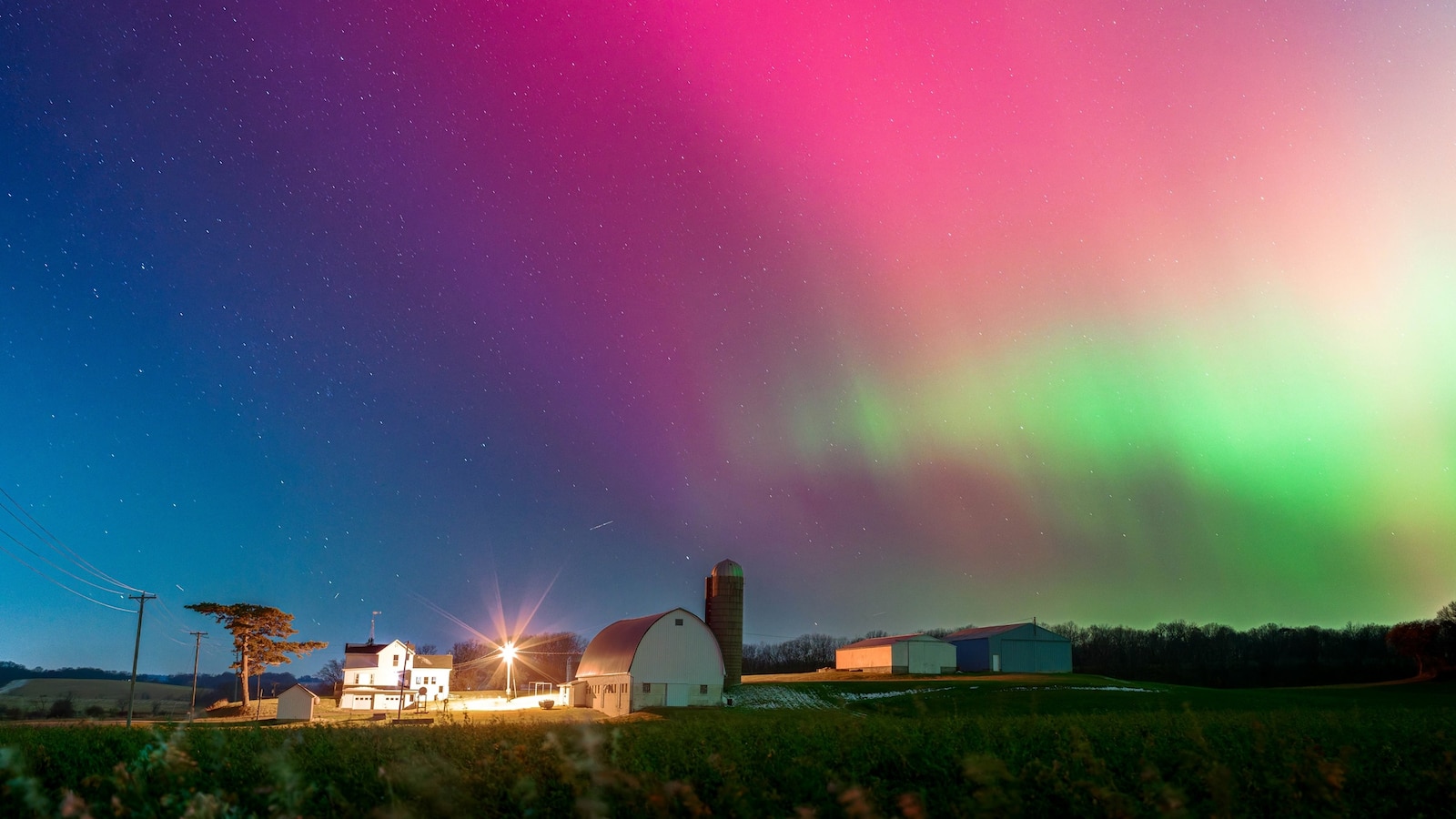
It's been a busy week for the sun, and aurora watchers in some northern and upper Midwest states looking for a glimpse of the famed colorful sky could benefit from enhanced solar activity Thursday night into Friday morning, Oct. 9.
uncertain
watchers → look → morning
On Tuesday, a coronal mass ejection (CME), a massive burst of charged particles embedded in a magnetic field, departed the sun bound for Earth.
asserted
ejection → charge → Earth
The ejection is associated with a moderate solar flare.
asserted
ejection → associate → flare
The National Oceanic and Atmospheric Administration's Space Weather Prediction Center (SWPC) has issued a moderate Geomagnetic Storm Watch beginning Thursday evening into Friday, as a result of the CME.
asserted
Oceanic → issue → CME
According to NOAA, a geomagnetic storm is "a major disturbance of Earth's magnetosphere that occurs when there is a very efficient exchange of energy from the solar wind into the space environment surrounding Earth."
uncertain
that → accord → Earth
While the agency says much of the activity will be minor, there could be periods of moderate storm activity.
uncertain
much → say → activity
The UK Met Office says there's even a slight chance of strong G3 levels.
asserted
Office → say → levels
The SWPC says the solar activity could create minor impacts to our technological infrastructure, but it's "mainly manageable."
On the bright side, the aurora borealis, which appears in the night sky when electrically charged particles from the sun hit Earth's atmosphere, could be visible in areas that don't normally experience it.
uncertain
that → say → it
"Aurora may be seen as low as New York to Wisconsin to Washington state," SWPC said in its alert.
uncertain
SWPC → see → alert
Another CME linked to a smaller solar flare is also headed toward Earth but is only expected to deliver a "glancing blow" over the weekend, according to the UK Met Office.
uncertain
CME → link → Office
All this solar weather will keep conditions unsettled to active over the next few days.
asserted
conditions → keep → days
But whether you'll be able to see the auroras depends on exactly when the CME arrives, the cloud cover and the magnetic orientation of the CME's magnetic field.
asserted
CME → see → field
When geomagnetic activity becomes stronger, the aurora can sometimes be seen farther south than usual.
asserted
aurora → become → ?
 The Aporia