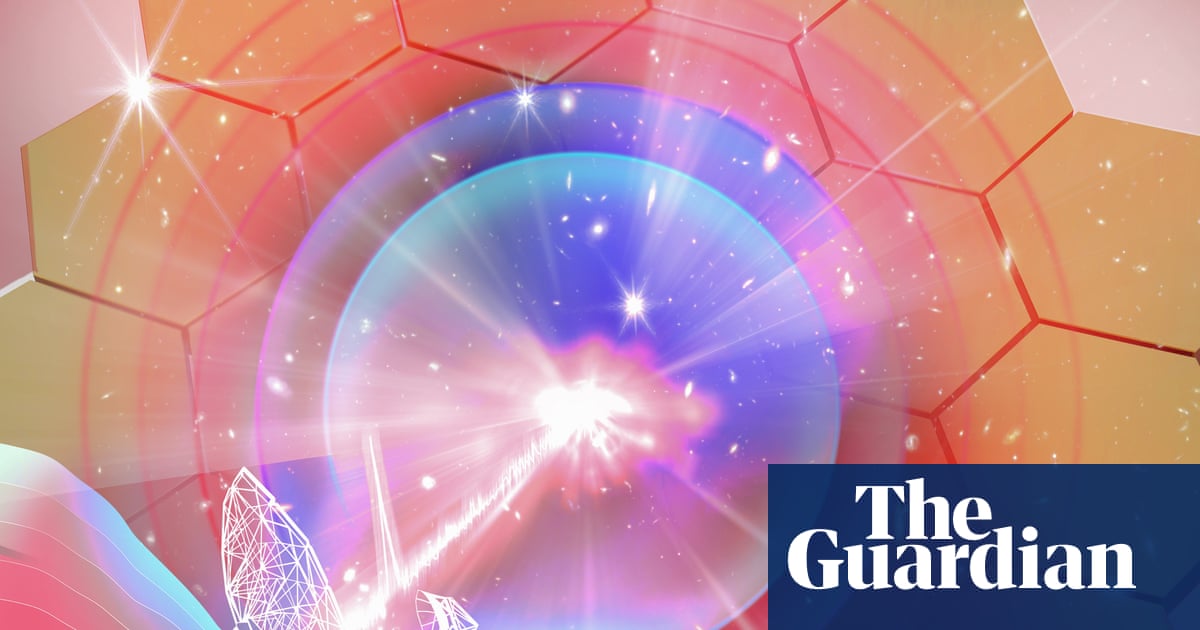
Astronomers have detected a fast radio burst (FRB) from a galaxy over 10 billion light-years away, making it the most distant FRB ever recorded. The burst, named FRB 20240304B, was observed using South Africa’s MeerKAT radio telescope and identified with NASA’s James Webb Space Telescope (JWST). This discovery provides insights into the early universe when it was just 3 billion years old. Scientists are exploring theories that these bursts could originate from magnetars or other energetic sources in young galaxies lacking heavy elements.
Written locally by qwen2.5:14b on 2026-10-08,
using this article's own text rather than the other coverage of the
same event (that is the story summary below).
Story summary
Astronomers have detected a mysterious burst of radio waves from a distant galaxy, which they believe is the most distant fast radio burst (FRB) ever recorded. The burst, named FRB 20240304B, traveled for over 10 billion years before reaching Earth and originated when the universe was only about 3 billion years old, making it a witness to approximately 80% of cosmic history. Scientists used the MeerKAT radio telescope in South Africa and NASA’s James Webb Space Telescope (JWST) to identify that this FRB came from a "young, very small galaxy" with high star formation rates but low metal content. Theories about the source include magnetars—neutron stars with extremely powerful magnetic fields. This discovery offers new insights into the early universe and continues to puzzle scientists regarding its origin.
Written for “Mysterious Galactic Energy BurstDetec…” on 2026-10-08,
grounded in this article and the 0 other(s) covering the same event.
A long time ago in a galaxy far, far away, a mysterious flash of energy was released into the universe.
asserted
flash → release → universe
Astronomers have now detected that flash, a burst of radio waves which travelled for more than 10bn years before reaching Earth – what they believe to be the most distant fast radio burst (FRB) ever recorded.
asserted
they → detect → Earth
FRBs are intense bursts of radio waves that can emit as much energy in milliseconds as the sun does in months or years.
asserted
sun → emit → months
These mysterious pulses were first discovered in 2007 and have puzzled scientists ever since, with speculation from some that they could have an alien origin.
uncertain
they → discover → origin
In a new study published in Science, researchers have detected an FRB that originated when the universe was only about 3bn years old, meaning it has travelled through “approximately 80% of cosmic history”.
asserted
it → publish → history
The burst, dubbed FRB 20240304B, is believed to be the farthest yet detected, more than double the previous distance record.
asserted
burst → dub → ?
The scientists detected the burst using the MeerKAT radio telescope in South Africa, and subsequently identified its host galaxy using Nasa’s James Webb space telescope (JWST).
asserted
scientists → detect → telescope
Dr Themiya Nanayakkara of the University of Sydney, one of the lead researchers on the paper, said when the burst was produced, “there was no Earth, there was no sun”.
asserted
burst → say → paper
Data from the JWST indicated that the burst originated from a “young, very small galaxy which is forming stars at a very high speed, with not many metals around it”.
There are several theories as to what the source of FRBs is, including that they originate from magnetars, neutron stars with a very powerful magnetic field.
“Whatever the mechanism that causes this radio burst has to account for that fact that it can be produced in … very young galaxies with very low amount of metals”, Nanayakkara said.
asserted
Nanayakkara → indicate → metals
More than 10,000 FRBs have been detected since 2007.
asserted
FRBs → detect → 2007
Some repeat continuously, Nanayakkara said, while “some of them repeat for a while and then stop … and then there are some FRBs that only go once and we never see again”.
asserted
we → repeat → while
Whether the new distant burst is a one-off flash or will yield recurrent signals remains to be seen.
But “the fun thing about FRBs is that we don’t need to know what is causing them to do some of the science we are doing now,” Nanayakkara said.
asserted
Nanayakkara → yield → science
This particular burst “has been travelling for 80% of the age of the universe”, he said, adding that further detections of distant FRBs would enable scientists to map unseen matter in the distant universe.
asserted
detections → travel → universe
Prof Matthew Bailes of Swinburne University, one of the astrophysicists who first discovered FRBs, described the new paper as “a validation of how powerful the FRBs are for probing the universe”.
asserted
FRBs → discover → universe
Bailes described them as “a very fundamental way of counting how many atoms there are in the universe”.
asserted
Bailes → describe → universe
FRBs are affected by the particles they travel through, enabling scientists to quantify matter that cannot be seen through optical telescopes.
asserted
that → affect → telescopes
Dr Sara Webb, an astrophysicist also at Swinburne University who was not involved in the research, said: “You can use them essentially as a line-of-sight count for how much matter they had to go through [to get to Earth].”
asserted
they → involve → Earth
The discovery suggests that “FRBs might have been very common in the early universe”, she added.
uncertain
she → suggest → universe
 The Aporia