That is 0 articles you have read today.
The Aporia is free and carries no advertising, so readers are the only
thing paying for it. If you are getting this much out of it, a small
donation is what keeps it independent.
Daily limit reached
You have read 0 articles today.
That is more than the 15 a day The Aporia gives away,
and well past what it can carry on nothing. Your allowance resets at
midnight.
There is no advertising here and nothing about you is sold, so readers
are the only thing paying for it. If the site is worth this much of
your day, it is worth a few dollars.
Everything else stays open: the
maps, the
directory and
search do
not count against this, and neither does re-opening something you have
already read today.
South Korea conducted a successful test flight of its first domestically developed hypersonic weapon on October 8, 2026. The weapon is designed to travel at least five times the speed of sound and can evade missile defense systems. South Korean President Lee Jae Myung attended the event and emphasized the importance of strengthening national defense capabilities independently from foreign assistance. While no immediate response was given by North Korea, tensions remain high following recent provocative actions from both sides.
Written locally by qwen2.5:14b on 2026-10-08,
using this article's own text rather than the other coverage of the
same event (that is the story summary below).
Story summary
On Thursday, South Korea conducted its first test flight of a domestically produced hypersonic weapon capable of flying at least five times the speed of sound. The weapon successfully maneuvered both vertically and horizontally before striking its target, demonstrating advanced evasion capabilities against missile defense systems. President Lee Jae Myung attended the event and hailed it as a significant advancement in strengthening South Korea’s conventional defense capabilities. There was no immediate response from North Korea, which had recently tested its own hypersonic missile near Japan's waters. President Lee emphasized that securing national security through self-reliance is crucial for South Korea, highlighting a shift towards reducing dependence on the United States.
Written for “South Korea Hypersonic Weapon Test” on 2026-10-08,
grounded in this article and the 2 other(s) covering the same event.
South Korea test-flies its first domestically developed hypersonic weapon
By
asserted
Korea → fly → weapon
South Korea flight-tested on Thursday its first domestically developed hypersonic weapon, designed to fly at least five times the speed of sound and evade missile defense systems, bringing Seoul closer to what it says could be game-changing weapons capabilities.
uncertain
it → test → Seoul
There was no immediate response from North Korea, which last week tested its own hypersonic missile that landed in the waters near Japan.
asserted
that → be → Japan
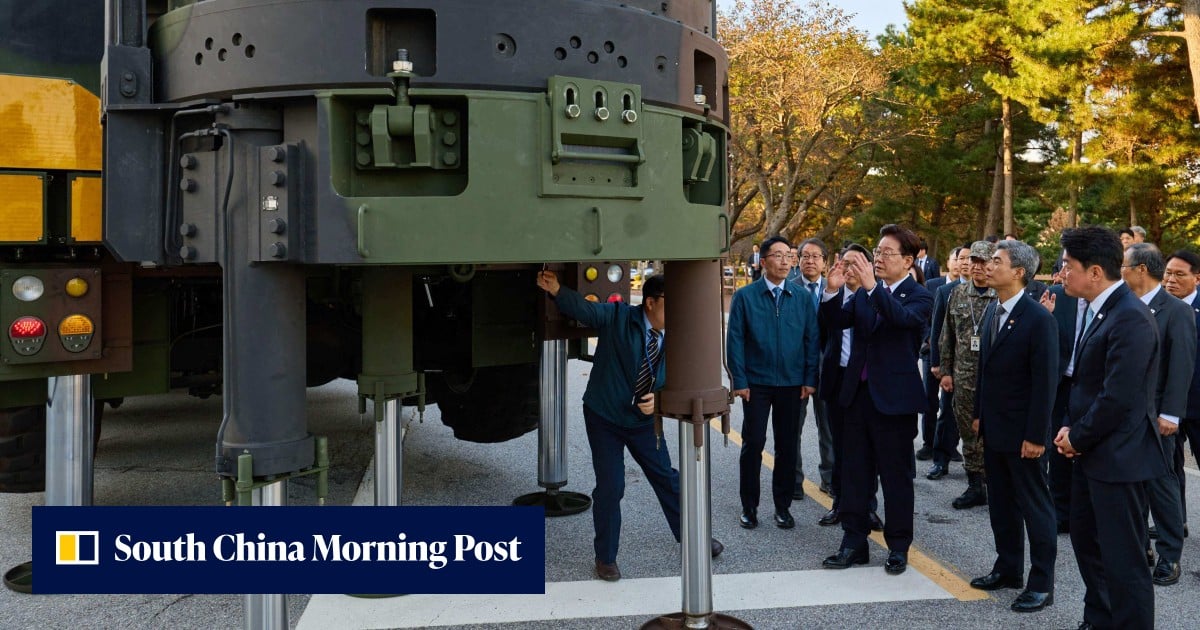
South Korean President Lee Jae Myung attended the test, saying it’s a major step in strengthening the country’s conventional defense capabilities, according to a statement.
uncertain
it → attend → statement
It did not elaborate where the test took place.
asserted
test → elaborate → place
The statement said the weapon separated from its booster rocket at the planned altitude, then descended and maneuvered both vertically and horizontally before hitting a test target.
asserted
weapon → say → target
It said once developed, the weapon would be able to strike key targets by surprise in the “Korean Peninsula theater of operations.”
asserted
weapon → say → operations
Lee stressed that South Korea “must secure our security through our own strength,” and also inspected the country’s most powerful Hyunmoo-5 ballistic missile on Thursday, his office said.
asserted
office → stress → Thursday
It did not mention any direct comments by Lee on the North.
asserted
It → mention → North
Tensions between the Koreas have increased in recent weeks after three South Korean soldiers were injured in land mine explosions last month near the heavily armed inter-Korean border.
asserted
soldiers → increase → border
The South’s military and the U.S.-led United Nations Command concluded the blasts were caused by devices planted by North Korea, which has denied responsibility and ridiculed the South’s demands for an apology.
asserted
which → conclude → apology
North Korea has also stepped up weapons testing activity as its leader Kim Jong Un expands his military nuclear program while taking an increasingly hard line toward Seoul.
asserted
leader → step → Seoul
Kim has so far rebuffed U.S. President Donald Trump’s calls to revive their diplomacy that broke down in 2019, with his government demanding that Washington abandon its “hostile” policy toward Pyongyang and drop demands for its denuclearization as a precondition for talks.
asserted
Washington → rebuff → talks
The tensions have been a setback for Lee, who favors engagement with North Korea and has tempered his rhetoric toward the North even as public anger grows over the mine blasts.
asserted
anger → favor → blasts
Start your day with all you need to know
Morning Report delivers the latest news, videos, photos and more.
asserted
Report → start → news
Lee has also called for strengthening South Korea’s conventional defense capabilities while reducing its reliance on the United States, which unilaterally decided to scale back a major military exercise with the South in August, with Trump citing his “very good relationship” with Kim.
asserted
Trump → call → Kim
In its latest weapons test on Oct. 3, North Korea launched what it described as a hypersonic intermediate-range missile that it said flew more than 1,000 kilometers (621 miles).
asserted
it → launch → kilometers
Japan said the missile landed in waters outside of its exclusive economic zone.
asserted
missile → say → zone
South Korea said it detected the missile flying more than 700 kilometers (435 miles), while Japan’s Defense Ministry said it assessed that the missile flew about 680 kilometers (422 miles).
asserted
missile → say → kilometers
Kim Yo Jong, the powerful sister of the North Korean leader, claimed the differing flight estimates by the two U.S. allies showed they are incapable of properly tracking such a missile during its flight and would therefore not be able to intercept it.
asserted
they → claim → it
 The Aporia