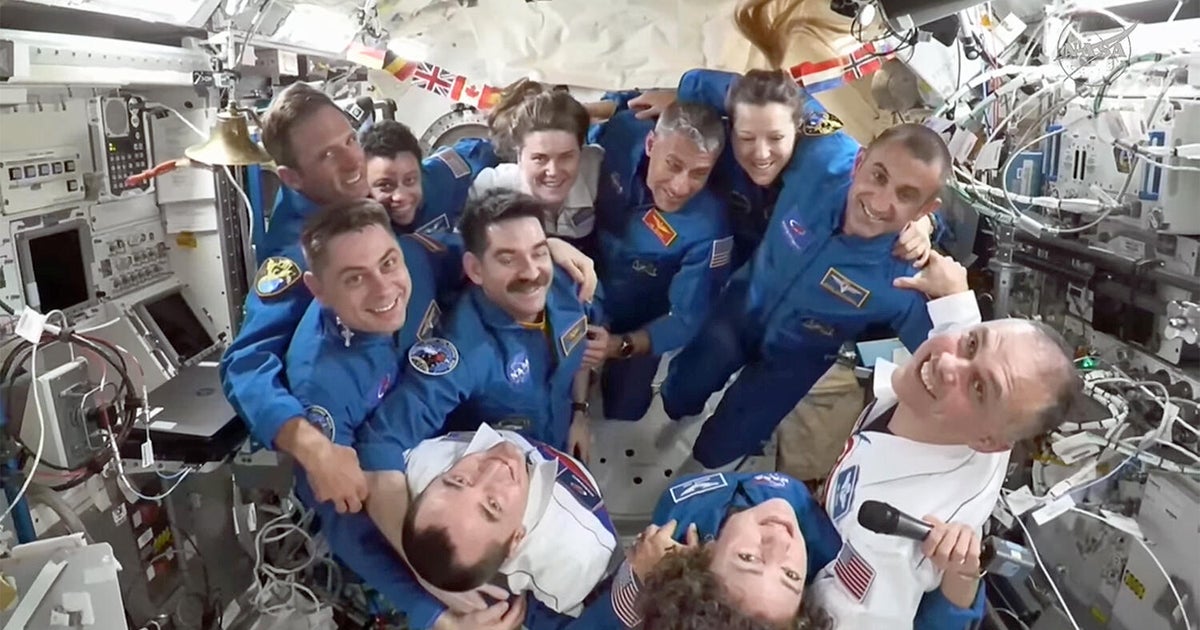
NASA’s Crew-12 astronauts are set to return to Earth after 237 days aboard the International Space Station, with splashdown expected off the coast of California on Thursday morning US time (Friday local Australian time). The four-person crew—Jessica Meir, Jack Hathaway, Sophie Adenot, and Andrey Fedyaev—launched on February 13 for orbital research. Their SpaceX Dragon capsule undocked from the ISS on Wednesday evening, beginning their descent back to Earth. NASA will provide live coverage starting at 10:20 AM EDT (12:20 AM AEST), with splashdown anticipated around 11:34 AM EDT (1:34 AM AEST).
Written locally by qwen2.5:14b on 2026-10-08,
using this article's own text rather than the other coverage of the
same event (that is the story summary below).
NASA's Crew-12 astronauts are set to parachute back to Earth in a SpaceX capsule after 237 days of orbital research and lab maintenance on the International Space Station.
asserted
astronauts → set → Station
The four crew members launched into space on February 13 to oversee scientific investigations to help prepare humans for future Moon and Mars exploration, the US space agency said.
asserted
agency → launch → exploration
Preparations for their return have been underway for several weeks, and the astronauts' SpaceX Dragon capsule undocked from the ISS on Wednesday evening, Australian time.
asserted
capsule → undock → evening
Here is what to know about their expected splashdown voyage.
asserted
know → know → voyage
When will NASA SpaceX Crew-12 return to Earth?
asserted
NASA → return → Earth
The astronauts have already started their 27-hour voyage home and are currently in orbital transit.
asserted
astronauts → start → transit
NASA said the quartet's return began with the closure of the Dragon capsule's hatch at 6:05am US Eastern time (8:05pm AEST) on Wednesday, followed by a final undocking from the ISS at 8:05am (10:05pm AEST).
asserted
return → say → 8:05am
The timeline of their expected descent and splashdown into the Pacific Ocean off the coast of California is:
- 10:20am EDT Thursday (12:20am AEST Friday): NASA begins voyage live coverage;
- 10:46am EDT Thursday (12:46am AEST Friday): SpaceX Dragon capsule begins deorbit burn and controlled descent;
- 11:34am EDT Thursday (1:34am AEST Friday): Splashdown, followed by a NASA and SpaceX crew retrieval.
The US space agency said the crew have spent weeks packing items to return with them to Earth, including personal belongings, cargo and scientific samples.
asserted
crew → expect → belongings
During their descent to Earth, the astronauts will need to drink fluids from bags containing salt tablets to maintain hydration and help their bodies adjust to a return to gravity, NASA said.
asserted
NASA → need → gravity
The astronaut crew consists of NASA's Jessica Meir and Jack Hathaway, serving as the mission's commander and pilot respectively, as well as French engineer and specialist helicopter pilot Sophie Adenot and Russian military pilot and cosmonaut Andrey Fedyaev.
asserted
crew → consist → commander
This latest mission was Commander Meir's second in space since being selected as a NASA astronaut in 2013.
asserted
mission → select → 2013
During her first voyage, she spent 205 days in orbit as a flight engineer and took part in NASA's first three all-woman spacewalks outside the ISS.
asserted
she → spend → ISS
US Navy Commander Hathaway became a NASA astronaut in 2021 and this year's mission was his first in space.
asserted
mission → become → space
Beforehand, he was deployed aboard the USS Harry S Truman aircraft carrier and accumulated more than 2,500 flight hours in 30 different aircraft, including 39 combat missions.
asserted
he → deploy → missions
This mission was also the first for French Air Force Colonel Adenot, who previously worked as an Airbus helicopter cockpit design engineer, search and rescue pilot and formation flight leader.
asserted
who → work → engineer
Roscosmos cosmonaut and Air Force Major Fedyaev was previously deployed to the ISS for 186 days in 2023 as a mission specialist for NASA's SpaceX Crew-6.
asserted
Fedyaev → deploy → Crew-6
Before that, he was a military pilot engineer and served in the Russian Ilyushin-38 aircraft unit in the Kamchatka Region.
asserted
he → serve → Region
The 12th SpaceX rotation voyage to the ISS was aimed at research and technology advancements "for future Moon and Mars missions and [to] benefit humanity back on Earth", NASA said.
asserted
NASA → aim → Earth
The astronauts' research included:
- Studies of pneumonia-causing bacteria to improve potential treatments;
- On-demand intravenous fluid generation for future missions;
- The monitoring of plant health and enhanced microbe food production in space, and;
- Examinations of how a person's physical characteristics could affect blood flow during spaceflight.
uncertain
characteristics → include → spaceflight
Support teams aboard the ISS also helped Crew-12 prepare a SpaceX Falcon 9 rocket booster for a second flight.
asserted
teams → help → flight
Who replaced Crew-12 in space?
asserted
Who → replace → space
The four astronauts taking the place of Crew-12 aboard the ISS arrived in space on October 1 after an eight-hour express rocket launch into orbit that set a US speed record.
asserted
that → take → record
She will be joined by NASA’s Luke Delaney, who is a retired Marine; Canada’s Joshua Kutryk, a colonel in the Royal Canadian Air Force; and Russia’s Sergey Teteryatnikov, a former submariner.
asserted
who → join → Force
Colonel Kutryk will become the fourth man to become a father while orbiting Earth, with his wife Heather due to give birth to their third child in late November.
asserted
wife → become → November
Their stay on the ISS will last six months, but the four astronauts have already begun their work.
asserted
astronauts → last → work
NASA said in their first days in space, Commander Watkins collected and analysed her own blood samples for a risk assessment study of space-caused blood clots, while Major Delaney logged his sleep patterns to monitor his health data.
asserted
Delaney → say → data
Colonel Kutryk had his veins scanned by a device used on the ISS to monitor cardiovascular health, and cosmonaut Teteryatnikov wore an acoustic sensor around his neck to record his breathing for a respiratory study.
asserted
Teteryatnikov → have → study
First launched in November 1988, the ISS became a continuous, inhabitable space base for humanity in the year 2000.
asserted
ISS → launch → year
NASA describes it as "the most enduring platform for international cooperation in orbit", and the temporary home of flight crews from various nations, inter-orbital missions, launch vehicles, training and engineering facilities and communications networks.
asserted
NASA → describe → nations
Its primary use is for research on living and working in space, with the ultimate goal of allowing humans to be sent further into space than ever before.
asserted
humans → live → space
The ISS orbits Earth at a speed of about 28,163km/h, meaning it laps the planet roughly every 90 minutes.
asserted
it → orbit → planet
The main ground control centres that oversee operations aboard the ISS are located in the US and Russia, however there are also additional support centres in Canada, Japan and Europe.
asserted
that → oversee → Canada
While the expected life span of the ISS has been extended multiple times, the entire base exists as separate, connected modules — meaning when one part wears out or becomes unusable, it can be replaced.
asserted
it → expect → modules
NASA says the station should be able to remain a working laboratory until at least 2030.
asserted
station → say → 2030
 The Aporia