The U.S. Democratic Party's left wing is seeking significant influence ahead of November’s midterm elections, following victories in primary contests that mirror the impact of the Tea Party on Republicans post-2008. Key insurgent candidates include democratic socialists Angie Nixon and others who focus on economic inequality and corporate power. Election forecasters predict a 76% chance for Democrats to regain control of the House of Representatives and a more competitive race for the Senate. Activist groups like Our Revolution highlight priorities such as combating oligarchy and supporting universal health care, positioning themselves for greater influence within the party.
Written locally by qwen2.5:14b on 2026-10-08,
using this article's own text rather than the other coverage of the
same event (that is the story summary below).
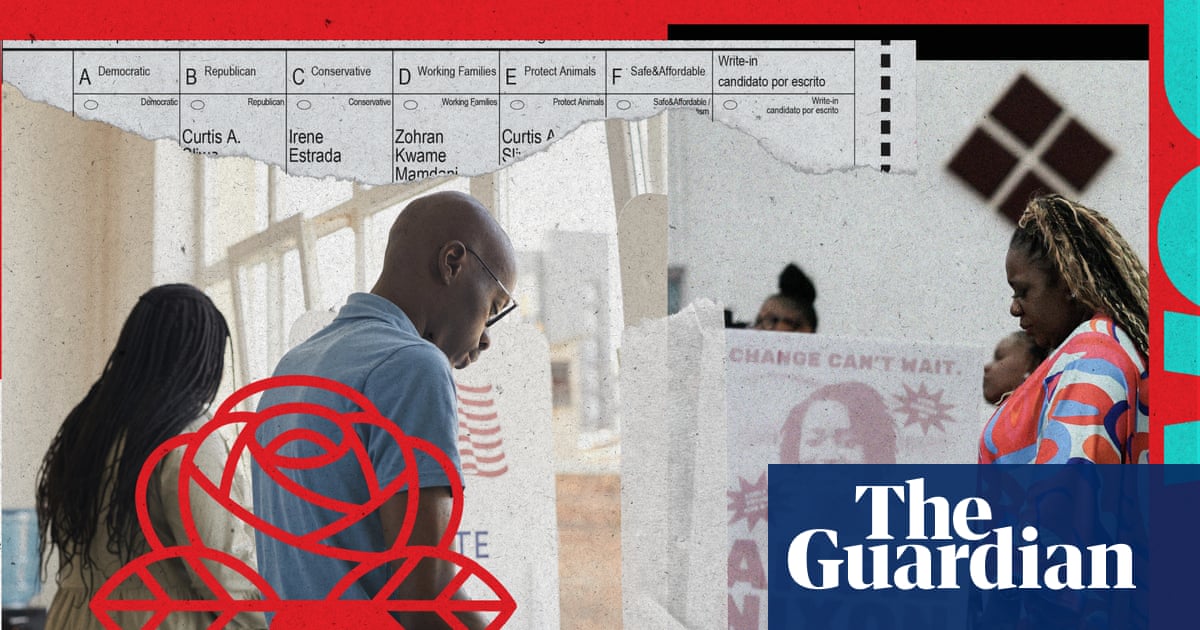
A resurgent American left is heading into November’s midterm elections hoping not merely to help Democrats recapture Congress, but to reshape the party that takes power.
asserted
that → head → power
A string of wins in primaries — the contests in which parties choose their candidates — has drawn comparisons with the conservative Tea Party movement that emerged after Barack Obama’s 2008 election and pushed Republicans sharply rightward, paving the way for Donald Trump.
asserted
that → choose → Trump
The analogy is imperfect, as today’s insurgents — ranging from democratic socialists to more conventional left-wing liberals — do not march under a single banner.
asserted
insurgents → range → banner
Their numbers remain far smaller than the dozens of Tea Party-aligned Republicans swept into Congress in 2010.
But the insurgents are united by an impatience with party leaders, a focus on economic inequality and corporate power, and a belief that defeating Trump should be the beginning rather than the end of their ambitions.
asserted
defeating → remain → ambitions
Election forecaster Decision Desk HQ gives Democrats a 76 per cent chance of taking the House of Representatives and a slimmer advantage in the Senate.
asserted
HQ → give → Senate
In Senate primaries, leftists defeated establishment-backed rivals in Michigan and Minnesota and democratic socialist Angie Nixon stunned a heavily favoured opponent in Florida.
asserted
Nixon → defeat → Florida
Five House candidates backed by the Democratic Socialists of America (DSA) have won nominations in staunchly left-leaning districts, putting the group on course to grow from two members to seven.
Our Revolution, the organization that grew out of leftist icon Bernie Sanders’s presidential campaigns, says as many as 22 new allies could enter the House and six the Senate, though many face competitive races.
And seven sitting Democrats are set to lose their House seats after defeats in primaries, matching the highest total this century, with at least four falling to challengers from their left.
uncertain
four → back → left
Our Revolution executive director Joseph Geevarghese argues that left-wing activists are supplying much of the energy behind a prospective Democratic victory — and will expect influence in return.
asserted
activists → argue → return
“We are not junior partners anymore,” he said in a statement.
asserted
he → say → statement
“If our movement delivers the majority, leadership is going to have to earn our votes.”
asserted
leadership → deliver → votes
A September survey of 1,500 Our Revolution members illustrates the mood of that activist base, although it is not representative of the wider electorate.
asserted
it → illustrate → electorate
Ninety-two per cent said confronting “oligarchy” and corruption should be a priority for a Democratic Congress, while 85 per cent backed universal government-run health insurance.
asserted
cent → say → insurance
A larger left-wing bloc could give Democratic leaders reliable votes against Trump — or use its numbers to demand greater influence over legislation, committee assignments and the party’s leadership itself.
uncertain
bloc → give → legislation
That leverage would be greatest in a narrowly divided House, where the speaker is elected by the full chamber and a handful of holdouts can extract concessions.
asserted
handful → divide → concessions
House Democratic leader Hakeem Jeffries, in line to become speaker, has said he does not support the DSA’s agenda but that its primary winners would be part of a broad Democratic caucus.
asserted
winners → become → caucus
Our Revolution has criticized him over his stance on universal health care and his ties to tech, crypto and pro-Israel donors, warning that activists will not simply “rubber stamp the old order.”
asserted
activists → criticize → order
Florida Democratic congressman Jared Moskowitz voiced the establishment’s unease.
asserted
Moskowitz → voice → unease
“They could turn out to be our Freedom Caucus,” he told National Review, referring to the right-wing faction that has repeatedly tormented Republican House leaders.
uncertain
that → turn → leaders
In the Senate, Democratic leader Chuck Schumer has watched preferred candidates lose primaries to challengers from his left.
asserted
candidates → watch → left
At least four of the party’s Senate nominees have said they will not back him for leader, although no rival has launched a bid to replace him.
asserted
rival → say → him
The Tea Party’s breakthrough year saw several of its nominees lose Senate races Republicans had expected to win, and a poor November showing by high-profile left-wing candidates would strengthen moderates who argue that ideological ambition costs the party winnable seats.
asserted
ambition → see → seats
“Our party has a socialism problem,” centrist Pennsylvania senator John Fetterman — an outspoken opponent of leftist fellow Democrats, particularly those who criticize Israel — told a talk radio show in August.
asserted
who → have → August
“I’ll be the one Democrat that calls it for what it is,” he added, “and not use the euphemism that it’s a big-tent situation.”
asserted
it → call → euphemism
 The Aporia