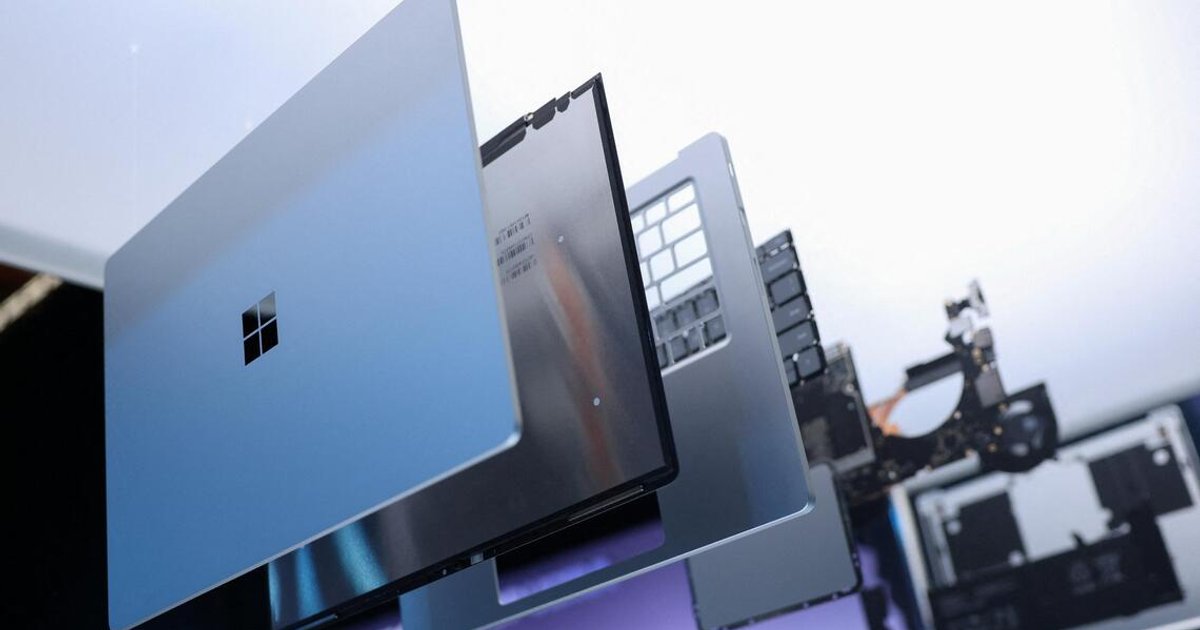
Microsoft announced the Surface Ultra laptop priced at over $2,500, featuring Nvidia's RTX Spark AI chip to support hybrid intelligence computing both locally and in the cloud. The launch is part of a strategy to integrate advanced AI capabilities directly into devices, competing with Apple’s recent desktop computer releases. CEO Satya Nadella emphasized Microsoft’s vision for pervasive hybrid intelligence across all computing devices, aligning closely with Nvidia’s goals for expanding its reach beyond data centers into personal computing.
Written locally by qwen2.5:14b on 2026-10-08,
using this article's own text rather than the other coverage of the
same event (that is the story summary below).
Story summary
On October 7, Microsoft unveiled its new Surface Ultra laptop at an event in San Francisco. The device is designed for developers and creators and features Nvidia artificial intelligence (AI) chips. Priced over US$2,500, the Surface Ultra represents a move towards hybrid intelligence computing, where AI tasks can be processed both locally on the device and via Microsoft’s cloud services. This approach aims to reduce reliance solely on remote cloud data centers, which are slower and more expensive for running AI applications. Nvidia's involvement marks its entry into personal computing, traditionally dominated by Intel and Qualcomm processors. Both Satya Nadella, CEO of Microsoft, and Jensen Huang, CEO of Nvidia, emphasized the future importance of integrating AI across all devices and computing tasks.
Written for “Microsoft AI Laptop Launch” on 2026-10-08,
grounded in this article and the 0 other(s) covering the same event.
Why this leaning score
This article does not take a side on a contested political
question, so it has no leaning score. That is an
answer rather than a gap: a match report or a rescue can be warmly
or critically written without being left or right, and scoring it
anyway is how approval of a subject gets recorded as a political
position.
No political leaning scored for article 64396 · logged 2026-10-08
Microsoft pushes AI vision with new, expensive Surface laptop
AI generated
asserted
Microsoft → push → laptop
Microsoft is pushing a “hybrid intelligence” future with a new Surface Ultra laptop that runs on Nvidia artificial intelligence (AI) chips and will cost more than US$2,500 (S$3,200), the company announced Oct 7.
asserted
company → push → 2,500
The launch is part of a broader push by tech companies to release hardware that can handle more AI computing on-device and offline, so users do not have to rely solely on remote cloud data centres, where running AI is slower and more expensive.
asserted
running → release → AI
It also sees Nvidia, whose data centre processors power the AI revolution, make a move into personal computing, a sector dominated for decades by chips from Intel and Qualcomm.
asserted
processors → see → Intel
There will never be a moment where we will go and look and say: ‘Oh, this runs locally, this runs in the cloud.’
asserted
this → go → cloud
You will expect this hybrid intelligence to be everywhere and pervasive,” CEO Satya Nadella said during an event in San Francisco.
asserted
Nadella → expect → Francisco
He was joined onstage by Nvidia CEO Jensen Huang, who echoed the idea that AI will be integrated into all computing going forward and on all devices.
asserted
AI → join → devices
Agentic AI, in particular, will be central to software development, Huang said, referring to systems programmed to be autonomous and perform tasks without supervision.
asserted
Huang → say → supervision
With all the changes from AI, “the computer has to be revolutionised,” Huang said.
asserted
Huang → have → AI
The partnership between the two US-based tech titans helps them compete with Apple, Intel and AMD in the personal computing market.
asserted
them → base → market
Apple unveiled two desktop computers in September, the Mac mini and Mac Studio, which it touted as powerful new options capable of processing AI software locally.
asserted
it → unveil → software
Microsoft has been working on building “AI PCs” since at least 2024, when its laptops were powered by Qualcomm chips.
asserted
laptops → work → chips
The new Surface Ultra will use Nvidia’s state-of-the-art AI chip, RTX Spark, which the semiconductor giant announced earlier in 2026.
asserted
giant → use → 2026
It will cost US$2,599 and begins shipping on Oct 16.
asserted
It → cost → Oct
Some AI computing power and data will be processed locally, or on the device, while other applications are still handled remotely via Microsoft’s cloud computing services.
“We built it for developers and creators pushing the limits of performance,” Microsoft Executive Vice President of Windows and Device Pavan Davuluri said on Oct 7.
asserted
Davuluri → compute → Oct
The news comes just a couple of weeks after Microsoft announced it would integrate Word, Excel and Powerpoint into its AI-powered assistant Copilot, in an effort to make AI the entry point for its famous suite of productivity software.
asserted
AI → come → software
OpenAI, the company behind ChatGPT, and Claude-maker Anthropic each launched their own document creation tools in recent months.
asserted
OpenAI → launch → months
The two San Francisco-based AI labs are also key suppliers for Microsoft, since Copilot runs primarily on their models.
asserted
Copilot → base → models
Microsoft’s in-house models currently only power a few products, such as GitHub’s Copilot coding tool.
asserted
models → power → tool
In June, Microsoft also unveiled its own cutting-edge artificial intelligence models – a crucial step toward reducing its dependence on OpenAI, the creator of ChatGPT.
asserted
Microsoft → unveil → ChatGPT
Microsoft, the first company to have invested massively in OpenAI, has for several years been seeking to reduce its reliance on its Sam Altman-led partner.
asserted
Microsoft → invest → partner
It renegotiated their alliance in 2025 and retains only a non-exclusive license on its technology until 2032 though is OpenAI’s biggest shareholder.
asserted
It → renegotiate → 2032
 The Aporia