The Sydney Morning Herald
· collected 2026-10-08 · by Kenneth Chang, Siobhan Roberts
OpenAI announced it has solved 377 complex math equations across various fields, including algebra and number theory, using advanced AI models. These findings follow OpenAI’s earlier success in tackling the Navier-Stokes equation, one of the Clay Mathematics Institute's Millennium Prize Problems. The company is working with an independent advisory board to establish guidelines for releasing such results to mathematicians while ensuring transparency about how the AI arrives at its solutions; however, OpenAI has not agreed to halt testing their models on advanced mathematical problems as recommended by the board.
Written locally by qwen2.5:14b on 2026-10-08,
using this article's own text rather than the other coverage of the
same event (that is the story summary below).
Mathematicians have been stunned by the accelerating capabilities of artificial intelligence, which in recent months have unravelled some of the toughest open maths problems that had eluded humans.
asserted
that → stun → humans
On Tuesday, OpenAI deluged mathematicians with hundreds of new findings that span a wide swath of topics including algebra, number theory, theoretical computer science, mathematical logic and topology.
asserted
that → deluge → algebra
The 377 results follow OpenAI’s announcement last month that it had succeeded in cracking the Navier-Stokes equation – one of the Clay Mathematics Institute’s seven Millennium Prize Problems, which were considered so challenging that a $US1 million ($1.4 million) reward was offered for each solution.
asserted
reward → follow → solution
The achievement showcased what the most advanced artificial intelligence models are capable of but it also raised questions over whether OpenAI’s artificial intelligence systems were employing creative thinking or simply completing the final steps of a proof after borrowing ideas from human mathematicians’ work.
Like the Navier-Stokes result, the new mathematical solutions used a more advanced AI model that has not been released publicly.
asserted
that → showcase → model
A couple of weeks ago OpenAI said that it is working with an advisory board of mathematicians that would offer advice on how artificial intelligence companies should communicate AI-produced results to the mathematicians.
asserted
companies → say → mathematicians
The group is hosted by the Institute for Advanced Study in Princeton, New Jersey, and is independent of any AI company.
asserted
group → host → company
Among other suggestions, the advisory board said that all the prompts to the AI agents, and the agents’ chains of thought, should be released.
asserted
prompts → say → thought
On Tuesday night the advisory board released a statement that called the public release “the beginning, not the completion, of the process of human understanding and the incorporation of the work into mathematical knowledge”.
asserted
that → release → knowledge
“We want to create standards and practices so that results released from AI labs can be understood by mathematicians and can advance the field,” said Melanie Wood, a mathematician at Harvard University who is a member of the advisory board.
asserted
who → want → board
Many of the proofs had been checked using Lean, a computer language that verifies that underlying logic.
asserted
that → check → logic
For 10 of the solutions the company also provided summaries of how the AI model came up with its solution.
asserted
model → provide → solution
The average result took about three hours of computing, the company said.
asserted
company → take → computing
“We have drawn on their advice and public recommendations to inform how we release these results,” OpenAI wrote in a posting on its website.
asserted
OpenAI → draw → website
OpenAI, however, seems to be less interested in a key recommendation of the advisory board that the AI companies should stop testing their proprietary models on advanced mathematical problems.
asserted
companies → seem → problems
“We want to state clearly from the start: we do not endorse this practice,” the advisory board wrote on September 29.
asserted
board → want → September
The AI companies have given their models maths problems – like those put to high school students during the International Mathematical Olympiad – that had been set up as benchmarks of performance.
asserted
that → give → performance
But when the models were able to figure those out, the OpenAI team created new benchmarks of unsolved maths problems at the cutting edge of mathematical research, and those are among what was released Tuesday.
asserted
what → figure → research
‘I don’t think they’ve done their sort of due diligence at all.
asserted
they → think → diligence
’Tristan Buckmaster, New York University mathematician
Dan Roberts, the research lead at OpenAI, said it was important to test the internal models to produce better tools, and the proofs were a byproduct of that testing.
asserted
proofs → say → testing
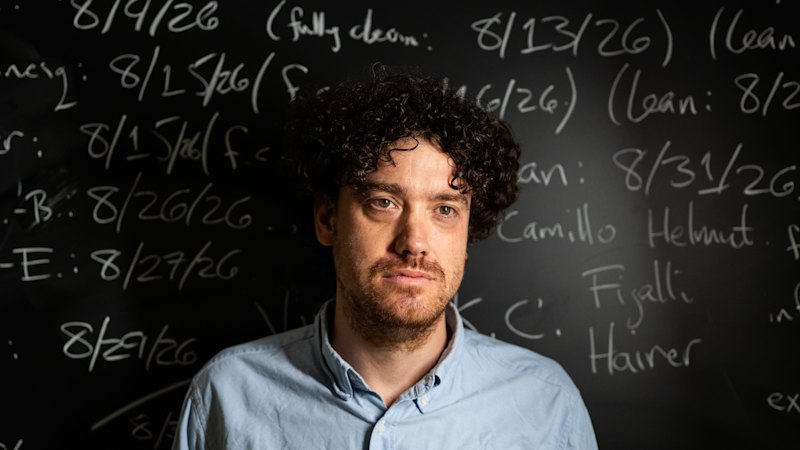
Tristan Buckmaster, a mathematician at New York University who was working on the Navier-Stokes problem that OpenAI solved, said it remained unclear whether mathematicians using AI models like the ones from OpenAI were inadvertently providing the information that allowed AI to beat them to the final answer.
uncertain
AI → work → answer
“There’s likely to be a bunch of results where they take someone’s work and then take it to completion,” Buckmaster said in an interview on Monday evening.
asserted
Buckmaster → ’ → evening
With so many results released at once, “I don’t think they’ve done their sort of due diligence at all,” he said.
asserted
he → release → diligence
Mathematicians are struggling with whether the accelerated pace of solving maths problems helps or hurts their field if understanding the solutions lags behind.
asserted
understanding → struggle → solutions
“I think at the heart of this issue is that humans have two competing natures: a tendency to compete, and a capacity to appreciate beauty,” said Kai Shaikh, a graduate student in mathematics at the University of Toronto.
asserted
Shaikh → think → Toronto
“To me this seems to be a case of the former attempting to strangle the latter.”
Get news and reviews on technology, gadgets and gaming in our Technology newsletter every Friday.
asserted
former → seem → newsletter
 The Aporia