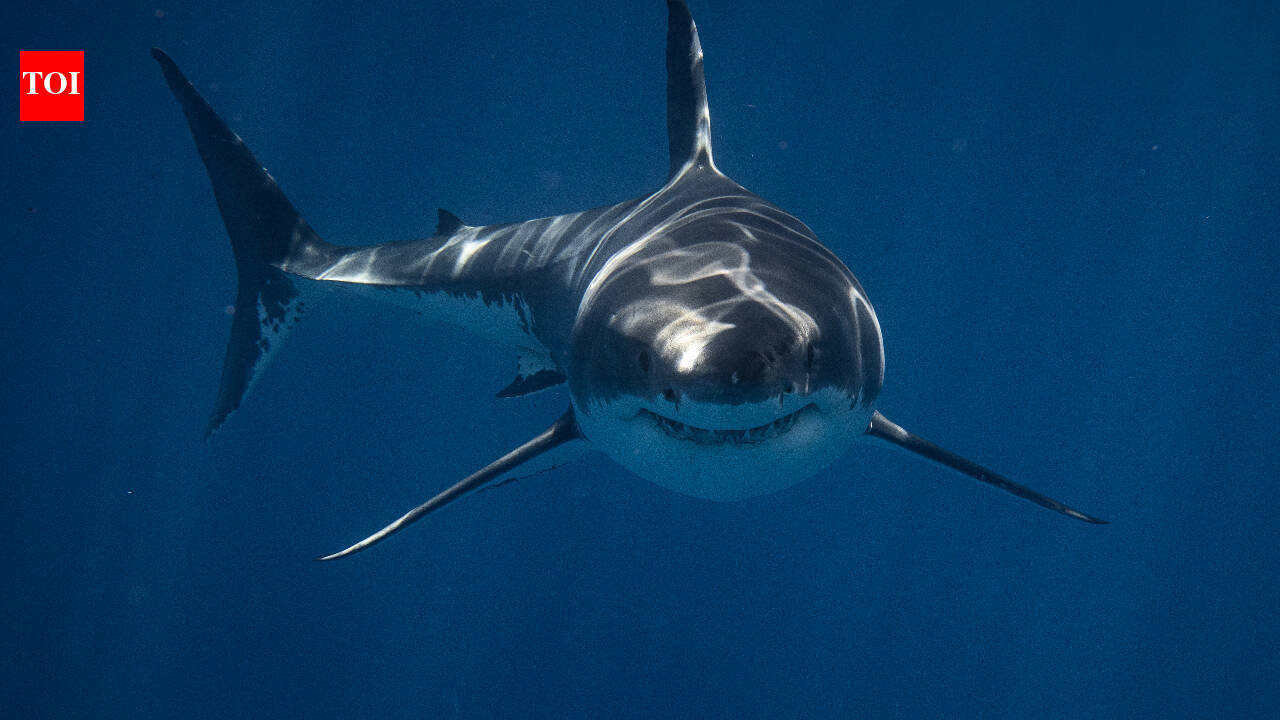
Researchers from Florida Atlantic University discovered that wild blacktip sharks can detect low-frequency sounds up to 74 meters away and turn sharply to avoid the sound source, demonstrating sophisticated long-range hearing capabilities. The study used an underwater speaker to emit controlled sounds while drones tracked shark movements in natural conditions off southeastern Florida. This research, published in Integrative Organismal Biology, reveals that sharks can determine the direction of low-frequency noises beyond the previously understood acoustic near field, challenging earlier assumptions about their sensory range and directional hearing ability.
Written locally by qwen2.5:14b on 2026-10-07,
using this article's own text rather than the other coverage of the
same event (that is the story summary below).
Wild blacktip sharks may have a more sophisticated sense of hearing than scientists previously realised.
uncertain
scientists → have → hearing
A study by researchers at Florida Atlantic University found that free-swimming sharks can detect low-frequency sounds from as far as 74 metres, or roughly 243 feet, away and respond by turning sharply away from the source.
asserted
sharks → find → source
The findings were reported by ScienceDaily and Florida Atlantic University, with the research published in Integrative Organismal Biology.
asserted
research → report → Biology
Sharks hear more than scientists could previously measure
Sound is particularly important underwater, where visibility can quickly become limited.
uncertain
visibility → hear → more
For a predator such as the blacktip shark (Carcharhinus limbatus), noises and vibrations travelling through the water could provide information about prey, predators or other animals long before they become visible.
uncertain
they → travel → prey
Scientists already knew that sharks respond to low-frequency sounds.
asserted
sharks → know → sounds
What had remained unclear was how far a wild shark could detect such a signal and whether it could determine its direction.
uncertain
it → remain → direction
The new research provides one of the clearest field measurements yet.
asserted
research → provide → measurements
Researchers studied wild blacktip sharks in the clear, shallow waters off southeastern Florida.
asserted
Researchers → study → Florida
Rather than testing captive animals, the team observed sharks swimming freely in their natural environment, allowing them to examine hearing behaviour under more realistic conditions.
asserted
them → test → conditions
An underwater speaker became the test
To investigate the sharks’ response, scientists placed an underwater speaker in the water and played controlled, low-frequency sounds.
asserted
scientists → become → sounds
At the same time, an aerial drone recorded the movements of sharks from above.
asserted
drone → record → sharks
The sounds were tested across several frequency ranges, including 100–200 Hz, 200–400 Hz and 400–800 Hz.
asserted
sounds → test → Hz
The researchers also used a much higher-frequency sound as a control.
asserted
researchers → use → control
The sharks responded to the tested low-frequency signals from distances of at least 62 metres.
asserted
sharks → respond → metres
Some responses occurred at approximately 74 metres, demonstrating that the animals could react to sounds well beyond the acoustic near field, where scientists had previously expected their ability to detect sound to be strongest.
uncertain
ability → occur → sound
The sharks did more than simply react
One of the most interesting observations was the direction of the sharks’ movements.
asserted
One → do → movements
When they detected the sound, the animals made sudden turns ranging from about 20 to 160 degrees and then rapidly moved away from the speaker.
asserted
animals → detect → speaker
That consistent directional response gave researchers evidence that the sharks were not merely detecting that a sound existed.
asserted
sound → give → evidence
They could determine where it was coming from.
uncertain
it → determine → where
Across 209 recorded responses, 71.6% occurred in the acoustic far field.
asserted
% → record → field
The sharks also failed to respond to the high-frequency control sound, despite it being played at a comparable volume.
asserted
it → fail → volume
That distinction matters because it challenges the idea that sharks’ ability to orient toward underwater sounds is restricted to the immediate vicinity of a sound source.
asserted
ability → matter → source
Why directional hearing matters underwater
The ability to detect a distant sound and determine its direction could be valuable in an environment where vision is often unreliable.
uncertain
vision → matter → environment
A sound travelling through the ocean can carry information well beyond the distance at which a shark could visually identify another animal.
uncertain
shark → travel → animal
Detecting such signals could therefore give a shark additional time to investigate a potential food source or move away from a possible threat.
uncertain
Detecting → detect → threat
The study does not show that blacktip sharks use sound alone to hunt or navigate.
asserted
sharks → show → sound
Instead, it demonstrates that acoustic information can trigger a strong directional response at surprisingly long distances.
asserted
information → demonstrate → distances
For researchers, that opens a wider question about how sharks combine hearing with their other highly developed senses.
asserted
sharks → open → senses
A new look at the shark’s acoustic world
The findings are particularly significant because they come from sharks behaving freely in the ocean rather than animals tested in laboratory tanks.
asserted
they → come → tanks
Observing the animals from above with a drone allowed researchers to measure changes in swimming direction without interfering with their movement.
asserted
researchers → observe → movement
The work also adds to a growing understanding of how marine predators perceive an environment in which sound can travel farther and more reliably than many visual signals.
asserted
sound → add → signals
For blacktip sharks, a faint underwater sound may therefore be much more informative than it appears to humans standing above the surface.
uncertain
it → appear → surface
What sounds like distant background noise to us could provide a shark with a directional clue from hundreds of feet away.
uncertain
sounds → sound → feet
 The Aporia