This surprising mammal fossil is giving scientists something to chew on
asserted
fossil → give → something
This surprising mammal fossil is giving scientists something to chew on
Over the years, a section of the Inner Mongolia region of China has coughed up heaps of remarkable fossils, ranging from feathered dinosaurs to flying reptiles.
asserted
section → give → reptiles
"To say it's [a] hot spot is actually [an] understatement," says Zhe-Xi Luo, a paleontologist at the University of Chicago.
asserted
Luo → say → Chicago
Many of these fossils wind up at the nearby Paleontological Museum of Liaoning, a facility that Luo and his colleague, Thomas Martin of the University of Bonn, visit each year to examine new finds.
asserted
Luo → wind → finds
A decade ago, a specimen in a thick slab of shale caught their eye.
asserted
specimen → catch → eye
It was the fossilized bones and soft tissue impressions of an ancient mammal that lived some 165 million years ago.
asserted
that → live → mammal
"Early fossil mammals — in fact, they are exceedingly rare," says Luo.
asserted
Luo → say → fact
This animal, which the team named Megacauda sungei and have described in the journal Nature, was a prize discovery.
asserted
team → name → journal
The remains were so intact that it was possible to determine that it was likely capable of chewing food and then swallowing it, and also suckling — traits that are shared by mammals.
asserted
that → determine → mammals
Luo and his colleagues conclude that these evolutionary innovations — and their presence among our ancient mammalian relatives — extend deep into the past to at least the middle Jurassic.
asserted
innovations → conclude → Jurassic
"It's all there in one remarkable fossil," says Luo.
asserted
Luo → say → fossil
A chihuahua-sized chimera
The fossil was about the size of a chihuahua, but somewhat hard to discern from the rock surrounding it.
asserted
fossil → discern → it
"The fossil itself is actually very dark," explains Luo.
asserted
Luo → explain → ?
And it's kind of difficult to have beautiful photographs."
asserted
it → have → photographs
One of his collaborators, Chang-Fu Zhou of Shandong University of Science and Technology, snapped a different kind of vivid image using a technique called X-ray fluorescence spectroscopy.
asserted
One → snap → technique
"It would make this bone pop out in different colors," says Luo.
asserted
Luo → make → colors
The resulting image rendered the skeleton a bright yellow and it showcased a curious combination of characteristics.
asserted
it → result → characteristics
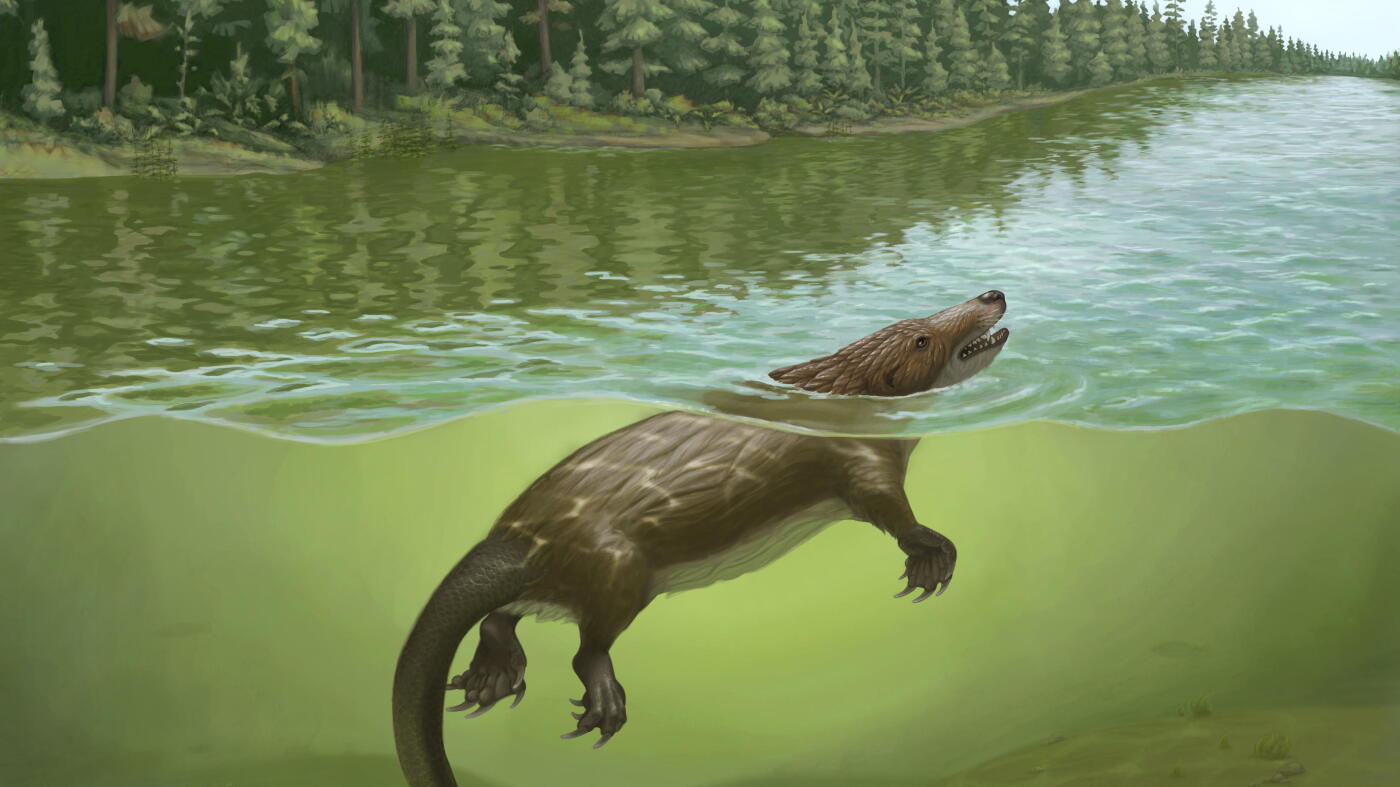
The back end, which includes the pelvis, hind limbs, and tail, resembles a modern-day platypus.
asserted
which → include → platypus
These features suggest that this animal was likely semi-aquatic and foraged in the water.
asserted
animal → suggest → water
"The big tail is good for swimming," says Luo.
asserted
Luo → swim → swimming
"However," he continues, "its teeth and the jaw would be very different from platypus.
asserted
teeth → continue → platypus
Indeed, Luo and his colleagues found a smattering of small salamander bones inside the fossil that they suspect the animal had eaten by first cutting and shearing with its sharp teeth.
asserted
animal → find → teeth
A lot to swallow
There was something else that Luo instantly noticed about the fossil.
asserted
Luo → swallow → fossil
"My eyes zeroed in on these tiny hyoid bones," he recalls.
asserted
he → zero → bones
The human hyoid bone sits in the throat, half an inch or so above the Adam's apple, and supports the backside of the tongue.
asserted
bone → sit → tongue
The team later CT scanned the fossil, including the underside of the skull, which exposed a delicate roof of the mouth as well as a series of bone hooks and ridges.
asserted
which → scan → hooks
With this combination of rarely preserved features, "we are able with great confidence to reconstruct the whole muscular skeletal machinery," says Luo.
asserted
Luo → preserve → machinery
This reconstruction revealed that the animal was likely capable of doing two things that are unique to mammals.
asserted
that → reveal → mammals
The first is swallowing food after chewing it.
asserted
first → swallow → it
Other vertebrates tend to bite and gulp.
asserted
vertebrates → tend → ?
But mammals "chew down all the food with our teeth," Luo says.
asserted
Luo → chew → teeth
"And then we swallow one bolus of food down to our esophagus at a time.
asserted
we → swallow → time
"
Consider, for a moment, a carnivore that chews meat, an herbivore that crunches on vegetables, and an insect-eater that chomps bugs.
asserted
that → consider → bugs
This diverse array of foods all get chewed up and then swallowed down a mammalian throat in a similar way.
asserted
array → chew → way
Secondly, this fossil appears to have been capable of suckling, which embodies something even more fundamental.
asserted
which → appear → something
"That ability to suckle mother's milk literally defined our biology," says Luo.
asserted
Luo → suckle → biology
"And that's why our group is called mammals.
asserted
group → call → ?
We're named after the mammary glands.
asserted
We → name → glands
Small but varied
"It's a fascinating specimen," says Jessica Theodor, a paleontologist at the University of Calgary who wasn't involved in the research.
asserted
who → say → research
"The whole setup looks more like what we see in modern mammals."
asserted
we → look → mammals
…and 6 more, not listed.
 The Aporia