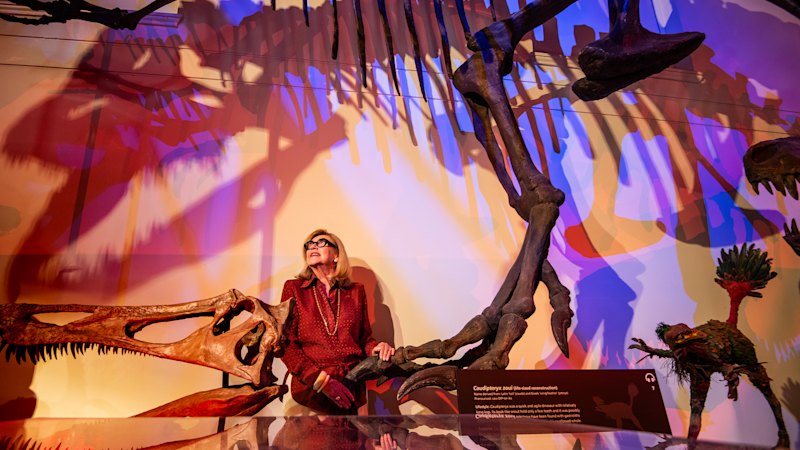
To celebrate its 200-year anniversary next year, the Australian Museum in Sydney will host the skeleton cast of Patagotitan mayorum, the largest dinosaur to have walked the Earth at nearly 38 meters long. The exhibit, set to open in November and displayed in the museum's basement hall, includes an original fossil thigh bone, which is the largest dinosaur fossil ever discovered. Museum CEO Kim McKay emphasizes that this massive creature weighed around 70 tonnes when alive during the Cretaceous period about 100 million years ago.
Written locally by qwen2.5:14b on 2026-10-07,
using this article's own text rather than the other coverage of the
same event (that is the story summary below).
Story summary
The Australian Museum in Sydney will celebrate its upcoming bicentennial by hosting the skeleton of Patagotitan mayorum, the largest dinosaur ever discovered. At nearly 38 metres long and estimated to weigh around 70 tonnes, this colossal creature roamed Argentina’s Patagonia during the Cretaceous period, about 100 million years ago. Due to local laws preventing the whole skeleton from leaving Patagonia, a moulded cast will be displayed alongside an original fossil thigh bone—the largest dinosaur fossil ever found. The exhibit, scheduled for summer, will fill almost the entire length of the museum's touring exhibition hall in its basement, marking what chief executive Kim McKay calls "icing on the cake" during her 12-year tenure.
Written for “Dinosaur Exhibition Australia” on 2026-10-07,
grounded in this article and the 0 other(s) covering the same event.
Only a couple of Sydney-born institutions have reached the 200-year milestone.
asserted
couple → bear → milestone
These include Australia Post, the NSW Supreme Court, Westpac Bank and the Royal Botanic Garden Sydney.
asserted
These → include → Post
The Herald will join the prestigious list in 2031, while the Australian Museum, founded in 1827, will do so next year.
asserted
Museum → join → 1827
To celebrate, the museum will bring the skeleton of the biggest dinosaur to have roamed the Earth into its famed exhibition halls over the summer.
asserted
museum → celebrate → summer
At almost 38 metres long, Patagotitan mayorum is a colossal prehistoric giant that ruled Argentina’s Patagonia during the Cretaceous period about 100 million years ago.
asserted
that → rule → period
Local laws prevent the whole skeleton from leaving Patagonia, so a moulded cast will be sent, along with an original fossil thigh – the largest dinosaur fossil bone ever found, according to Australian Museum chief executive Kim McKay.
uncertain
cast → prevent → McKay
“It will take up the entire length, virtually, of our touring exhibition hall down in the basement,” McKay said.
asserted
McKay → take → basement
“I had never seen anything as big, and I’ve always been a bit of a dinosaur fanatic.
asserted
I → see → fanatic
“It is estimated to have weighed an extraordinary 70 tonnes when it had its flesh on it …
asserted
it → estimate → it
there have been some other recent finds of dinosaurs in that field, but they’ve only found small fragments of bones that could indicate there could have even been a bigger one.
uncertain
that → find → bones
Patagotitan’s skeleton will lead an exhibition cast of dinosaurs from across the mountainous region displayed at the Australian Museum, which opens in November as part of a year-long program marking the AM’s 200th anniversary.
asserted
which → lead → anniversary
McKay said leading the organisation through its 200th anniversary was “icing on the cake” of her 12-year tenure, and there was much to uncover about the period Sydney was in as it established many of its longest-running institutions.
asserted
it → say → institutions
“It’s just a blip in time, 200 years compared to [First Nations people’s] occupation and settlement of Australia – but it was interesting what started to evolve here
asserted
what → ’ → Australia
,” she said.
asserted
she → say → ?
“The emergence of the 1600s of the Enlightenment in the UK and Europe really played into that.
asserted
emergence → play → that
And there was this sense of we can’t be a progressive society until we embrace learning and knowledge in a new way.”
asserted
we → be → way
Before the University of Sydney, McKay noted, the museum and State Library were the first places to establish a place for scientific knowledge in the city.
asserted
museum → note → city
But it’s always been charged with recording and researching new species as well as tracking what happens to them over time – a role she parallels with the Herald.
asserted
she → charge → Herald
“[The Herald and the museum] have a lot in common in that way, our longevity, but also in storytelling.
asserted
Herald → have → storytelling
There’s a lovely link there because The Sydney Morning Herald has chronicled the story of this city, and many of those early stories were about what was happening at the museum.
asserted
what → ’ → museum
That history is even etched into its building, McKay said.
asserted
McKay → etch → building
“The knowledge is ingrained.
asserted
knowledge → ingrain → ?
You see the patina of footprints on the floor, and how a stone hearth is worn away by footprints and so forth.
asserted
hearth → see → footprints
The sandstone here evokes that period – convict labour, hand-hewn, that sandstone,” she said.
asserted
she → evoke → period
“The [current] building was started in 1845.
asserted
building → start → 1845
It was finished in 1850, and the taxidermy lab was down in the basement next to the kitchen, and in those days, the director lived here with his family.
asserted
director → finish → family
This was a place where people lived, worked and developed.”
asserted
people → live → ?
 The Aporia