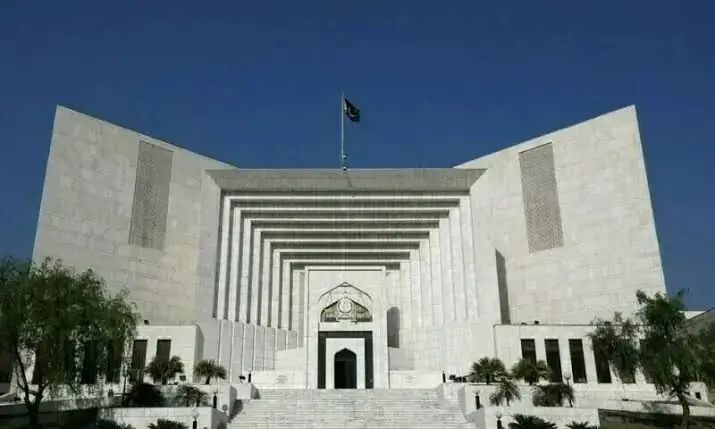
The Supreme Court ruled on Wednesday that a marriage could be dissolved on grounds of shiqaq (marital discord) under a residuary provision of the Dissolution of Muslim Marriages Act, 1939 even when cruelty was not proven.
uncertain
cruelty → rule → Act
The residuary provision of the Dissolution of Muslim Marriages Act, 2(ix), explains the grounds on which a woman can obtain a decree for the dissolution of her marriage.
asserted
woman → explain → marriage
In its judgement, the SC stated: “A marriage may be dissolved by a court, but neither spouse should be judicially deprived of a lawful right, nor judicially burdened with a stigma, without the foundation of law and evidence.”
uncertain
spouse → state → law
The judgement was issued by a five-member bench, headed by Justice Shahid Waheed and comprising Justices Naeem Akhter Afghan, Muhammad Hashim Khan Kakar, Ishtiaq Ibrahim and Miangul Hassan Aurangzeb.
asserted
judgement → issue → Afghan
The judges had taken up two connected petitions, filed by Zainab Bibi and Imran Naz Begum, against separate orders of the Peshawar High Court (PHC).
asserted
judges → take → Court
Both cases arose from family suits where wives sought dissolution of marriage on the ground of cruelty and claimed maintenance, dower and dowry articles.
asserted
wives → arise → articles
The family court found cruelty unproven in both cases, but dissolved both marriages through khula — a woman’s right to seek release from a marriage.
asserted
cruelty → find → marriage
The family courts also directed the two women to return their dower, while the appellate court and the PHC largely upheld these decrees.
asserted
court → direct → decrees
The two women raised two principal grievances before the SC: first, that their marriages could not lawfully be dissolved through khula because they neither sought nor consented to it, as their cases were founded on cruelty; and second, their financial claims should have been allowed in full.
uncertain
claims → raise → cruelty
The SC’s 15-page judgement on their please, authored by Justice Waheed, drew a distinction between khula and shiqaq and explained that khula proceeded from a wife’s voluntary election to obtain release from the marriage and ordinarily carried financial consequences.
asserted
khula → author → consequences
Shiqaq, by contrast, arose from an objectively established condition of serious matrimonial breach and did not depended on a wife’s surrender of dower or any benefit as consideration for her release, the judgement stated.
asserted
judgement → arise → release
The SC held that family courts committed an error in converting the petitioners’ claims for the dissolution of their marriages on the ground of cruelty into decrees of khula without obtaining their clear and voluntary consent or election.
uncertain
courts → hold → consent
Those decrees, to the extent that they rested upon khula, could not be sustained, the judgement said, though the SC did not set aside the dissolution altogether.
uncertain
SC → rest → dissolution
“The matrimonial relationships have undergone a serious and continuing rupture; reconciliation has failed; the evidence does not establish the statutory ground of cruelty; and the record, taken as a whole, establishes a condition of ‘shiqaq’ of the kind contemplated by verse 35 of Surah An-Nisa of the Holy Quran and recognised under Muslim law, thereby bringing the cases within the residuary provision contained in section 2(ix) of the Act of 1939,” the SC explained.
asserted
SC → undergo → 1939
The dissolution could therefore lawfully be sustained, but upon a juridical basis different from that adopted by the family courts, the SC judgement said, adding that marriages of the petitioners were liable to dissolution on the ground of shiqaq falling within section 2(ix) of the Dissolution of Muslim Marriages Act, 1939, and not on the basis of khula.
uncertain
shiqaq → sustain → khula
However, the directions requiring the petitioners to return, surrender or waive their dower merely as a consequence of khula should consequently stood set aside, the SC ruled.
asserted
SC → require → khula
Their entitlement to dower would be determined in accordance with the Act of 1939, it declared.
asserted
it → dower → 1939
The SC observed that the Quranic emphasis upon reconciliation in cases of shiqaq was meaningful precisely because it contemplated the possibility that reconciliation may fail.
uncertain
reconciliation → observe → possibility
“The law should neither rush towards separation nor prolong a matrimonial relationship which has ceased to serve its lawful purposes,” the judgement held.
asserted
judgement → rush → purposes
Where reconciliation had failed, and the relationship had reached the condition of shiqaq, the judicial task was to bring the matter to a lawful conclusion without unnecessary attribution of blame or deprivation of rights, the judgement explained.
asserted
judgement → fail → rights
The SC emphasised that courts must distinguish between an unhappy marriage and one in a state of shiqaq.
asserted
courts → emphasise → shiqaq
“Mere incompatibility, occasional disagreement, anger, short separation or the existence of matrimonial litigation cannot, by themselves, satisfy the test.
asserted
incompatibility → satisfy → test
The court must be satisfied that the breach is genuine, serious and continuing; that the matrimonial relationship has ceased to function in accordance with its essential purposes; and that reconciliation has failed despite meaningful judicial effort,” the judgement emphasised.
asserted
judgement → continue → effort
The wife should not be compelled to surrender dower through an involuntary conversion of her statutory claim into khula, it said, adding that the husband should also not be judicially characterised as cruel or guilty of matrimonial misconduct without the evidentiary foundation required by law.
uncertain
husband → compel → law
“Allegations of cruelty, ill-treatment, neglect and misconduct frequently arise in an emotionally charged environment.
asserted
Allegations → arise → environment
The courtroom should not become an institution through which matrimonial discord is converted into a permanent injury to the reputation and dignity of either spouse,” it explained.
asserted
it → become → spouse
The judgement further stated: “The law must determine rights; it need not aggravate human conflict.
asserted
it → state → conflict
Where the evidence does not establish a particular matrimonial wrong to the standard required by law, the courts should refrain from declaring it proved.
asserted
it → establish → law
Conversely, where the evidence establishes that the matrimonial relationship itself has descended into a state of serious and continuing rupture, the absence of proof of a particular matrimonial wrong does not necessarily require parties to remain bound to one another indefinitely.”
asserted
absence → establish → one
The judgement explained that shiqaq was not established by every quarrel, disagreement, incompatibility or temporary estrangement in a marriage.
asserted
shiqaq → explain → marriage
“It requires a genuine and continuing rupture of such character that the essential purposes of marriage cannot realistically be fulfilled, coupled with failure of reasonable efforts at reconciliation.”
asserted
purposes → require → reconciliation
 The Aporia