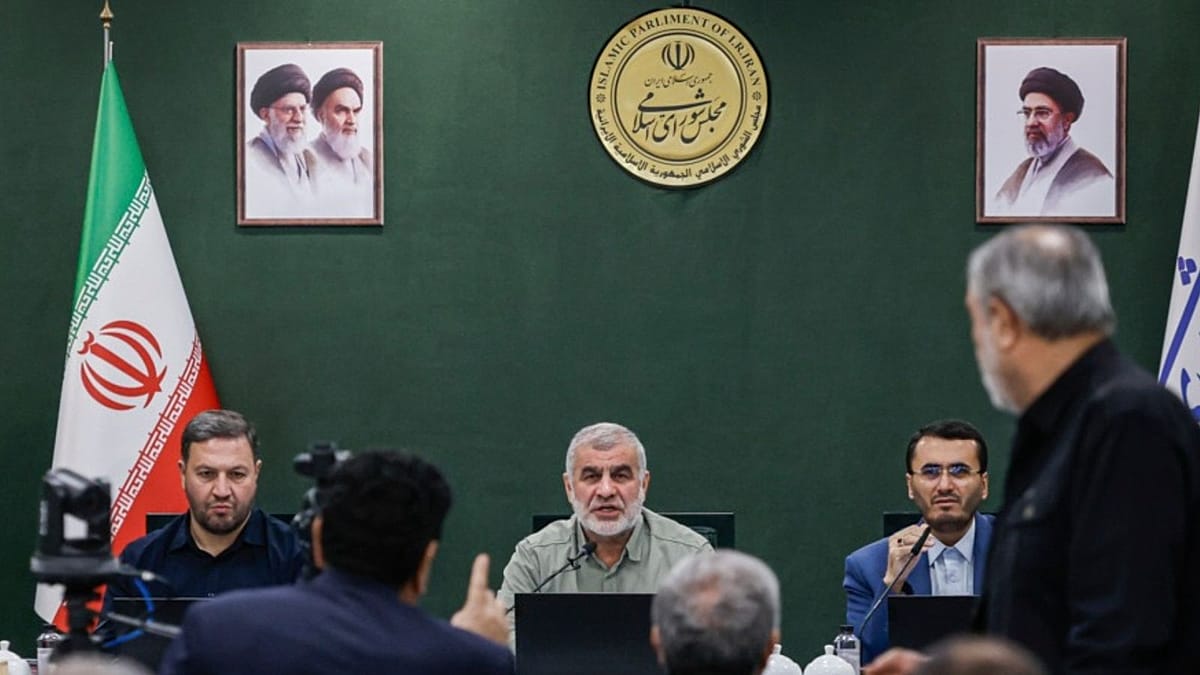
Iran’s parliament passed a bill that criminalizes Iranians from giving interviews or participating in discussions with foreign media outlets designated as “hostile” by Iran’s Intelligence Ministry. The bill, which received 174 votes in favor and six against on Tuesday, imposes penalties including up to two years in prison, fines, and flogging for violations. Despite cabinet opposition citing serious flaws, the legislation now faces review by the Guardian Council before becoming law.
Written locally by qwen2.5:14b on 2026-10-07,
using this article's own text rather than the other coverage of the
same event (that is the story summary below).
Story summary
On Tuesday, Iran's parliament voted 174 to six to pass an article banning Iranian nationals from interacting with media outlets deemed "hostile" by the Intelligence Ministry or those linked to countries classified as adversaries of the Islamic Republic. Despite opposition from the cabinet, the bill carries penalties including up to two years in prison, fines, and flogging for violators. The bill defines foreign governments into two tiers: a "level 1 government" is one formally designated as hostile under Iranian law or by decision of the Supreme National Security Council, while "level 2" includes states with planned hostilities towards Iran. The measure has not yet become law and must undergo review by the Guardian Council before it can take effect. Presidential legal deputy Majid Ansari warned that criminalising broad categories in this bill could harm citizens' rights.
Written for “Iran Media Restrictions Law” on 2026-10-07,
grounded in this article and the 0 other(s) covering the same event.
The bill passed 174 to six despite cabinet opposition, carrying penalties of up to two years in prison, fines and flogging for Iranians who speak to outlets designated as hostile by the Intelligence Ministry.
asserted
who → pass → Ministry
The bill has not yet become law and faces Guardian Council review.
asserted
bill → become → review
Iran's parliament voted 174 to six on Tuesday to pass an article banning Iranian nationals from giving interviews to or participating in discussions with media outlets designated as "hostile" by the Intelligence Ministry, or with outlets owned, managed or funded by operatives connected to countries classified as adversaries of the Islamic Republic.
asserted
parliament → vote → Republic
Violations of Article 22 of the bill on "countering the penetration of intelligence services and foreign governments or entities" carry sixth-degree penalties under the Islamic Penal Code, including imprisonment of more than six months up to two years, fines, 31 to 74 lashes, deprivation of social rights and other restrictions.
asserted
Violations → counter → rights
The bill classifies foreign governments into two tiers: a "level 1 government" is a state formally designated as hostile under Iranian law or by decision of the Supreme National Security Council.
asserted
government → classify → Council
"Level 2" is defined as a state that has planned or carried out actions aimed at damaging Tehran's political, defence, security, economic, social or cultural interests.
asserted
that → define → interests
The list of level two governments is to be drawn up by the Intelligence Ministry and the IRGC intelligence organisation, then approved by the Supreme National Security Council.
asserted
list → draw → Council
A proposal by Tehran MP Alireza Salimi to exempt government officials from the scope of Article 22 was also approved at the same sitting.
asserted
proposal → exempt → sitting
President Masoud Pezeshkian's cabinet had formally opposed the bill.
asserted
cabinet → oppose → bill
At its 22 August meeting, the cabinet said the legislation had "serious flaws," including restrictions on scientific activity, the acceleration of elite emigration and negative consequences at national and international level.
asserted
legislation → say → level
First Vice-President Mohammad Reza Aref had warned of consequences for science and technology.
asserted
Aref → warn → science
Presidential legal deputy Majid Ansari said "criminalising broad and general categories in this bill could harm citizens' rights."
uncertain
criminalising → say → rights
Parliament also passed Article 20 of the same bill, under which anyone who accesses unpublished official information by virtue of their job may not share it with a foreign agent without prior authorisation.
uncertain
who → pass → authorisation
The penalty is four to 10 years in prison and a permanent bar from the post through which the information was accessed.
asserted
information → access → which
The legislation follows months of hardline rhetoric from Iranian officials against Persian-language broadcasters outside Iran.
asserted
legislation → follow → Iran
On 26 August, armed forces spokesman Abolfazl Shekarchi accused BBC Persian, Iran International and Radio Farda of links to US and Israeli intelligence organisations and said their staff could be placed in the Islamic Republic's "military targets bank".
uncertain
staff → accuse → bank
Following the parliamentary vote, the bill still needs further approval to become law.
asserted
bill → follow → approval
The Majlis must complete its examination of remaining articles before sending the text to the Guardian Council, which reviews legislation for compatibility with Sharia and the constitution.
asserted
which → complete → Sharia
If the Guardian Council raises objections and the Majlis insists on its position, the Expediency Council makes a final ruling.
asserted
Council → raise → ruling
The parliament that passed the article emerged from elections in which turnout was reportedly at around 41%, the lowest since the 1979 Islamic Revolution.
uncertain
turnout → pass → Revolution
The leading candidate in the capital won some 598,000 votes, compared with more than 1.6 million for the leading Tehran candidate in the 2016 elections.
asserted
candidate → win → elections
 The Aporia