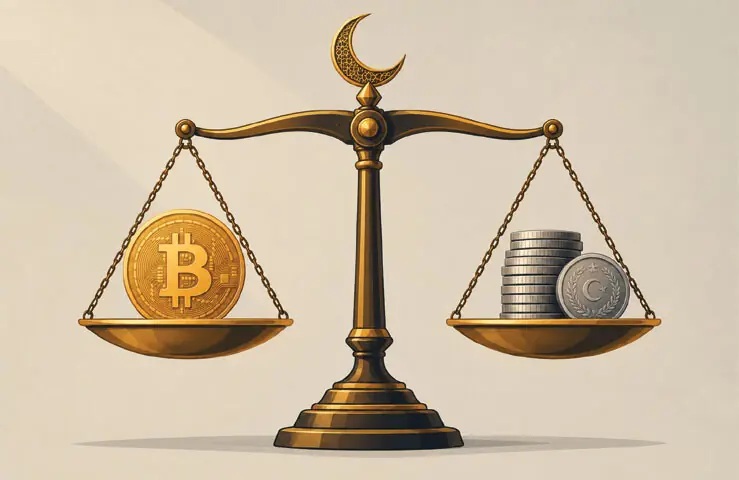
Pakistan made global headlines this June when Islamic scholar Mufti Taqi Usmani, along with five others, issued a fatwa [religious edict] arguing that it was “impermissible” to use cryptocurrencies to purchase goods.
asserted
it → make → goods
The argument was that crypto is “merely the recording of fictitious numbers in a digital account”, it is not recognised as maal [wealth] in Shariah.
asserted
it → recognise → Shariah
Bilal bin Saqib, chairman of the Pakistan Virtual Assets Regulatory Authority (PVARA), followed up with a request for clarification: crypto actually encompasses a range of assets — from pure digital currencies to gold-backed tokens, stablecoins and complex financial instruments — some of which translate to legal claims on real-world wealth, precious metals and currencies.
uncertain
some → follow → wealth
In several of these cases, cryptocurrency technology, the underlying blockchain, simply acts as a recording ledger, much like a database in a bank.
asserted
technology → underlie → bank
This ruling has significant implications in Pakistan for two reasons: one, after eight years of an outright ban on banking for all things crypto, Pakistan recently made a whiplash pivot to full-throated advocacy, jumping on board the crypto bandwagon.
asserted
Pakistan → have → bandwagon
This fatwa will certainly complicate matters.
asserted
fatwa → complicate → matters
Second, and more importantly, Saqib claimed recently in a Senate committee briefing that Pakistan is already the world’s third largest crypto market, with some 40 million crypto accounts.
asserted
Pakistan → claim → accounts
This number dwarfs our active taxpayer count, which stands at merely six million.
asserted
which → dwarf → million
The debate over cryptocurrency in the Muslim world is still evolving, raising questions not only about digital assets but about the nature of money and the financial systems built around it
Given this context, it is certainly good to have the grand crypto debate now rather than later.
asserted
it → evolve → debate
As two computer science academics with a research focus on crypto, we authored a paper summarising Islamic perspectives on this topic in 2018.
asserted
we → author → 2018
Lacking background in economics and theology, we expected a straightforward exercise in documenting legal rulings.
asserted
we → lack → rulings
Instead, it was eye-opening.
asserted
it → open → ?
Our current debate, we believe, is merely the tip of the iceberg.
asserted
we → believe → iceberg
‘Islamic economics’ is a work in progress
Modern Islamic economics is a relatively recent creation, emerging in the late 20th century through the pioneering works of Iranian cleric Baqir Sadr and Pakistani theologian Abu-‘Ala Mawdudi.
asserted
economics → emerge → Sadr
The First International Conference on Islamic Economics was conducted only 50 years ago, in 1976.
asserted
Conference → conduct → 1976
The vision of this domain is to contribute to the lofty objectives of Islamic law [Maqasid-i-Shariah] — ie as per Imam Ghazali, “to promote the well-being of the people, which lies in safeguarding their faith, their lives, their intellect, their posterity and their wealth.
asserted
which → contribute → faith
Whatever ensures the safeguarding of these five serves public interest and is desirable, and whatever hurts them is against public interest and its removal is desirable.
asserted
removal → ensure → interest
This vision results in clear prohibitions on usury and interest, gambling and other speculative activities, earnings from unethical and immodest practices, and prohibition on trading in forbidden goods.
asserted
vision → result → goods
On the other hand, it expressly encourages participatory banking, profit and loss sharing, Islamic endowments, and Zakat.
asserted
it → encourage → banking
But beyond these bare essentials, things are far more grey and there is still considerable work to be done.
asserted
things → be → essentials
Islamic economics has also faced criticism for drifting from its foundational principles and merely replicating conventional Western economics with a religious flavour.
asserted
economics → face → flavour
To address these challenges, Indian economist Dr Muhammad Nejatullah Siddiqui, a pioneer in the field, explicitly called for a broadening of horizons, for scholars to engage in constructive discussions with experts in different domains, and embrace divergent views.
asserted
scholars → address → views
This leads directly to our second point.
asserted
This → lead → point
Dialogue between scholars, economists and technologists is needed
asserted
Dialogue → need → scholars
A thematic study of 32 public fatwas issued between 2014 and 2024 found that 17 prohibited cryptocurrency outright, 10 permitted it conditionally, and five were cautious or neutral.
asserted
five → issue → it
The study also identified four key factors in the debate:
• Should cryptocurrencies be treated as maal [wealth and property] or thamaniyyah [money]?
• Gharar [excessive uncertainty] due to volatility and lack of transparency and regulation
• Speculation akin to maysir [gambling]
• Mafsadah [harm to society], including illicit and criminal use, environmental damage, and systemic wealth inequality
Egypt’s Dar al-Ifta al-Misriyya, a prominent Islamic advisory body, classified Bitcoin as haraam [forbidden] in 2017.
asserted
Misriyya → identify → 2017
Darul Uloom Deoband in India took a similar position in 2018.
asserted
Deoband → take → 2018
Saudi Arabia and Pakistan, meanwhile, withheld legal recognition from cryptocurrencies.
asserted
Arabia → withhold → cryptocurrencies
However, the study also notes that religious and legal positions on crypto have evolved due to growing understanding of the technology, more transparency and regulation.
asserted
positions → note → technology
In particular, digital assets — as opposed to decentralised cryptocurrencies — may be permissible when their structure and purpose satisfy Shariah requirements.
uncertain
structure → oppose → requirements
By 2023, bodies such as Indonesia’s Majelis Ulama Indonesia and Malaysia Shariah Advisory Council have moved towards varying levels of conditional acceptance.
asserted
bodies → move → acceptance
Indonesia’s Nahdlatul Ulama, described by some as the world’s largest Islamic organisation, with around 100 million members and affiliates, went a step further, classifying Bitcoin as maal and tsaman [medium of exchange].
asserted
Ulama → describe → exchange
The International Islamic Financial Services Board (IFSB), an international standardisation body, has incorporated digital assets into its Islamic-finance regulatory analysis, and called on stakeholders to assess Shariah issues associated with their different characteristics.
asserted
Board → incorporate → characteristics
Research on the Mufti Taqi Usmani fatwa also appears to be ongoing.
asserted
Research → appear → fatwa
Dar ul Uloom Karachi is undertaking scholarly webinars and expert discussions to “further strengthen and refine” their research.
asserted
Karachi → undertake → research
We expect opinions and rulings in the Islamic world will continue to evolve, particularly as Western governments draw ever closer to regulating and institutionalising crypto.
asserted
governments → expect → crypto
Beyond the economics jargon and the glitter of the technology, crypto forces us to confront the very fundamentals of what money has become, the way modern governments and financial systems operate and, more than anything else, the overarching role of Empire.
asserted
governments → force → Empire
One cannot pass sentence on crypto without contemplating the obvious elephant in the room — just how ‘Islamic’ is our mainstream financial system?
asserted
system → pass → room
The global financial crisis of 2008 opened our eyes to the extreme manipulations that have now become a routine part of the system, inflicting untold misery on the world.
asserted
that → open → world
It is an open secret that the US government simply prints money when it feels like it.
asserted
it → print → it
…and 11 more, not listed.
 The Aporia