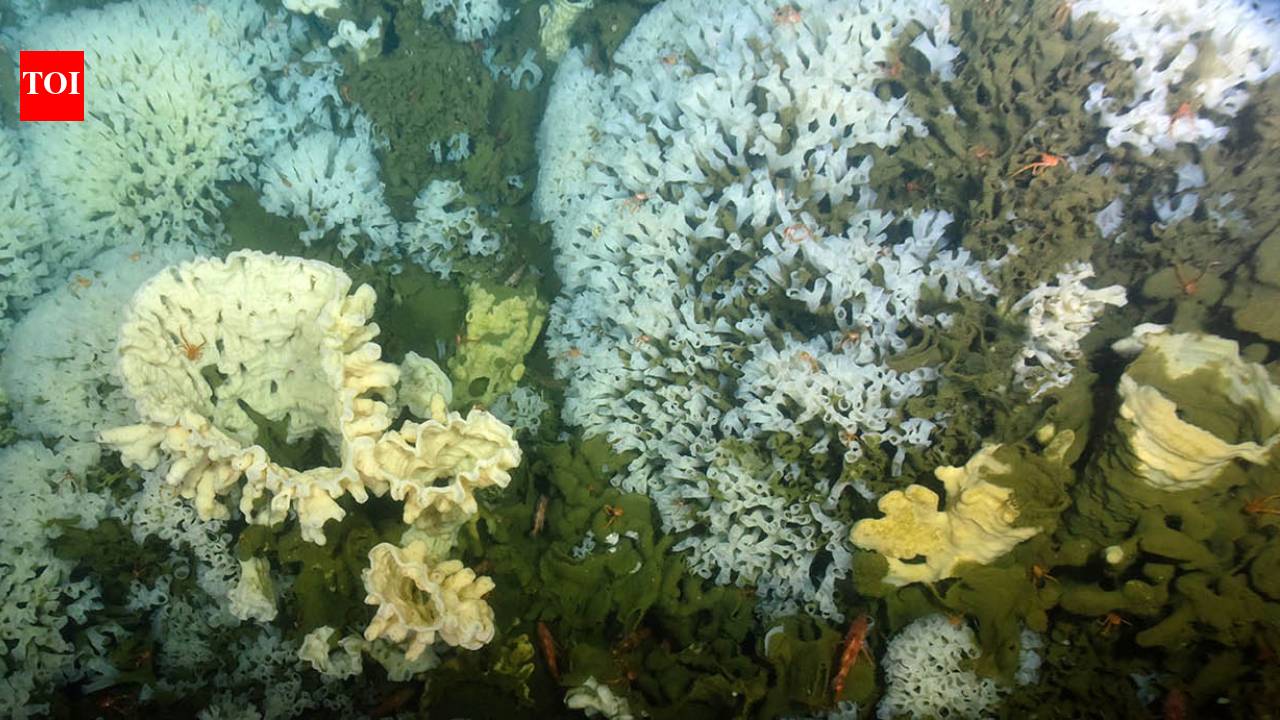
Far beneath the cold waters off British Columbia, an extraordinary ecosystem is thriving in near-total darkness, a vast network of reefs made not from tropical coral, but from animals whose skeletons are built from silica, the same material found in glass.
asserted
skeletons → thrive → glass
These are glass sponge reefs, and for decades scientists believed reef-building sponges of this kind had disappeared from Earth roughly 40 million years ago.
asserted
sponges → believe → Earth
Then, in 1987, Canadian scientists discovered that they were still alive.
asserted
they → discover → 1987
According to Fisheries and Oceans Canada (DFO), four major glass sponge reefs were discovered that year in Hecate Strait and were found to be more than 9,000 years old.
uncertain
reefs → accord → Strait
The discovery revealed that an ecosystem once thought extinct had survived in the deep waters off Canada's Pacific coast.
asserted
ecosystem → reveal → coast
Today, these extraordinary formations are often described as the “Sea of Glass.”
asserted
formations → describe → Glass
Reefs built by animals, not coral
Glass sponges are marine animals whose intricate skeletons are made from silica.
asserted
skeletons → build → silica
Unlike the soft-bodied sponges familiar from shallow waters, these deep-sea animals create rigid, glass-like structures.
asserted
animals → create → structures
Some species are capable of building reefs.
asserted
species → build → reefs
New generations of sponges settle on the skeletons left behind by previous generations, gradually creating enormous mounds and ridges on the seafloor.
asserted
generations → settle → seafloor
DFO says the reefs can grow to hundreds of square kilometres and reach heights of up to 25 metres.
asserted
reefs → say → metres
The largest reefs in Hecate Strait and Queen Charlotte Sound lie between about 140 and 240 metres below the surface.
asserted
reefs → lie → surface
The four major Hecate Strait reefs cover an area of about 1,000 square kilometres and are considered the largest living examples of glass sponge reefs that were once widespread during the Jurassic period.
asserted
that → cover → period
A prehistoric ecosystem that survived
Glass sponge reefs were discovered alive in Hecate Strait in 1987 after being thought extinct for 40 million years.
asserted
reefs → survive → years
(Photo: DFO, Sally Leys, University of Alberta, CSSF ROPOS)
The story of these reefs goes back hundreds of millions of years.
asserted
story → go → years
Fossil evidence shows that they formed extensive reef systems long before modern coral reefs dominated many marine environments.
asserted
reefs → show → environments
Scientists believed living reef-building glass sponges had disappeared approximately 40 million years ago.
asserted
sponges → believe → ?
That assumption was overturned when Canadian scientists mapped the seafloor off British Columbia in the 1980s.
asserted
scientists → overturn → 1980s
Natural Resources Canada scientist Kim Conway, who was involved in the expeditions, recalled that researchers initially encountered unusual mounds and ridges without immediately understanding what they were.
asserted
they → involve → mounds
It took several expeditions and years of investigation before scientists determined that the formations were reefs created by sponges.
asserted
formations → take → sponges
The discovery was formally confirmed in 1987.
asserted
discovery → confirm → 1987
Why these reefs exist off British Columbia
Glass sponges can be found in oceans around the world, but the enormous reef formations are exceptionally rare.
asserted
formations → exist → world
According to DFO, British Columbia's glass sponge reefs occur in Hecate Strait, Queen Charlotte Sound, the Strait of Georgia and Howe Sound.
uncertain
reefs → accord → Georgia
Most are found at depths between about 90 and 300 metres, although some reefs in Howe Sound occur much closer to the surface.
asserted
reefs → find → surface
The reefs require a particular combination of environmental conditions, including cold, nutrient-rich water and sufficient dissolved silica for the sponges to build their skeletons.
asserted
sponges → require → skeletons
These conditions have allowed the animals to survive and build reef structures over thousands of years.
asserted
animals → allow → years
The 9,000-year-old reefs survive today in Hecate Strait, Queen Charlotte Sound and Howe Sound.
asserted
reefs → survive → Strait
They are functioning ecosystems that continue to play an important role in the modern ocean.
asserted
that → function → ocean
Glass sponges pump seawater through their bodies and filter microscopic organisms and particles from the water.
asserted
sponges → pump → water
Their enormous reef structures also provide shelter, refuge and nursery grounds for marine species, including rockfish, finfish and shellfish.
asserted
structures → provide → rockfish
DFO describes the reefs as important habitat for numerous aquatic species.
asserted
DFO → describe → species
The intricate structures effectively transform sections of the deep seafloor into complex underwater habitats, creating an oasis of marine life in otherwise relatively flat areas of the Pacific.
Thousands of years to build, but easily damaged
The extraordinary age of these reefs also makes them extremely vulnerable.
asserted
them → transform → reefs
Their skeletons are made of silica and can be broken by physical contact.
asserted
skeletons → make → contact
DFO warns that fishing gear and other activities that disturb the seafloor can damage the structures, while increased sediment can smother the sponges and interfere with their ability to survive.
asserted
sediment → warn → ability
DFO notes that individual glass sponges can live for more than 200 years, while recovery from significant reef damage could take tens to several hundreds of years.
uncertain
recovery → note → years
If the skeletons of dead sponges are destroyed or buried, new generations cannot use them as the foundation for further reef growth.
asserted
generations → destroy → growth
Climate change is adding another concern, with scientists investigating how warming and changing ocean chemistry could affect the fragile organisms and the ecosystems they support.
uncertain
they → add → organisms
Canada created a marine protected area
The discovery eventually led to major conservation measures.
asserted
discovery → create → measures
In 2017, Fisheries and Oceans Canada designated the Hecate Strait and Queen Charlotte Sound Glass Sponge Reefs as a Marine Protected Area.
asserted
Canada → designate → Area
The protected area covers approximately 2,410 square kilometres and was created to conserve the biological diversity, structural habitat and ecosystem functions associated with the ancient reefs.
asserted
area → cover → reefs
…and 11 more, not listed.
 The Aporia