When someone shows you who they are, as American writer and civil rights activist Maya Angelou once said, you should believe them the first time.
asserted
you → show → them
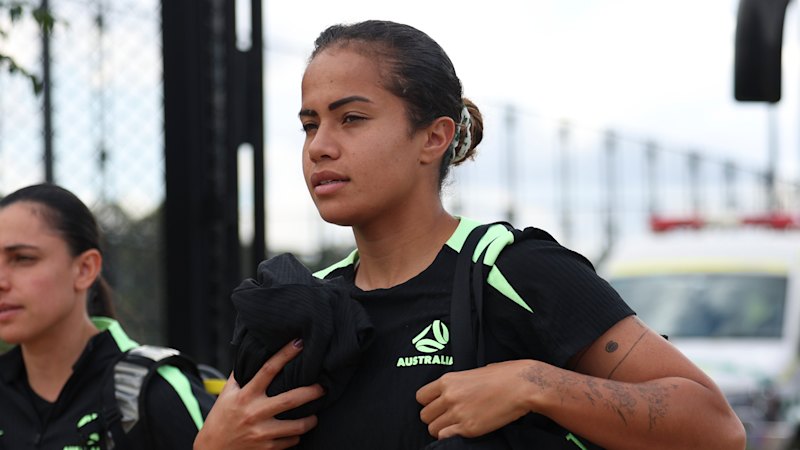
Mary Fowler has shown us who she is.
asserted
she → show → us
She is not exactly hiding it.
asserted
She → hide → it
She has told us, explicitly and proudly, about what makes her tick, the things that she truly values in life, and where soccer sits in her personal pecking order – and we admire her for this.
asserted
we → tell → this
But we don’t seem to be listening.
asserted
we → seem → ?
We are patiently waiting for her to finally find that permanent role in the Matildas’ starting XI so that we can watch her settle in and play there for the next decade.
asserted
her → wait → decade
We dream of seeing her become an undisputed global superstar, winning Ballons d’Or and UEFA Champions League medals, leading the Matildas and Australian soccer towards greatness, all without wondering if she actually wants any of these things, or if we just want them for us, via her.
asserted
we → dream → her
Fowler is reportedly back in Sydney visiting her partner, Penrith Panthers NRL star Nathan Cleary, as he recovers from a career-threatening broken leg.
uncertain
he → visit → leg
These are presumably the unexplained “personal circumstances” that led to her pulling out of the Matildas’ friendlies against Germany and Haiti – but since nothing has been said officially, we still don’t know for sure.
asserted
we → lead → Germany
Regardless, coach Joe Montemurro has been denied a critical opportunity to advance his preparations for next year’s FIFA Women’s World Cup, insofar as where Fowler fits into those plans.
asserted
Fowler → deny → plans
These are not “only friendlies”; this team will have just a handful of games together before the tournament begins, and Fowler has rarely been fully fit since Montemurro began in the job in June 2025.
asserted
Montemurro → have → June
She is such a special player, Australia’s World Cup hopes rest at least partly on her shoulders.
asserted
hopes → rest → shoulders
It exposes a tension between the inherent collective demands of international soccer and individual autonomy to decide what matters most in a player’s life.
asserted
what → expose → life
In Fowler’s case, it forces us to confront the possibility that her idea of her career might look very different to ours.
uncertain
idea → force → ours
“Obviously I enjoy playing football, but I wouldn’t say it’s my passion,” Fowler said last year on the Keegan and Company podcast, recorded in the days after she underwent surgery on her ACL.
asserted
she → play → ACL
When she was much younger, soccer was her “everything”, she explained.
asserted
she → explain → ?
These days, it’s just her job.
asserted
it → ’ → ?
That doesn’t mean she’s not committed – obviously, she is – but it helps us understand her perspective.
asserted
us → mean → perspective
“I play it because there are a lot of things I enjoy about it,” she said.
asserted
she → play → it
“I really enjoy travelling, being with my teammates, the people that I’ve met through football, but if I finished it tomorrow, I probably wouldn’t have any regrets.
asserted
I → enjoy → regrets
There’s other things outside of football I am more passionate about.
asserted
I → ’ → football
”
It would be totally understandable, then, for Fowler to want to be by Cleary’s side at a time of serious trauma, and for that to outweigh her desire to play.
asserted
that → want → desire
If Fowler or Football Australia had confirmed this was why she wasn’t available for the Matildas, many people would have congratulated her for setting boundaries.
asserted
people → confirm → boundaries
She went even deeper on these topics in her book, Bloom, released last year, in which she detailed her thought process during the last time she withdrew from a Matildas camp, in late 2024.
asserted
she → go → 2024
She publicly cited “physical and mental fatigue” – and she was applauded for her bravery – but when she first approached the team to ask for some time off, “the response wasn’t as supportive as I’d hoped,” she wrote.
asserted
she → cite → time
Fowler was told it would not be a good look, that the Matildas risked the appearance of “favouritism” and that it could open a “can of worms” within the squad.
“Although I noted the amount of pressure being put on me to still come in, I’m glad I stood firm in my decision,” she wrote.
uncertain
she → tell → decision
“I made it known that, with all due respect, I was going to do what was best for me.
asserted
what → make → me
There was a lot that didn’t sit well with me in the way those discussions were handled, but eventually I was given approval to pull out of the camp.
asserted
I → be → camp
I didn’t enjoy feeling like I was a commodity, but I understood that sometimes that’s just the ruthless side of business …
asserted
that → enjoy → business
no matter what pressures or backlash you face, you shouldn’t feel guilty for making yourself a priority.”
Fowler is still only 23, but has a maturity well beyond her age.
asserted
Fowler → face → age
This is someone who meditates, who journals, who has thought all of this through, football and life, at a deeper level, and determined that the former is just a small part of the latter.
asserted
former → meditate → latter
Many people go through their entire lives without figuring this stuff out.
asserted
people → go → stuff
But multiple things can be true at once: that Fowler is entitled to make the call she believes is right for herself, and that others, including her teammates, coaches and Matildas supporters, don’t have to love it.
asserted
others → entitle → it
This is, as she put it, the ruthless side of the business.
asserted
she → put → business
The Australian jersey is not a mere work uniform, but a representation of something much larger than the person wearing it: of fans who have emotionally invested in this team precisely for these reasons; of players and staff who accept that pursuing a common goal sometimes requires putting the collective above themselves; of every other aspiring footballer who would drop everything for the chance to pull it on, even just once.
asserted
who → wear → it
There is a reason it is referred to as “international duty.”
asserted
it → be → duty
When you have been selected to play for your country, availability is supposed to be the default position.
asserted
availability → select → country
Of course, soccer does not come before everything, and there are times when players are given leave on compassionate grounds.
asserted
players → come → grounds
But there are also times when players would rather be somewhere else for perfectly compelling personal reasons and turn up anyway, because representing your country demands a higher level of sacrifice.
asserted
representing → be → sacrifice
They routinely leave partners and children behind, surrender precious time at home, travel enormous distances, which put strain on their bodies and minds, and sometimes face pressure from the clubs who actually pay their day-to-day wages.
asserted
who → leave → wages
…and 6 more, not listed.
 The Aporia