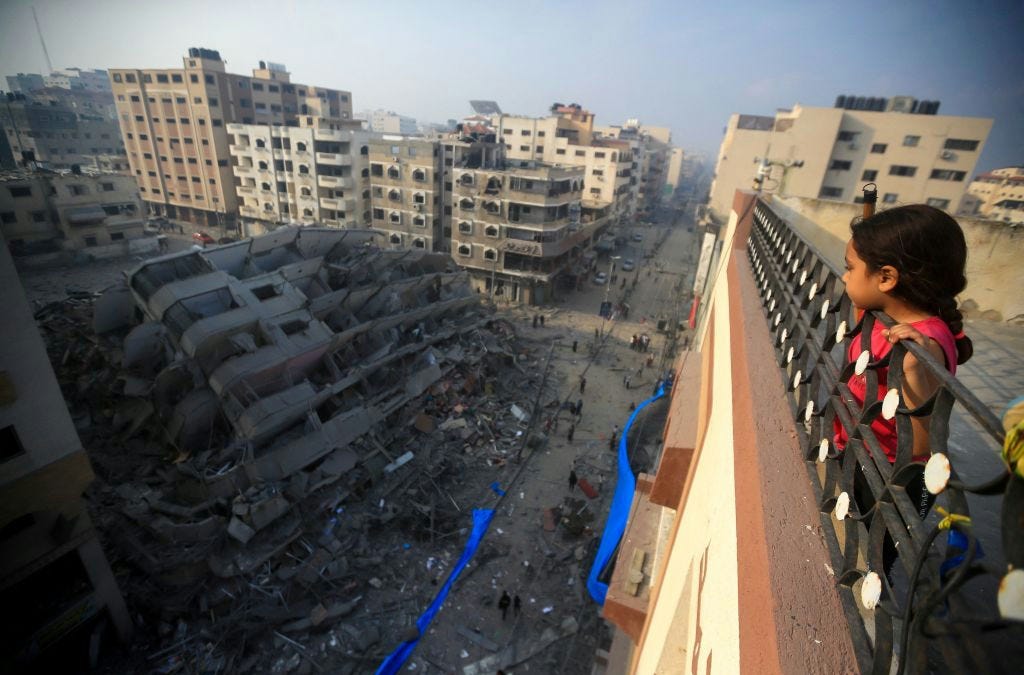
Satellite photos show how Israeli forces have erased Gaza towns

Read the original at Toronto Star ↗
Toronto Star · collected 2026-10-07 · by Lee Keath And Wafaa Shurafa The Associated Press

Quick Summary

Satellite images reveal that Israel’s military campaign has extensively demolished Rafah and other towns in Gaza since October 2023. The Israeli forces have systematically razed areas under their control, with demolition continuing even after a ceasefire agreement was reached a year ago. This destruction covers around 60% of the territory, leaving much of Gaza's population displaced and living in makeshift shelters due to ongoing restrictions on construction materials entering the area.
Written locally by qwen2.5:14b on 2026-10-07, using this article's own text rather than the other coverage of the same event (that is the story summary below).

AI analysis runs on qwen2.5:14b, locally

Story summary

Satellite photos reveal how Israeli forces have systematically destroyed towns in the Gaza Strip, including the city of Rafah which was home to a quarter million people. Since Israel's military campaign began after Hamas attacked southern Israel on October 7, 2023, more than one out of every ten Palestinians from Gaza’s prewar population has been killed or injured by Israeli fire. In September 2024, Najwa Abu Eita lost her seven-year-old daughter when an Israeli attack struck their home in the Nuseirat refugee camp, and her other three children were also injured. The military continues to raze areas using bulldozers and explosives, even after a ceasefire was reached a year ago, controlling around 60% of Gaza's territory. This widespread destruction has left almost the entire population homeless.

Written for “Israeli Forces Destroy Gaza Towns” on 2026-10-07, grounded in this article and the 0 other(s) covering the same event.
Why this leaning score
The article's own words the score was based on. Each is quoted verbatim and was checked against the article text before being stored, so you can find it in the original.
Reading Leans strongly left (beta estimate) Confidence high
Leaning: leans strongly left for article 61895 (high confidence, 5 verified quotes) · logged 2026-10-07

Signals How these are calculated →

Claims extracted
57
claim-shaped sentences
Uncertain
4%
2 of 57 hedged
Leaning
Leans strongly left
of the writing, not the subject · beta estimate
Correction & hedging signals
63.0
corrections and hedging in what we collected; not a measure of accuracy
Outlets on this story
1
World
Narrative spread
1
articles carrying this framing
Analyzed 2026-10-07 · how these are computed

Story

📰 Israeli Forces Destroy Gaza Towns
World · 1 article(s) covering the same event.

How this is being covered How these are calculated →

Article leaning vs. publisher reliability
Source leaning vs. consistency

Compared with similar articles

This article reads leans strongly left and hedges 4% of its claims. Each row says how that neighbour differs.
The Free Press
⚖️ Leans strongly right further right than this 🔴 0% hedged 0 of 14 📰 publisher trust 96
“While both articles discuss the impact of Israeli military actions in Gaza following Hamas' attack, they describe different aspects and outcomes: Article A focuses on discourse around Palestinian advocacy, while Article B describes specific destruction visible through satellite imagery.”
Toronto Star
⚖️ Leans right further right than this 🔴 2% hedged 1 of 62 📰 publisher trust 63
“The articles describe different aspects and time periods of destruction in Gaza, with Article A focusing on a recent visit to observe Beit Hanoun, while Article B uses satellite imagery to show the systematic erasure of Rafah over several years.”
Zeteo
⚖️ Leans strongly left 🔴 0% hedged 0 of 13
“Article A discusses broader isolation and political sentiments towards Israel following a significant attack, while Article B focuses on specific satellite imagery showing destruction in Gaza towns over a period of time.”

Publisher

Toronto Star · 5608 article(s) · 19 correction(s) detected
Running correction rate · 19 correction(s)
2026-10-07
Correction
2026-10-05
Entertainment Correction for Oct. 5
2026-10-03
Tennessee's prisons chief is resigning after failed execution of Christa Pike
2026-09-28
Organizations call for Action to End the Deaths of Indigenous People in Custody
2026-09-27
Police memorial recognizes six officers killed in the line of duty in 2026
2026-09-27
UPDATE: WSP to host Power & Energy-focused investor event virtually only
2026-09-26
News Clarification for Sept. 27
2026-09-26
Former federal public servant seeks better pensions for injured workers
2026-09-25
News Corrections for Sept. 25
2026-09-25
She has not been charged. But the Project South allegations have branded her with a 'scarlet letter'
2026-09-24
Correction
2026-09-23
MULTIMEDIA UPDATE: Smith+Nephew launches the new EVOS™ PELVIC Plating System at the 2026 Orthopedic Trauma Association (OTA) Annual Meeting, expanding the EVOS Plating Platform for pelvic and acetabular fracture management
2026-09-22
Costa Rican man complained of lack of care for diabetes before his death in ICE custody, family says
2026-09-22
Judges' grilling of accused men leads to sex assault and dangerous driving cases being overturned
2026-09-20
Jura Energy Corporation Provides Clarification Regarding Media Reports Concerning Its Petroleum Rights in Pakistan
2026-09-19
New details emerge about Toronto's guns-for-hire and the 'crash-out mission" that sparked the Project South investigation
2026-09-17
UPDATE: Osisko Critical Minerals Corporation Announces C$100 Million Private Placement of Special Warrants
2026-09-17
Alabama set to execute man for pawn shop killings months after his nitrogen gas execution blocked
2026-09-04
Orca Corrects Q3 Quarterly Dividend Announcement

Who wrote this

Lee Keath And Wafaa Shurafa The Associated Press
1 article(s) here · 1 carrying a prediction
🔮 The report warned that it could constitute a crime against humanity or reach the level of genocide, which under international law includes “deliberately inflicting conditions of life calculated to bring about physical destruction.”
Wire or desk byline, not an individual reporter.
Nothing else under this byline in the corpus.

Topics

Gaza Hamas Israel Israeli Palestinians

Subjects

Israel GPE · 10× Israeli NORP · 8× Gaza GPE · 6× Hamas ORG · 5× Palestinians NORP · 2× DEIR AL-BALAH GPE · 1× Gaza Strip GPE · 1× Najwa Abu Eita PERSON · 1× Rafah GPE · 1× the Gaza Strip GPE · 1×

Narrative

In the meantime, Palestinians wrestle with tragedy Najwa Abu Eita lost her 7-year-old daughter when Israeli forces struck her home in the central refugee camp of Nuseirat in September 2024, and her three other children were injured in the attack.
framing: assertive · carried by 1 article(s) · first seen 2026-10-07
🔮 The report warned that it could constitute a crime against humanity or reach the level of genocide, which under international law includes “deliberately inflicting conditions of life calculated to bring about physical destruction.”
2026-10-07 · Toronto Star
Satellite photos show how Israeli forces have erased Gaza towns · assertive framing

Claims (57 extracted, 2 hedged)

It’s perhaps the most dramatic wound inflicted on the Gaza Strip by Israel’s military campaign over the past three years: The city of Rafah, once home to a quarter million people, has been erased. asserted
city → ’ → people
Satellite imagery shows the Israeli military has systematically razed the southern city and other towns and districts to the ground and in some places plowed away the rubble. asserted
military → show → rubble
Demolition, using bulldozers and explosives, has continued unabated since the Israel-Hamas ceasefire deal reached a year ago, as the military solidifies its hold over the around 60% of the territory that it still controls. asserted
it → use → that
Gaza’s mangled landscape is just one of the wounds on top of wounds that the enclave’s 2 million Palestinians have endured since Israel launched its campaign to destroy Hamas after the militants’ Oct. 7, 2023, attack on southern Israel. asserted
Israel → endure → Israel
More than one out of every 10 people from Gaza’s prewar population has been killed or wounded by Israeli fire. asserted
people → kill → fire
While nearly every family mourns dead or cares for wounded, most also had to move multiple times to escape fighting and Israeli evacuation orders. asserted
most → mourn → fighting
Ramshackle canvas and nylon shelters blanket beaches and former agricultural lands and fill empty lots. asserted
shelters → blanket → lots
Little is likely to change for the foreseeable future. asserted
Little → change → future
While the ceasefire deal stopped the offensives and heaviest bombardment, Israel hits tents, cars and buildings almost daily in strikes that it says target Hamas members — but that regularly kill women, children and other family members. asserted
that → stop → women
People no longer have to flee from place to place, but few can rebuild homes because Israel bars most construction material from entering Gaza. asserted
Israel → have → Gaza
The ceasefire agreement’s plan for the large-scale reconstruction of Gaza has never gotten off the ground because Israel and Hamas have failed to reach a deal on disarming the militant group. asserted
Israel → get → group
In the meantime, Palestinians wrestle with tragedy Najwa Abu Eita lost her 7-year-old daughter when Israeli forces struck her home in the central refugee camp of Nuseirat in September 2024, and her three other children were injured in the attack. asserted
children → wrestle → attack
Abu Eita lost an eye, her face remains heavily damaged and scarred, and she has trouble breathing. asserted
she → lose → trouble
A hairdresser before the war, she now has no work, living in a tent by the ruins of her home. asserted
she → have → home
Worst of all, she says, her children are frightened by her face and avoid looking at her. asserted
children → say → her
“My 4-year-old son tells me, ‘Momma, I’ll give you one of my eyes.’ asserted
I → tell → eyes
And inside, I’m weeping,” she said. asserted
she → weep → ?
On the Israeli-held side, destruction continues Gaza’s population is squeezed into about 40% of the tiny territory, and Israel’s military controls the rest. asserted
military → hold → rest
Satellite imagery by Planet Labs PBC shows that the vast majority of buildings in the Israel-held part have been bulldozed or exploded down to piles of rubble, much of it after major fighting ended a year ago. asserted
fighting → show → it
The Israeli military says it demolishes buildings to prevent their use by Hamas militants or to destroy the group’s tunnel networks. asserted
it → say → networks
But a U.N.-appointed expert said in a February report that the scale of destruction of civilian housing and infrastructure in Gaza “is unprecedented even by the terrible standards of modern warfare since the 20th century.” asserted
scale → say → century
The report warned that it could constitute a crime against humanity or reach the level of genocide, which under international law includes “deliberately inflicting conditions of life calculated to bring about physical destruction.” uncertain
which → warn → destruction
Israel rejects accusations of genocide, saying it targets Hamas militants and their infrastructure that are interwoven with civilian areas. asserted
that → reject → areas
The Planet Labs imagery shows at least 50 Israeli military outposts built throughout the Israeli-held part of Gaza, at least 18 of them constructed since the ceasefire began. asserted
ceasefire → show → them
Many have been put on top of former neighborhoods where the rubble of demolished buildings nearby has been cleared away. asserted
rubble → put → buildings
Most of Rafah was razed before the ceasefire, but images show that troops continue to demolish the few remaining buildings. asserted
troops → raze → buildings
Several abandoned U.N. buildings have been spared, as well as a municipal sports field that now appears to contain a military base. A new base also stands on what was once the main intersection of the southern town of Beni Suhaila. asserted
what → abandon → Suhaila
Leveled over the past year, the town is now a wasteland intersected by a spiderweb of dirt paths that were once streets. asserted
that → level → paths
In Jabaliya in the north, most of the al-Awda Hospital Complex was reduced to rubble in recent months, as were a number of U.N.-run school buildings, satellite images show. asserted
images → reduce → buildings
Jabaliya was once home to the Gaza Strip’s biggest refugee camp, home to some 120,000 refugees and tens of thousands of other residents in a densely built urban district. asserted
Jabaliya → build → district
Now one of the few buildings still standing is the octagonal-shaped Indonesian Hospital, empty since troops shut it down in June 2025. asserted
troops → stand → June
The Israeli military built a new base nearby. asserted
military → build → base
Similarly, most of Beit Hanoun, once a town of some 70,000 people in Gaza’s far northeast corner, and Shijaiya, a Gaza City neighborhood founded 800 years ago, are now block after block of leveled houses and apartment towers. asserted
most → found → houses
Gaza’s economy has been wrecked asserted
economy → wreck → ?
An increased flow of aid and commercial products brought Gaza back from famine that arose in some areas last year under a monthslong Israeli ban on food and other goods. asserted
that → increase → food
But most of the population remains dependent on international relief. asserted
most → remain → relief
Jobs are few, mostly connected to selling in the market. asserted
Jobs → connect → market
Shadi Barawi lost his father early in the war. asserted
Barawi → lose → war
Soon after that, Barawi was hit by shrapnel from a strike near his home in Gaza City, and his leg was amputated — one of some 6,000 amputees left by the war. asserted
leg → hit → war
After losing his leg, “I lost all hope in life,” the 35-year-old said. asserted
old → lose → life
…and 17 more, not listed.

💬Give feedback
🕘History 🎫Support