Kmart removed its $89 Anko camera glasses from online sale following a privacy backlash that led to an investigation by Australia's Privacy Commissioner. More than 57,000 people signed a petition calling for the glasses' removal. The cheaper Anko glasses had sold out within days of their July 28 release, undercutting Meta’s Ray-Ban models significantly in price. Privacy commissioner Carly Kind is now investigating Shenzhen Qingcheng Future Technology and other retailers selling similar smart glasses due to privacy concerns raised by Attorney-General Michelle Rowland.
Written locally by qwen2.5:14b on 2026-10-07,
using this article's own text rather than the other coverage of the
same event (that is the story summary below).
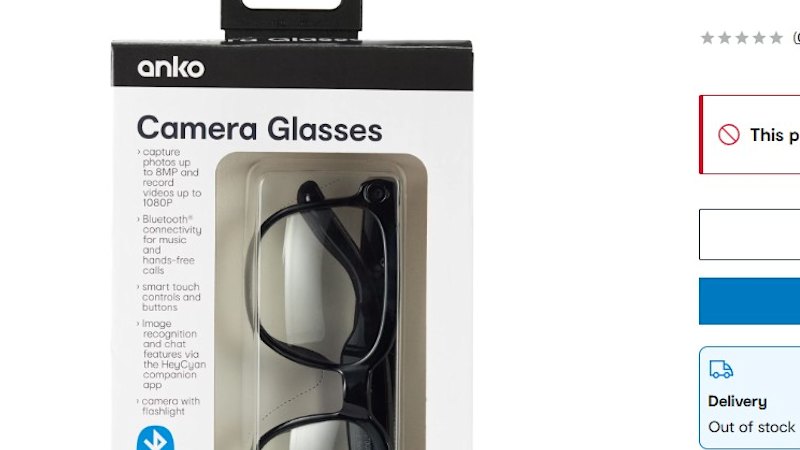
Kmart has removed its $89 camera glasses from sale online, two months after the cut-price devices sparked a national privacy backlash and calls for the federal government to step in.
asserted
government → remove → backlash
The Anko smart glasses, which shoot video and take photos through a camera built into the frame, no longer appear on Kmart’s website.
asserted
which → shoot → website
The retailer still sells a $39 pair of speaker glasses, which play music and take calls but have no camera.
asserted
which → sell → camera
Kmart was contacted for comment.
asserted
Kmart → contact → comment
The development follows a campaign by activist Gina Martin, who petitioned Kmart group managing director Aleksandra Spaseska to remove the glasses from stores and online.
asserted
who → follow → stores
GetUp, which hosted the petition, said more than 57,000 of its members had joined the push.
asserted
57,000 → host → push
The glasses went on sale on July 28 and sold out in less than a week, undercutting Meta’s Ray-Ban models by hundreds of dollars.
asserted
glasses → go → dollars
When this masthead reported on the backlash in August, Kmart described them as part of an “established and increasingly mainstream category” of wearable technology.
asserted
Kmart → report → technology
Privacy commissioner Carly Kind on Wednesday announced an investigation into Shenzhen Qingcheng Future Technology, the Chinese company whose HeyCyan app runs the Anko glasses, as well as cheap glasses sold on Big W Marketplace and Amazon.
asserted
app → announce → Marketplace
Kind’s office began questioning Meta, Kmart, Google and Shenzhen Qingcheng on August 12, after attorney-general Michelle Rowland asked it to examine smart glasses because of the risk of women and children being filmed covertly.
asserted
women → begin → risk
Shenzhen Qingcheng did not respond.
asserted
Qingcheng → respond → ?
“In the absence of any response from Shenzhen Qingcheng to the OAIC’s preliminary inquiries, I have no assurance that it is protecting personal data of Australians as required by the Privacy Act,” Kind said.
asserted
Kind → have → Act
Kind has written to retailers selling devices that use HeyCyan, urging them to “consider whether it is appropriate to continue making these devices available”.
asserted
devices → write → them
The investigation gives Kind compulsory information-gathering powers, and she can seek civil penalties in the Federal Court if she finds serious or repeated interferences with privacy.
asserted
she → give → privacy
Opening an investigation does not mean the commissioner has found the company broke the law.
asserted
company → open → law
Shenzhen Qingcheng was contacted for comment.
asserted
Qingcheng → contact → comment
Milica Stilinovic, a postdoctoral research associate at the University of Sydney’s Governing Immersive Tech project, said cheaper glasses often came with questionable data-retention practices and recording lights that were hard to see or missing altogether.
asserted
that → say → practices
“State and federal governments must urgently answer the call to step up and protect Australians against non-consensual recording, data breaches, and basic notions of privacy,” Stilinovic said.
asserted
Stilinovic → answer → privacy
Her team’s research, released in August, found that in Instagram videos where women appeared not to know they were being filmed, about 60 per cent of the interactions could be classed as potential harassment.
uncertain
cent → release → harassment
The more expensive glasses remain on sale.
asserted
glasses → remain → sale
Meta has sold more than 7 million pairs of its glasses, and Google and Apple are both preparing rivals.
asserted
Google → sell → rivals
Ferris said Meta was still selling millions of pairs, and that Australia’s privacy laws “weren’t written for a world with hidden cameras on people’s faces”.
asserted
laws → say → faces
Meta has said every pair carries a white light that flashes during recording and cannot be switched off without disabling the camera.
asserted
that → say → camera
Local councils have already acted.
asserted
councils → act → ?
Brisbane City Council has banned non-consensual filming with camera devices, including smart glasses, at its 21 public pools, and Yarra, the City of Sydney and Canterbury-Bankstown have brought in similar rules at pools and leisure centres.
asserted
Bankstown → ban → pools
Finance Minister Katy Gallagher has asked the Australian Public Service Commission whether the glasses should be banned in public service workplaces.
asserted
glasses → ask → workplaces
The federal government is not planning an outright ban.
asserted
government → plan → ban
Consultation on its draft Privacy Act reforms closed in mid-September, and legislation is expected before the end of the year.
asserted
legislation → close → year
The Greens want a 12-month import ban on camera-enabled wearables, with an exemption for disability aids.
asserted
Greens → want → aids
 The Aporia