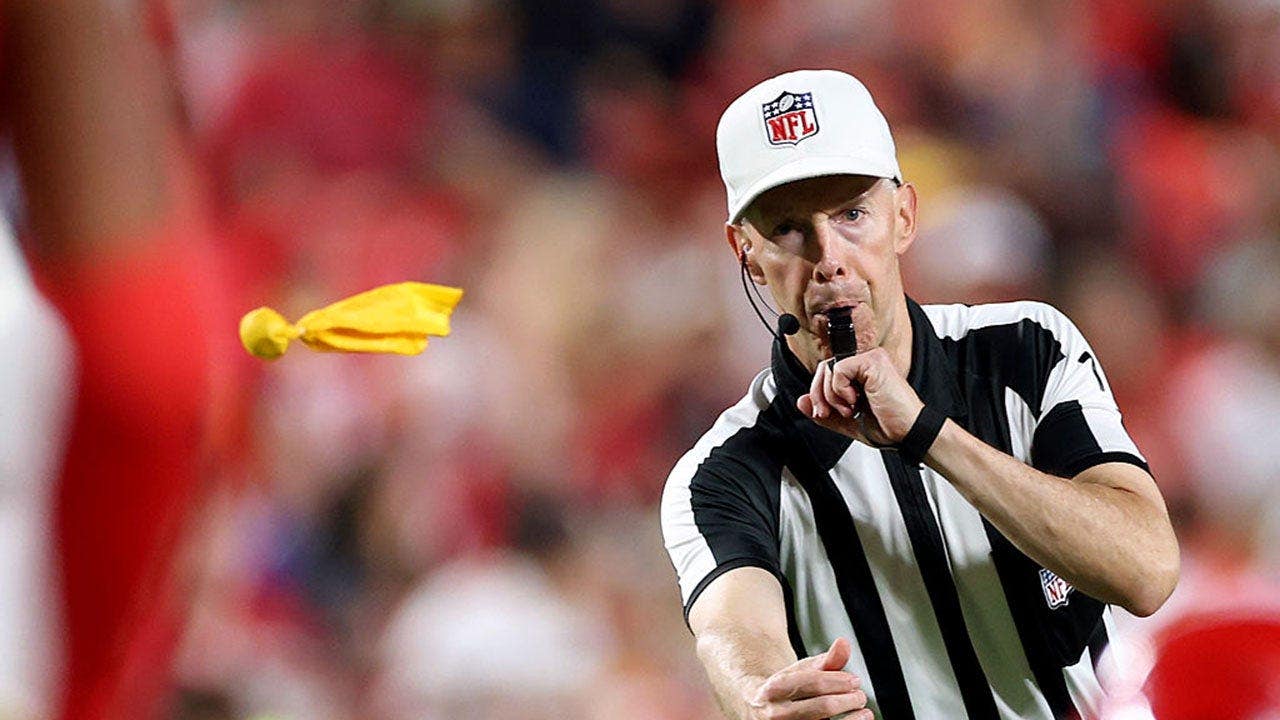
Each year, NFL fans complain that officials are throwing more flags than ever before.
asserted
officials → complain → flags
Most years, the perception exceeds the evidence.
asserted
perception → exceed → evidence
This year, the evidence supports the complaint.
asserted
evidence → support → complaint
This page may contain affiliate links to legal sports betting partners.
uncertain
page → contain → partners
If you sign up or place a wager, FOX News may be compensated.
uncertain
News → sign → wager
This content was created by a team that works independently from the FOX newsroom.
asserted
that → create → newsroom
According to ESPN Insights, the league has recorded more accepted penalties through Week 4 this season than in any other season since play-by-play data became available in 1978.
uncertain
data → accord → 1978
Officials assessed 271 accepted penalties, the second-highest total for any week over that span.
asserted
Officials → assess → span
That's around 17 accepted penalties per game.
asserted
That → accept → game
Sharp Football Analysis provided additional context on Tuesday.
asserted
Analysis → provide → Tuesday
According to its analysis, officials are flagging offenses at the highest per-snap rate through four weeks of any season since 2000, at 6.18 penalties per 100 snaps.
uncertain
officials → accord → snaps
The increase is also occurring at particularly consequential points in games.
asserted
increase → occur → games
Officials have set early-season records for accepted flags thrown in the red zone and on third and fourth downs in the second half.
asserted
Officials → set → half
These penalties aren't merely disrupting drives.
asserted
penalties → disrupt → drives
They are erasing points.
asserted
They → erase → points
So far this season, penalties have nullified 17 touchdowns.
asserted
penalties → nullify → touchdowns
To be clear, an accepted penalty does not mean officials made the correct call.
asserted
officials → accept → call
Last week, Rams coach Sean McVay said the NFL privately acknowledged that officials incorrectly called defensive pass interference against Los Angeles in the closing moments of its Week 3 loss to Denver, nullifying an interception.
asserted
officials → say → interception
Without the flag, the interception would've won the Rams the game.
asserted
interception → win → game
Instead, Denver retained possession and capitalized on the erroneous call to win.
asserted
Denver → retain → call
That example illustrates the larger problem.
asserted
example → illustrate → problem
The proliferation of flags has become one of the defining features of the 2026 season.
asserted
proliferation → become → season
Fans don't watch football to see officials determine the outcome of drives.
asserted
officials → watch → drives
Yet listen to almost any broadcast after a significant play, and you'll hear an announcer quickly add, "No flags."
asserted
announcer → listen → flags
Viewers have become conditioned not to trust the initial result of a play.
asserted
Viewers → condition → play
A touchdown, long completion, turnover, or critical stop now routinely produces a moment of hesitation as everyone scans the field for yellow.
asserted
everyone → produce → yellow
Waiting to find out whether a play counts has become part of the viewing experience.
asserted
play → wait → experience
Which raises a more important question: Why are officials throwing flags at such a historic rate?
asserted
officials → raise → rate
One possibility is that teams are simply playing sloppier football.
asserted
teams → play → football
Reduced offseason work and lighter practice schedules could plausibly contribute to more procedural errors, poor technique, and legitimate penalties.
uncertain
work → contribute → errors
But football has always operated under an inconvenient reality: officials could probably identify some technical violation on nearly every play.
uncertain
officials → operate → play
Some infractions are obvious and materially affect the play.
asserted
infractions → affect → play
Others occupy a gray area where enforcement depends largely on judgment and discretion.
asserted
enforcement → occupy → judgment
The distinction matters because officials plainly exercise that discretion later in the season.
asserted
officials → matter → season
The same officiating crews that produce flag-heavy games during the regular season generally adopt a more permissive standard in the playoffs.
asserted
that → produce → playoffs
Officials are more inclined to "let them play" in the postseason, particularly in high-leverage situations where a marginal call could dictate the outcome.
uncertain
call → let → outcome
By effectively raising the threshold in the playoffs, the NFL acknowledges that over-officiating diminishes the product and that marginal penalties should not decide its most important games.
asserted
penalties → raise → games
That also suggests the league accepts, or at least tolerates, the flag-heavy officiating that has come to define the early months of the season.
uncertain
that → suggest → season
If it didn't, it would instruct officials to exercise the same restraint in September and October that they routinely exercise in January.
asserted
they → do → January
Perhaps the league sees officiating controversy as a marketing tool.
asserted
league → see → tool
…and 11 more, not listed.
 The Aporia