US military interests control or have access to more than 100 defence facilities on Australian soil, in what some analysts describe as a “saturation” – even a “colonisation” – of the Australian continent.
asserted
analysts → control → continent
New data compiled by the Nautilus Institute and published by Guardian Australia maps the extent of US militarisation.
asserted
data → compile → militarisation
The US military controls 17 facilities on mainland Australia and has access to 75 more Australian-run military installations.
asserted
military → control → installations
US defence corporations have access to an additional 18.
asserted
corporations → have → 18
In total, the US military and US defence corporations have control of or access to 110 facilities on Australian territory, well over half of all the military installations in Australia.
asserted
military → have → Australia
“We have been thinking about American influence on Australian defence policy as a matter of penetration,” the database’s author, Prof Richard Tanter, tells the Guardian, “and we’re aware of the closeness of the alliance, the integration of the armed forces …
“But what this database shows is it’s not a matter of penetration, it’s a matter of saturation.
asserted
it → think → saturation
Over half of the defence facilities that we have looked at have some level of American access: that means American personnel, it means American corporations, some of the biggest armaments companies in the world.”
asserted
it → look → world
The US military controls or has access to 92 defence facilities on Australian soil for:
-
Gathering intelligence, accessing satellite data for targeting information and communications intercepts.
-
Training, including for 2,500 marines on dry-season rotation in the Northern Territory.
-
Pre-positioning warfighting assets such as Osprey aircraft.
-
Logistics hubs holding weapons, munitions and fuel, stored in case of a war in the Pacific.
asserted
military → control → Pacific
Some bases, including Pine Gap, play critical roles in identifying targets for US strikes overseas and are well known by Australians, even if their operations are highly classified.
asserted
operations → include → Australians
Others are massive – the Bradshaw field training area in the Northern Territory is the size of Cyprus – but barely known.
asserted
area → know → Cyprus
Announced in June, Bandiana base in Wodonga will be the site of tens of millions of dollars worth of pre-positioned US weapons, munitions, fuel and vehicles, stationed for rapid deployment in the event of conflict in the Pacific.
asserted
base → announce → Pacific
Beyond the military’s presence, at least 42 Australian military facilities are accessed by US defence contractors – some of the biggest weapons manufacturers in the world – which use Australian sites for manufacturing, testing and training of weapons systems deployed by militaries across the globe.
asserted
which → access → globe
Lockheed Martin assembles guided missiles in Port Wakefield, South Australia.
asserted
Martin → assemble → Wakefield
Northrop Grumman signed a multimillion-dollar contract this year to build rocket motors for guided weapons at Mulwala in New South Wales.
asserted
Grumman → sign → Wales
Collaboration with US manufacturers will “promote allied interoperability and provide a second source of supply for critical munitions”, the Australian defence force says.
asserted
force → promote → munitions
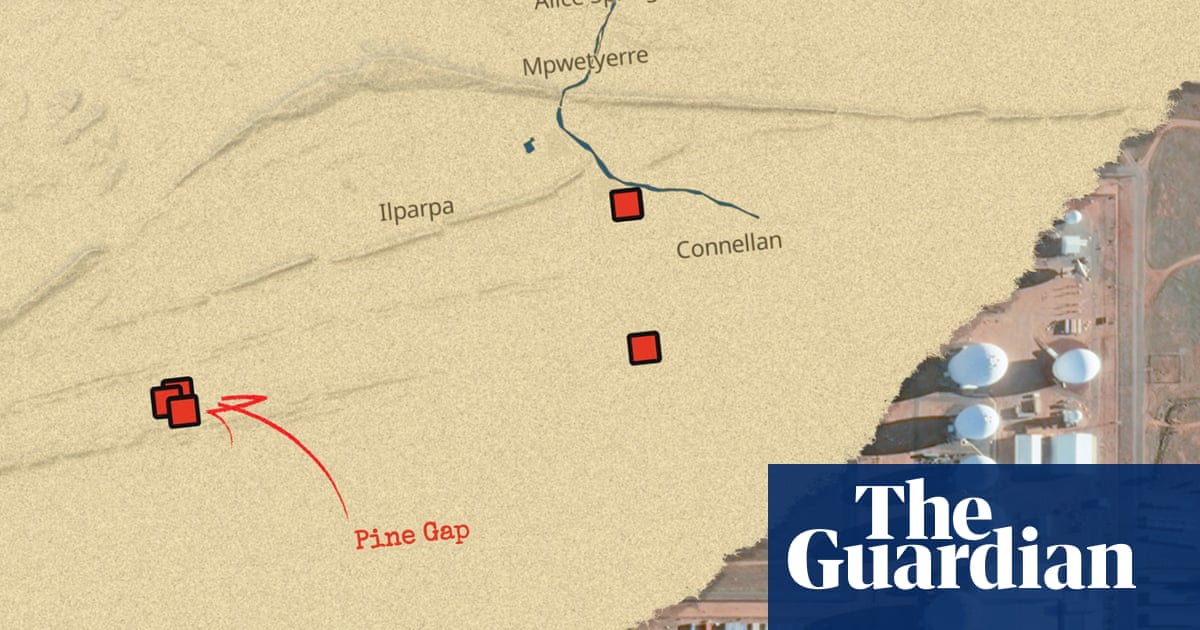
Of the military bases that operate under US control, with Australian access, Pine Gap is the best known.
asserted
Gap → operate → access
But its precise role in US warfighting is hidden from public view.
asserted
role → hide → view
Like several large military bases across Australia, Pine Gap hosts multiple defence facilities, each with distinct functions: a ground-control station for signals intelligence satellites; a relay ground station for early-warning missile launch systems; and a site for intercepting foreign satellite communications.
asserted
Gap → host → communications
The Nautilus Institute database counts defence facilities, rather than bases, so Pine Gap consists of three distinct, co-located facilities.
asserted
Gap → count → facilities
Critical to US operations around the world, including conflicts in the Middle East, it is formally a “joint defence facility” but it is always commanded by an American.
asserted
it → include → American
The Force Posture agreement – “with full respect for Australian sovereignty” – gives US forces and contractors “unimpeded access to and use of” agreed Australian facilities, including for deploying forces and materiel, bunkering vessels and refuelling aircraft.
asserted
agreement → give → aircraft
The US military presence will continue to expand.
asserted
presence → continue → ?
From next year up to 1,200 uniformed military personnel will operate from the HMAS Stirling submarine base just off Fremantle.
asserted
personnel → operate → Fremantle
The government insists that technically this will not be a US base – rather a “rotation” – but there is little contestation of its actual implication.
asserted
this → insist → implication
Arguing in favour of the Aukus nuclear submarine agreement, the former defence minister Christopher Pyne told a public inquiry the multibillion-dollar deal was “a lot more than the submarine procurement”.
asserted
deal → argue → procurement
“From a strategic point of view, it’s not something that’s ever really discussed in the public, but it’s one of the most important aspects of it: Aukus is also a new United States submarine base in the Indian Ocean.
asserted
Aukus → ’ → Ocean
“For the Americans, being able to have a submarine base in the Indian Ocean is a massive strategic advantage.”
asserted
being → have → Ocean
Tanter, a senior research associate at the independent public policy thinktank the Nautilus Institute for Security and Sustainability and an honorary professorial fellow at the University of Melbourne, says the US military’s expanding presence is not in service of its junior alliance partner but rather US interests alone.
asserted
presence → say → partner
“Over more than a decade, the United States has been preparing the capacity for high-tempo warfighting operations with China, springboarding from Australia,” he says.
asserted
he → prepare → Australia
“And that means we are aligning ourselves completely with American strategic planning.
asserted
we → mean → planning
“From a Chinese perspective, Australia is not so much hosting US bases on its territory, it’s a US base in its own right …
asserted
it → host → right
This database has been compiled from open-source information, responses provided to parliament, and government and commercial reporting.
asserted
database → compile → parliament
Tanter argues that the acceptance of the US military presence has become so ingrained within the government and defence that unwinding Australia’s enmeshment within the world’s most powerful military is increasingly difficult.
asserted
unwinding → argue → military
“This is a massive institutional failure in Australia, a kind of learned incapacity at a political, parliamentary and bureaucratic level,” he says.
asserted
he → say → level
“We’ve learned how not to ask those questions.”
asserted
We → learn → questions
At a press conference in June, the defence minister, Richard Marles, demonstrated the breadth of the US military presence in Australia.
asserted
minister → demonstrate → Australia
Speaking in Rockingham, Western Australia – across a narrow bay from HMAS Stirling – Marles was announcing the establishment of a $30m US logistics base in Wodonga, Victoria.
asserted
Marles → speak → Wodonga
“We are seeing a growing US footprint in Australia that is important in terms of building our own military capability but also it’s very important for Australia’s national security,” Marles said.
asserted
Marles → see → security
Marles said the “hugely significant American presence” in the region was a balance to China’s “very significant military buildup”.
asserted
presence → say → buildup
Earlier, the minister told the Defending Australia Summit that US military presence in Australia was indispensable to deter conflict in the region.
asserted
presence → tell → region
…and 37 more, not listed.
 The Aporia