On October 6, representatives from 30 countries observed Tuvalu's reclamation project aimed at combating rising sea levels caused by climate change. The event, held ahead of a preparatory conference for the United Nations COP31 climate forum in Turkey, involved spreading dredged sand over 6 hectares to reclaim lost land and protect it with sea walls and barriers costing approximately US$50 million. Foreign Minister Paulson Panapa emphasized the urgency of decisive action, as Tuvalu's main island is just 2 meters above sea level, making it one of the most vulnerable nations to climate change.
Written locally by qwen2.5:14b on 2026-10-06,
using this article's own text rather than the other coverage of the
same event (that is the story summary below).
Story summary
Prime Minister Anthony Albanese and Climate Change Minister Chris Bowen traveled to Fiji on October 5, 2026, for a "pre-COP" climate summit aimed at drawing global attention to the impacts of climate change in the Pacific. The event, co-hosted by Fiji, Tuvalu, and Australia, has drawn criticism due to only two leaders from outside the region accepting invitations, along with concerns over its cost, estimated at over $20 million. Despite this, Albanese emphasized the importance of the summit for amplifying Pacific voices on climate issues. The leaders visited Tuvalu, a nation highly vulnerable to rising sea levels, where they witnessed efforts like land reclamation and construction of sea walls aimed at staving off the effects of climate change.
Written for “Climate Summit Fiji” on 2026-10-06,
grounded in this article and the 8 other(s) covering the same event.
Why this leaning score
The model judged this article politically coded and scored it -0.35, but all 2 of its quote(s) are attributed speech - words the article quotes from someone, not the article's own narration, so the score is not published.
Written under an earlier scoring contract, which gave a paragraph
rather than checkable quotes. Re-analysing this article replaces it.
Leaning score withheld for article 59412: attributed speech only · logged 2026-10-06
Pacific leaders watch Tuvalu reclamation effort ahead of UN climate meet
FUNAFUTI, Tuvalu –
asserted
leaders → watch → meet
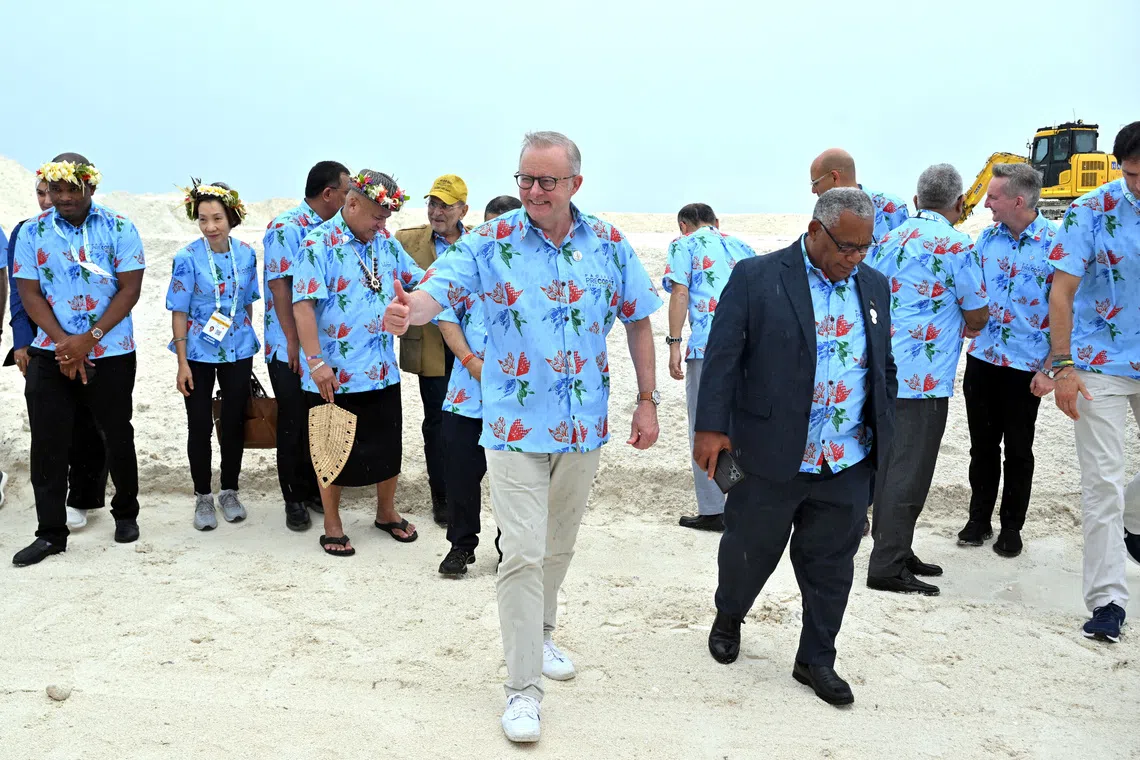
Representatives of 30 nations watched on Oct 6 as white sand dredged from an atoll lagoon was used to reclaim land from the ocean in a fight by the tiny Pacific nation of Tuvalu to keep its main island from being lost to rising waves.
asserted
sand → watch → waves
“You are standing on front-line soil,” Foreign Minister Paulson Panapa told the leaders gathered ahead of pre-COP, a preparatory conference for the United Nations COP31 climate forum in Turkey in November.
asserted
Panapa → stand → November
“Promises will not hold back rising tides...
asserted
Promises → hold → tides
what this moment requires is decisive delivery.”
asserted
requires → require → what
The reclamation effort on Oct 6, spread over 6ha, is part of work costing about US$50 million (S$64 million) of donor funds that also built sea walls and barriers to protect land.
asserted
that → spread → land
“We are sinking,” said Faiva Namoliki, a 39-year-old architect huddled in a sodden jacket in pouring rain outside the event.
asserted
Namoliki → sink → event
“Here they see the reality,” he said of the visitors.
asserted
he → see → visitors
“We hope they will carry the message away with them, and it will make a difference.”
asserted
it → hope → difference
Rising sea levels
Sea levels around Tuvalu have risen about 15cm in the three decades to 2023, say NASA researchers, or twice as fast as the global average.
asserted
researchers → rise → average
“Small amounts of sea level rise make a very big difference in making flood events bigger and more damaging,” Jamie Ovia, the head of Tuvalu’s climate change department, told the leaders.
asserted
Ovia → make → leaders
“If we add just 30cm of sea level rise – expected by 2050 – this supercharges the flooding and makes it drastically bigger than floods we would have seen every 100 years in the past.”
Such inundations would be economically crippling, he added.
asserted
he → add → past
Pre-COP events are typically technocratic meetings of climate negotiators, but Australia, which is leading the talks in 2026, aims with its Pacific partners to highlight the issue of rising sea levels through the Tuvalu gathering.
asserted
which → lead → gathering
It also seeks to bolster Australia’s ties in the region and counter growing Chinese influence.
asserted
It → seek → influence
But attendance fell short, with 11 of the Australian government’s tally of 14 attending presidents and prime ministers hailing from Pacific islands.
asserted
attendance → fall → islands
The rest came from Australia, Mauritius and East Timor.
asserted
rest → come → Australia
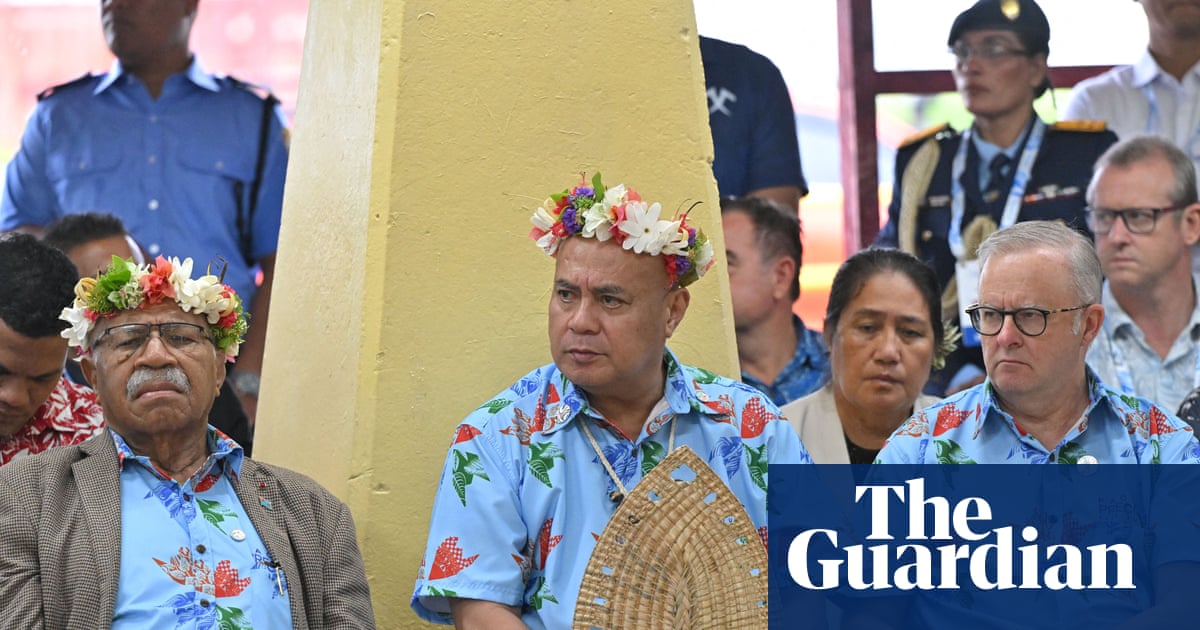
Dignitaries arrived amid heavy rain to be handed umbrellas as they descended from aircraft in matching bright blue patterned shirts, before a traditional song performance by dancers, drummers and singers with flower headbands.
asserted
they → arrive → headbands
Significant additions to land mass
The project highlighted on Oct 6 is the third in a series that will soon have added about 21ha to Tuvalu’s main island, project manager Alan Resture told the visitors.
asserted
Resture → highlight → visitors
Pacific nations have been at the forefront of efforts to limit global warming to 1.5 deg C to avoid its worst effects – a threshold the world is set to exceed in the coming years.
asserted
world → limit → years
“Every fraction of a degree matters,” Tuvalu Prime Minister Feleti Teo told the visiting leaders.
asserted
Teo → matter → leaders
Australia is bankrolling pre-COP, but has drawn fire as a major exporter of coal and gas that continues to approve fossil fuel projects.
asserted
that → bankroll → projects
“Here in Tuvalu, we are seeing what action can look like,” said Australian Prime Minister Anthony Albanese.
asserted
Albanese → see → what
“It’s about people.”
asserted
It → ’ → people
 The Aporia