Persuasion
· collected 2026-10-06 · by Philip A. GLOTZBACH
commentary
This article is brought to you by American Purpose, the magazine and community founded by Francis Fukuyama in 2020, which is proudly part of the Persuasion family.
asserted
which → bring → family
Our journey out of the dark political wood begins in an unlikely place, by taking a closer look at the fairy tale Hansel and Gretel to explore an often obscured but deep-seated tension.
asserted
journey → begin → tension
The basic plot seems straightforward enough: A humble woodcutter (or broom maker) and his second wife—now stepmother to his son and daughter, Hansel and Gretel—confront a severe famine.
asserted
woodcutter → seem → famine
The stepmother argues there’s not enough food to keep them all from starving.
asserted
stepmother → argue → them
Her solution is to reduce the number of hungry mouths by abandoning the children deep in the forest, so that at least she and her husband might survive the hard times.
uncertain
she → reduce → times
After some bickering and negotiation, the parents agree and, on their second try, succeed in leaving the children to fend for themselves.
asserted
parents → agree → themselves
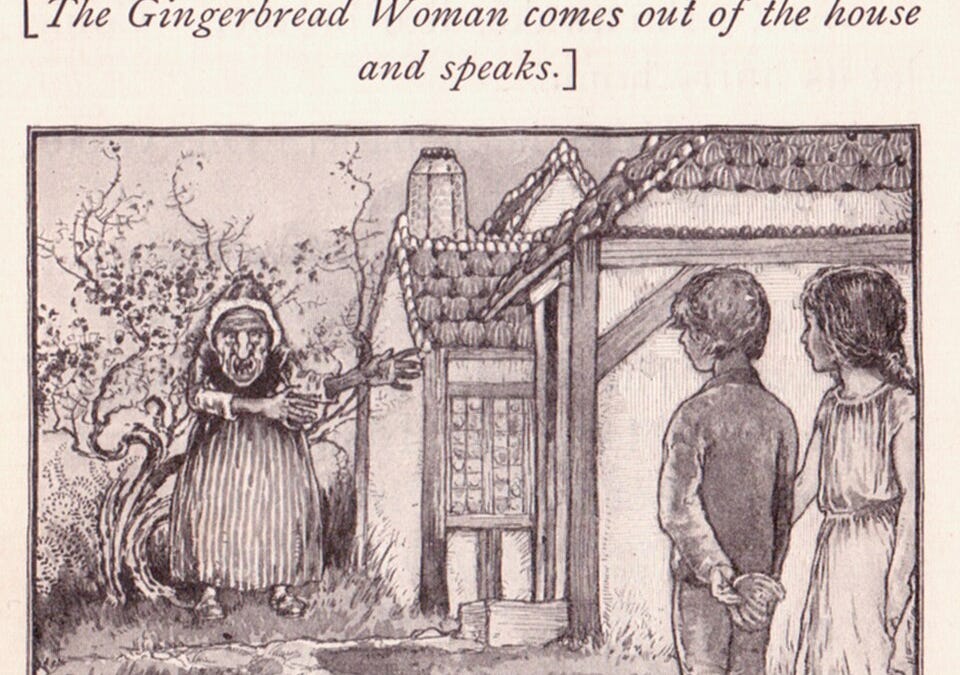
Hopelessly lost, the famished brother and sister stumble upon a house made of gingerbread and candy, where they are captured by the resident child-eating witch.
asserted
they → lose → witch
But before the witch can serve them up for supper, Gretel outwits her—by popping her into her own scorching oven.
asserted
Gretel → serve → oven
Now safe, the children gather as much of the witch’s hoard of gold and jewels as they can carry and set off for home.
asserted
they → gather → home
At last, they succeed in reuniting with their father, who has been pining (or searching) for them all along, the stepmother having died (or been sent away, or simply run off).
asserted
stepmother → succeed → them
The children joyfully fall into their father’s arms.
asserted
children → fall → arms
And then, enriched by the ex-witch’s treasure, they all live… well, you know.
asserted
you → enrich → treasure
But, despite the happy ending, the question remains: what is the moral status of the father in this story?
asserted
status → remain → story
Even though he initially resists the stepmother’s plotting, he eventually participates; so clearly, he must join her in being a bad character.
asserted
he → resist → her
And yet, in the story, the father ultimately emerges as good—as underscored by the children’s loving reunion with him at the end.
asserted
father → emerge → end
Whatever culpability the parents might have shared for abandoning the children has been wholly given to the late stepmother, with the (contrite) father effectively escaping blame.
uncertain
father → share → blame
How does the narrative accomplish this moral displacement?
asserted
narrative → accomplish → displacement
As we would expect, when the father first hears the stepmother’s scheme, he reacts with horror—rejecting it out of hand and refusing to go along with it.
asserted
he → expect → it
But his wife keeps at him… incessantly.
asserted
wife → keep → him
As Stephen King writes in his recent imaginative rendering, “she would give him no peace until he agreed.”
asserted
he → write → peace
Another modern version puts it even more bluntly: She nagged him until he was forced to concede.
asserted
he → put → him
From a rhetorical standpoint, the variations on this theme do the trick.
asserted
variations → do → trick
Their primary implication is that the father was eventually worn down by his malevolent wife’s persistent badgering, to the point where he could no longer oppose her.
uncertain
he → wear → her
He simply had no choice but to join the conspiracy.
asserted
He → have → conspiracy
Since one cannot be held responsible for something they’re forced to do, her strongarming provides him a valid excuse.
asserted
strongarming → hold → excuse
He’s off the ethical hook.
asserted
He → ’ → hook
But once the question of the father’s culpability has been brought to the foreground, the moral tension that haunts the story calls for a second look.
asserted
that → bring → look
the nagged-until-forced-to-agree excuse hold up to closer scrutiny?
asserted
excuse → nag → scrutiny
In fact, to describe it is already to lay bare its absurdity.
asserted
describe → describe → absurdity
We can imagine many forms of coercion, but nagging doesn’t even make the list!
asserted
nagging → imagine → list
Even if we regard “nagging” as a proxy for dependency, emotional blackmail, or fear of abandonment, it remains at best an influence, not a compulsion.
asserted
it → regard → abandonment
Here’s the key point: Our story’s customary treatment of the father exemplifies what I shall call the Hansel and Gretel fallacy.
asserted
I → ’ → what
This device is a rhetorical move that treats pressure as compulsion and influence as inevitability, such that someone’s compliance is portrayed as though no real alternative existed, thereby providing an excuse that cancels out their responsibility—and accountability—for what they have done.
asserted
they → treat → what
This form of responsibility-reassignment/excuse-making occurs all too frequently, not just in cherished children’s stories but in real life, as well.
asserted
form → occur → life
Most often, the moral stakes are low (“She made me go to the grocery store with her”) so it doesn’t matter much.
asserted
it → make → her
In that context, the “I-had-no-choice, I-was-merely-following-orders” defense rightly fell on deaf ears.
asserted
defense → have → ears
The challenge arises in the broad range of quotidian instances between those two extremes—especially in our public or corporate life, where the “I-was-forced-to-obey/agree” excuse is too easily invoked, either explicitly or, more often, implicitly.
asserted
excuse → arise → life
For example, consider institutional capitulation: At the beginning of President Donald Trump’s second term, certain universities, law firms, and news organizations quickly caved to pressure.
asserted
universities → consider → pressure
They agreed to actions (e.g. dismantling DEI programs or championing certain causes) incompatible with their basic institutional values, or paid monetary tributes, or both.
asserted
They → agree → tributes
When they are cloaked in rhetoric intended to deflect responsibility and accountability, such events often escape scrutiny in ways quite analogous to the fairytale.
asserted
events → cloak → fairytale
…and 22 more, not listed.
 The Aporia