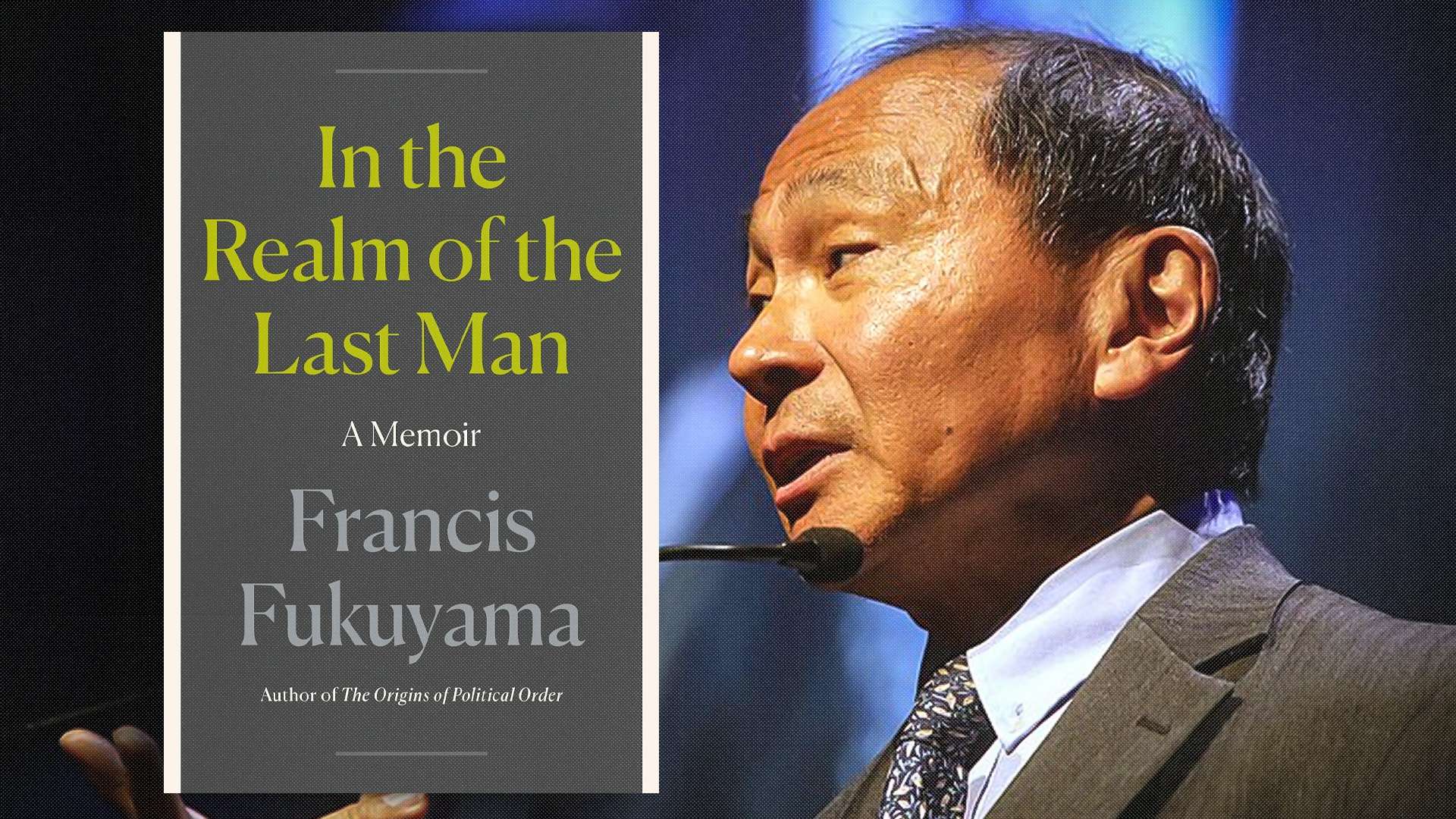
In the Realm of the Last Man: A Memoir, by Francis Fukuyama, Farrar, Straus and Giroux, 304 pages, $29
In his thirties, Francis Fukuyama was pursuing a respectable but low-key career as a RAND Corporation analyst and State Department bureaucrat focused on the Soviet Union.
asserted
Fukuyama → pursue → Union
His breakthrough into the public sphere came in the summer of 1989, when his essay "The End of History?" appeared in The National Interest.
asserted
essay → come → Interest
As a child of the Cold War, I was thrilled by his claim that we may be witnessing "the end point of mankind's ideological evolution and the universalization of Western liberal democracy as the final form of human government."
uncertain
we → thrill → government
This bold statement seemed confirmed by the fall of the Berlin Wall later that year and the collapse of the Soviet Union two years later.
asserted
statement → confirm → Union
Since then, Fukuyama has been one of America's leading public intellectuals.
asserted
Fukuyama → lead → intellectuals
Now he has written a charming and stimulating memoir, In the Realm of the Last Man.
asserted
he → write → Man
The book covers everything from his grandparents' time in a World War II internment camp to his break with prominent neoconservatives over the misbegotten invasion of Iraq; the career it reveals is an inspiring example of how a rigorous liberal education sharpens a relentlessly questing mind.
asserted
education → cover → mind
He credits his encounter with classicist Allan Bloom for instilling in him the passion to pursue the big questions: "What is the best way to live, what makes for the highest form of human happiness, what is the nature of justice, what is natural and what is conventional in human affairs."
asserted
what → credit → affairs
Fukuyama is entirely correct when he observes, "An appreciation for truly philosophical thought is a gift of inestimable value that remains with you for a lifetime.
asserted
that → observe → lifetime
"
But even as the book covers all these topics, it keeps coming back to ideas that Fukuyama started sketching in that 1989 essay and has expanded upon in countless works since then.
asserted
Fukuyama → cover → works
Fukuyama's argument that humanity had reached the end of history rested on his reading of the French philosopher Alexandre Kojève, who argued that the mainspring of history is humanity's drive for recognition, dignity, and respect.
asserted
mainspring → reach → recognition
In his interpretation of Kojève, Fukuyama adapted Plato's tripartite division of the human soul into logos (reason), eros (desire) and thymos (spiritedness).
asserted
Fukuyama → adapt → logos
Fukuyama contends that thymos is the true psychological driver of history, distinct from basic physical survival or economic calculation.
asserted
thymos → contend → survival
Human beings, he noted, are the only creatures that willingly risk death in the service of abstract ideals.
asserted
that → note → ideals
The "end of history," for Fukuyama, is achieved with the universal recognition of the equal dignity of all human beings as the foundational ideal of liberal democracies.
asserted
end → achieve → democracies
Liberal societies, he explains in Realm, provide "universal recognition by granting citizens equal rights; the rights to speak, to associate, to believe, and to have a share of political power through the vote.
asserted
he → explain → vote
In their brilliant 2009 book Violence and Social Orders, the Nobel-winning economist Douglass North and two colleagues approached humanity's political evolution from a less abstract but parallel track.
asserted
economist → win → track
The main problem that confronts societies encompassing more than a few hundred people, they argued, is how to control male violence.
asserted
they → confront → violence
Humanity's first solution to this problem was a "natural state" built around elite patron-client networks.
asserted
solution → build → networks
Think of chiefs, kings, and oligarchs as gang leaders who maintain relative social peace by running protection rackets: In exchange for a portion of your earnings, the strongman and his minions will try to make sure that other guys don't kill you or steal your stuff.
asserted
guys → think → stuff
The dawn of the 19th century, North noted, saw the development of "open access orders" where the rule of law supplanted elite hierarchical rule.
asserted
rule → note → rule
Subjects once under the authority of aristocrats become citizens bearing equal rights.
asserted
Subjects → become → rights
These precursors to today's liberal democracies were better at controlling social violence while simultaneously allowing more human flourishing through market-based economic growth.
asserted
precursors → control → growth
By the end of the 20th century, the number of people living in such societies had expanded greatly.
asserted
number → live → societies
Back in 1989, Fukuyama observed that some societies remain mired in history.
asserted
societies → observe → history
But he predicted such societies would eventually join the post-historical world through the "unabashed victory of economic and political liberalism."
asserted
societies → predict → liberalism
North and his colleagues do not seem to have considered the prospect that bored citizens would rebel against open access orders and revert to autocratic natural states.
asserted
citizens → seem → states
But Fukuyama did.
asserted
Fukuyama → do → ?
In the concluding paragraph of his 1989 essay, Fukuyama declared: "The end of history will be a very sad time."
asserted
end → conclude → history
Because "daring, courage, imagination, and idealism will be replaced by economic calculation, the endless solving of technical problems, environmental concerns, and the satisfaction of sophisticated consumer demands."
asserted
daring → replace → demands
The peace and prosperity that liberal societies make possible is not enough to satisfy some people's thymotic impulses.
asserted
societies → make → impulses
"Perhaps this very prospect of centuries of boredom at the end of history will serve to get history started again," he concluded.
asserted
he → serve → history
Fukuyama expanded on that idea in his 1992 book, The End of History and the Last Man.
asserted
Fukuyama → expand → History
Fukuyama took the term "the Last Man" from Friedrich Nietzsche's epithet for the contented beneficiaries of bourgeois peace and prosperity.
asserted
Fukuyama → take → peace
"We have been living in the realm of the Last Man for some time now," Fukuyama writes in his memoir.
asserted
Fukuyama → live → memoir
"The problem, though, is that the peace and prosperity brought about by the liberal order based on equal recognition is not enough for many people."
asserted
peace → bring → people
In Realm, Fukuyama reminds readers that the last chapters of The End of History and the Last Man "contain a clear premonition of the rise of the kind of demagogic populism that we have experienced from the mid-2010s to the present."
asserted
we → remind → present
To quote the older book directly: "if men cannot struggle on behalf of a just cause because that just cause was victorious in an earlier generation, then they will struggle against the just cause.
asserted
they → quote → cause
They will struggle for the sake of struggle.
asserted
They → struggle → struggle
They will struggle, in other words, out of a certain boredom: for they cannot imagine living in a world without struggle.
asserted
they → struggle → struggle
…and 31 more, not listed.
 The Aporia