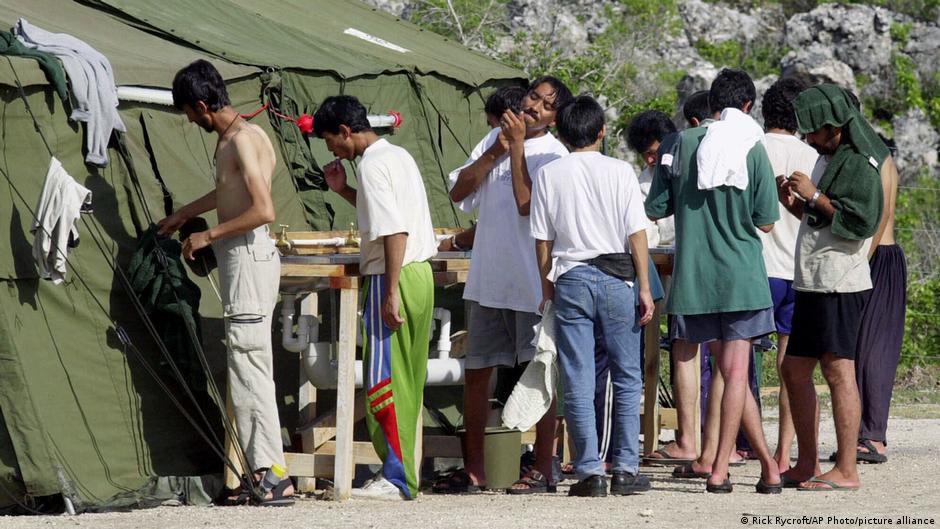
Nations that send asylum seekers to third countries for offshore processing and holding could spend billions, only to face accusations of human rights abuses and financial mismanagement, as in Australia.
uncertain
that → send → Australia
The European Union (EU) has nevertheless been considering the idea, and the United States (US) has already made similar third-country deals, but Australia has been processing or relocating people outside the country where they seek protection for more than two decades.
Former Australian Prime Minister John Howard introduced the so-called "Pacific Solution" in 2001, targeting immigrants who arrived by boat, and establishing Australian migration processing centers with the help from governments in Papua New Guinea (PNG) and the tiny island nation of Nauru .
Thousands sent to islands under Australia's 'Pacific Solution'
asserted
Thousands → consider → Solution
Center-left and center-right governments described the policy as a deterrent, saying people were less likely to attempt dangerous ocean crossings or pay smugglers if arriving by boat did not provide a route to Australia.
asserted
arriving → describe → Australia
In his 2001 election policy speech, Howard said the famous line, frequently quoted since: "We will decide who comes to this country and the circumstances in which they come."
In 2008, a newly elected Labor Party government phased out the practice, saying it was a cynical, costly, and ultimately unsuccessful exercise.
asserted
it → say → practice
But faced with more deaths at sea, a Labor government under Prime Minister Julia Gillard started sending maritime arrivals to Nauru and Manus again in 2012, after an expert panel recommended reopening the centers.
"I'm not going to play politics or look at political scoreboards when too many lives have been lost," Gillard said at the time.
asserted
Gillard → face → time
Between 2013 and 2014, the number of people transferred offshore peaked to more than 3,000.
asserted
number → transfer → 3,000
Journalists have been mostly barred from the centers on Nauru and Manus Island.
asserted
Journalists → bar → Nauru
Graham Thom, Advocacy Coordinator for the Refugee Council of Australia (RCOA), told DW that this lack of access and independent oversight meant many Australians accepted the narrative that the policy was working.
asserted
policy → tell → narrative
EU considers offshore arrangements
asserted
EU → consider → arrangements
People without a legal right to remain in the EU could face deportation to third countries as soon as 2027, with Rwanda and Uzbekistan reportedly under consideration as third-party countries, as well as Uganda.
uncertain
Rwanda → remain → countries
The European Parliament in June approved new rules that would pave the way for so-called "return hubs" outside the EU's borders.
asserted
that → approve → borders
Denmark's Minister for Immigration and Integration, Morten Bodskov, told reporters last month the hubs would not be detention and deportation centers.
"We are not talking about camps," Bodskov said, describing the scheme instead as "a new chance to have a life in a partner country."
asserted
Bodskov → tell → country
Denmark, alongside Germany, Austria, Greece, and the Netherlands, known collectively as the Group of Five, said in September they had agreed on steps towards a deal with a non-EU country, without naming it.
asserted
they → know → it
The group was to speak with the United Nations (UN) body, the International Organization for Migration, and the UN Refugee Agency about their next steps.
asserted
group → speak → steps
The proposal allows for harsh penalties for those who refuse to be removed to the hubs, including detention for up to 30 months pending deportation from the EU and entry bans.
asserted
who → allow → EU
US already has a third country migration scheme
The US government has already made deals with at least 30 third countries in Africa and Latin America.
asserted
government → have → Africa
In June, Amnesty International said some agreements had been revealed through the US Freedom of Information Act, while others "remain secret."
asserted
others → say → Act
The US Supreme Court ruled late last month that the second Trump administration could resume deportations under the third-country scheme, after a US appeals court ruled that immigrants must receive effective notice of their intended destination and an opportunity to challenge removal if they fear persecution or torture.
uncertain
they → rule → persecution
The first deportations from the US under the third-country removal scheme were of immigrants convicted of crimes, but more recently, foreign nationals not accused of any crime have also been deported.
asserted
nationals → convict → crime
Accusations of human rights abuse
Asylum seekers and human rights advocates have repeatedly alleged human rights abuses in Australia's offshore migration processing program, with Thom describing the policy as a "medieval idea."
asserted
Thom → allege → idea
A group of asylum seekers formerly detained on Manus Island reached a AU$70 million (€43.47 million/$48.47 million) settlement in 2017 after filing charges for abuse and unlawful detention.
asserted
group → detain → abuse
In February, an Australian Senate inquiry heard first-hand witness accounts of neglect, untreated health conditions, and serious concerns for the safety and dignity of camps inhabitants — especially of women being kept on Nauru.
asserted
inquiry → hear → Nauru
Prior to the hearing, 73 UN member states had publicly raised concerns about Australia's migration policies.
asserted
states → raise → policies
Brazil, China, Finland, Germany, Serbia, Switzerland and Turkey called for an end to offshore processing of asylum claims.
uncertain
Brazil → call → claims
Australia has yet to officially comment on the recommendations, but successive governments have said offshore processing helps deter dangerous boat journeys, with former Prime Minister Tony Abbott describing the policy during his term as "decent, humane and compassionate."
asserted
Abbott → have → term
The effect of offshore processing is difficult to isolate from other policy measures, especially the practice of turning back asylum boats.
asserted
effect → isolate → boats
This "turnback" policy was introduced and reintroduced under conservative governments in 2001 and 2013 respectively, but with inconsistent data on incidents.
asserted
policy → introduce → incidents
As in the US, offshore migration processing for Australia has expanded beyond its original scope, with Nauru recently agreeing to accept convicted foreign nationals from Australia who can't legally be returned to their countries of origin, at a cost of AU$2.5 billion over the next 30 years.
asserted
who → expand → years
Australia had already spent more than AU$13 billion on offshore detention since 2012.
asserted
Australia → spend → 2012
Measuring the success of Australia's model is difficult, but its significant long-term costs and legal and human rights concerns may serve as a warning for other countries considering similar policies.
uncertain
costs → measure → policies
 The Aporia