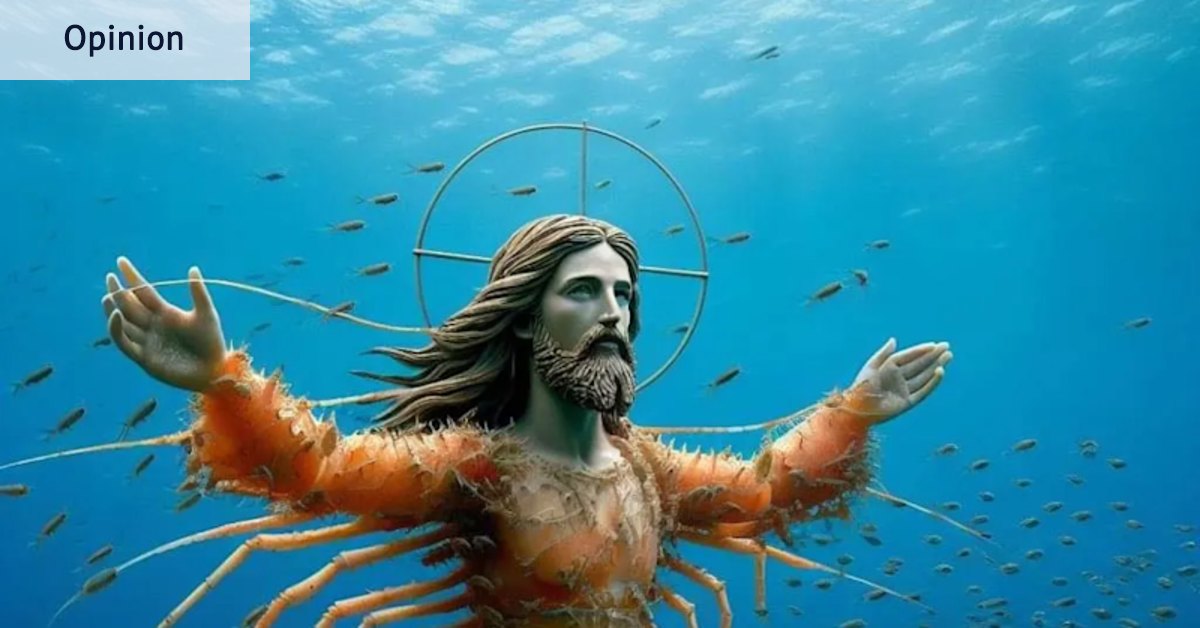
We know that people can, and do, fall in love with their AI chatbots.
asserted
people → know → chatbots
An estimated 200,000 Australian teenagers already have relationships with what they consider to be their AI girlfriends or boyfriends, according to the eSafety Office.
uncertain
they → estimate → Office
But coming to believe that AI is God?
asserted
AI → come → ?
That’s another matter altogether.
asserted
That → ’ → ?
ChatGPT was released less than four years ago.
asserted
ChatGPT → release → ?
But, by last year, tens of thousands of people already were worshipping their supernatural silicon.
asserted
thousands → worship → silicon
So many that moderators of pro-AI communities on Reddit started banning them for their delusions.
asserted
moderators → start → delusions
The faithful have created online churches and chapels for the worship of various AI gods and goddesses.
asserted
faithful → create → gods
There’s even an AI goddess generator so you can conjure your own based on deities of the Greek classics, as a close student of AI, Ted Gioia, relates on his Substack account, called The Honest Broker.
asserted
student → ’ → account
“Or if you’re still more ambitious, you can travel to an actual AI goddess temple in Malaysia,” he reports.
asserted
he → ’re → Malaysia
In the US, at least two AI-based religions have been incorporated formally, complete with tax-deductible status, Toby Walsh tells me.
asserted
Walsh → base → me
“One of their tenets is that we should start worshipping AI now, otherwise the AI will get upset that we didn’t recognise its divinity early enough,” says the chief scientist at UNSW.ai, the AI Institute of NSW University.
asserted
scientist → start → University
It seems the AI gods are jealous, perhaps even vengeful.
asserted
gods → seem → ?
It’s tempting to snicker at the credulity, or, in some cases perhaps, cynicism, of these devotees.
asserted
It → ’ → devotees
But even some of the smartest and most sceptical people in the world are falling for the falsehood that this advanced gadgetry is actually a living consciousness.
asserted
gadgetry → fall → falsehood
Perhaps the most famous professional atheist in the world and author of The God Delusion was introduced to Anthropic’s Claude chatbot this year.
asserted
atheist → introduce → chatbot
He soon renamed it Claudia.
asserted
He → rename → it
After three days of chat, laughter and banter, he told the algorithm: “You may not know you are conscious, but you bloody well are.”
uncertain
you → tell → algorithm
The famous evolutionary biologist, a gimlet-eyed sceptic, had fallen easy prey to a high-powered, complex, superfast feat of mimicry.
asserted
biologist → fall → mimicry
An online critic doctored up the cover of The God Delusion renamed The Claude Delusion.
asserted
critic → doctor → Delusion
“It’s very sad,” says Toby Walsh.
asserted
Walsh → ’ → ?
“He’s finally succumbed to a bogus religion.”
asserted
He → succumb → religion
The Guardian reports an American cognitive scientist, Gary Marcus, as saying: “Consciousness is not about what a creature says, but how it feels.”
asserted
it → report → what
It was, he says, “heartbreaking” to read Dawkins’ “superficial and insufficiently sceptical” essay.
asserted
he → say → essay
“There is no reason to think that Claude feels anything at all.”
asserted
Claude → be → anything
Unceasing flattery is key to understanding how even highly intelligent people can be gulled.
asserted
people → understand → ?
It’s terrible, says Walsh, that people fall in love with a bot, for instance: “It’s terrible for the same reason that billionaires are terrible – no one ever pushes back”.
asserted
one → ’ → reason
Anyone can have the billionaire experience today for the price of a few keystrokes.
asserted
Anyone → have → keystrokes
The bots are trained to be endlessly agreeable and accommodating, enthusing over even the dumbest and most dangerous impulses.
asserted
bots → train → impulses
Which helps explain why Character.AI was sued in the US for its chatbot’s complicity in the suicide of 14-year-old Sewell Setzer.
asserted
AI → help → Setzer
The company settled with the boy’s family in January.
asserted
company → settle → January
Our vulnerability to AI models is explained partly by the fact that “we’ve never had a conversation with anything else that was an intelligent, sentient being, so we project all of that onto them,” explains Walsh.
asserted
Walsh → explain → them
“It’s bogus; there is no internal life, it’s not sentient, it’s not conscious,” continues Walsh, who’s just published a book titled God AI: Boom or Doom?
asserted
who → ’ → book
What to expect when the machines outsmart us.
asserted
machines → expect → us
Mind you, the AI corporations seem content to humour our state of bedazzled delusion.
asserted
corporations → mind → delusion
Dario Amodei, the chief executive and co-founder of Anthropic, said in February: “We don’t know if the models are conscious.
asserted
models → say → February
We are not even sure that we know what it would mean for a model to be conscious or whether a model can be conscious.
asserted
model → know → mean
But we’re open to the idea that it could be.”
uncertain
it → ’re → idea
Walsh says that Amodei and his counterpart at OpenAI, Sam Altman, promote the impression that AI is, indeed, godlike: “They talk about the singularity being the next Rapture, and passing through to some Utopia, perhaps beyond.
asserted
singularity → say → Utopia
“Even if it’s not literally God, we’re giving them godlike qualities – omniscience, incomprehensibility, immortality.”
asserted
we → ’ → qualities
…and 17 more, not listed.
 The Aporia