The Sydney Morning Herald
· collected 2026-10-05 · by Cassandra Morgan
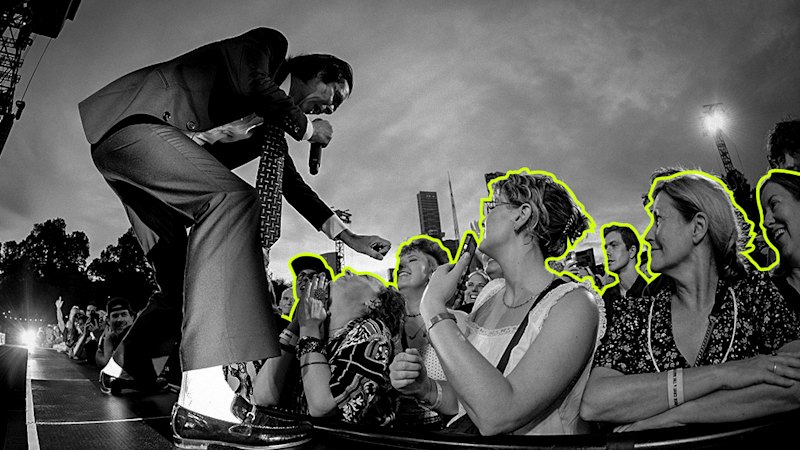
As dusk fell over Melbourne on a balmy, fragrant night, Nick Cave commanded a surge of people like a receding tide to the banks of the Yarra River.
asserted
Cave → fall → River
His striking figure stood alongside the city’s glowing skyline as bats flew overhead, the sharp edges of the Bad Seeds frontman’s raw menace tempered by the loss and longing of age.
asserted
edges → stand → age
More than four decades before, Cave strode like a preacher under the chandelier of St Kilda’s former Crystal Ballroom for the Bad Seeds’ first show.
asserted
Cave → stride → show
But it almost didn’t happen here, says the band’s promoter and tour producer Paul Sloan.
asserted
promoter → happen → ?
“I would have tried a dozen places before, because Alexandra Gardens said ‘no’ to me for months,” says Sloan, elbows resting on a leather armchair in a Melbourne hotel lobby.
asserted
elbows → try → lobby
“I ended up convincing them to let me do it.”
asserted
me → end → it
He lists off the rejections with his fingers – among them, ovals gate-kept for sport and a heritage venue hamstrung by bureaucracy.
asserted
He → list → bureaucracy
Through all of it, there were people who shared Sloan’s vision for a “quintessentially Melbourne” Cave experience, outside traditional black box venues such as The Forum, arenas such as Rod Laver, or Flemington Racecourse.
asserted
who → be → Laver
“We can’t put Nick out on the horse tracks.
asserted
We → put → tracks
His audience won’t want to be there, and he won’t want to be there
asserted
he → want → ?
,” Sloan says.
asserted
Sloan → say → ?
But in pursuing the ambitious and creative in Melbourne, “you enter a world of resistance”.
asserted
you → pursue → resistance
It’s an experience the city’s arts community is doggedly trying to shake.
asserted
community → ’ → ?
The future of the arts – and sport – is a key pillar of The Age’s Melbourne Assembly civic forum later this month, bringing together industry leaders, key decision-makers and the community.
“If I was in government in Melbourne in the curation of that tour, I would have said, ‘OK, we’ll give you that site for this show because it’s a Melbourne artist, but we want lead announcement’,” Sloan says.
asserted
Sloan → bring → announcement
“The narrative is stronger then because it means interstate travellers and international travellers are coming into the show because it feels more meaningful.
asserted
it → mean → show
“It’s a moment.”
asserted
It → ’ → ?
Melbourne claims to be the arts capital of Australia, and you can feel the weight of the city’s cultural discernment, Sloan says.
uncertain
Sloan → claim → discernment
But without the people at its core – the artists, performers and millions of fans supporting them – the city’s cultural identity disappears.
asserted
identity → support → them
Supporting the artists
Fiona Duncan scanned the details of the election announcements.
asserted
Duncan → support → announcements
But there is a gaping hole in Victorian Labor’s package to protect and support the state’s music industry, the Music Victoria chief executive says.
asserted
executive → be → industry
“It’s great to support the venues,” Duncan tells The Age.
asserted
Duncan → ’ → Age
”But if the artists who are meant to play in them can’t afford to keep making the music and can’t afford to perform, you’re not covering and supporting the whole story.
asserted
you → mean → story
As news of the reforms went public this month – earmarking $2.5 million to help venues stage gigs, and designating entertainment precincts in Collingwood, Fitzroy, Geelong and Ballarat – Duncan was en route back from the Reeperbahn Festival Conference in Hamburg, Germany, where she met international industry counterparts who have instituted a ticket levy.
asserted
who → go → levy
This, she says, is the key to shoring up artists’ future in Melbourne – and avoiding a mass exodus.
asserted
she → say → exodus
The proposed 1 per cent levy would apply to major concerts at stadiums and arenas, pooling into a trust of at least $4.4 million a year to help musicians build and sustain viable careers.
“We have the most arena ticket sales in the country, we have the most industry in this state, but we have the lowest per capita funding for industry out of all the other states other than the ACT and Tasmania,” Duncan says.
asserted
Duncan → propose → ACT
“We want to keep that money in Victoria.”
In the last financial year, Victoria invested some $3.37 million in contemporary music (48 cents per resident), to NSW’s $26.4 million ($3.10 per resident) and South Australia’s $2.75 million ($1.46 per head), according to Music Victoria’s analysis.
The state government is delivering one of Australia’s biggest cultural infrastructure projects through the $1.7 billion Melbourne Arts Precinct transformation, and has a strong track record of backing Victoria’s creative venues, a spokesman said.
uncertain
spokesman → want → venues
The project includes the latest iteration of the National Gallery of Victoria, which was visited by more than 3 million people across its two existing locations in 2025 (making it the most visited art museum in Australia).
asserted
it → include → Australia
Overall, more than 11.6 million people visited Victoria’s state-owned arts and cultural institutions in 2024-25.
asserted
people → visit → 2024
The Melbourne Arts Precinct in 2025 contributed $591 million to Victoria, according to an SGS Economics and Planning report.
uncertain
Precinct → contribute → report
In 2023-24, creative industries in Victoria brought some $41.1 billion into the state, representing some 8 per cent of its total economy.
asserted
industries → bring → economy
Victoria also has more music venues than any other state (although they have dwindled), and state Labor’s proposed reforms also include $1.5 million to transform underutilised spaces into live music and arts venues.
asserted
reforms → have → venues
But the industry remains at the mercy of “boom and bust” funding, Duncan says.
asserted
Duncan → remain → funding
In a poll on ideas to improve Melbourne, three-quarters of The Age’s readers supported Music Victoria’s ticket levy proposal, for which the organisation is yet to secure state government backing.
asserted
organisation → improve → backing
“Our plan with the levy is that there is that consistent, reliable funding mechanism that exists beyond an individual budget or election cycle,” Duncan says.
asserted
Duncan → be → budget
Opposition creative industries spokesman David Davis points to the Liberals and Nationals’ 10-year plan to retain, support and attract more live music events, and rebuild Victoria’s festival calendar.
asserted
Davis → point → calendar
The plan lays out support for business and tax relief, and backs onto Opposition Leader Jess Wilson’s promise for a one-point contact for pubs and clubs, along with fewer regulations, he says.
asserted
he → lay → regulations
“Last election, Labor talked a big talk and promised the world to the live music sector, but the support, planning and regulatory reform have not eventuated,” Davis says.
But Rising chief executive Hannah Fox argues the city should be asking a bigger question: instead of a sole focus on government funding, why don’t bureaucrats give artistic communities agency to help themselves?
asserted
bureaucrats → talk → themselves
The Rising festival covers all artistic genres – this year’s program showcased dancing Furbies, a stage transformed into a care home and covered in brown poo-goo, and a Barkindji artist’s immersive field of murnong.
asserted
program → cover → murnong
“So many spaces we think of as public or civic spaces have essentially been privatised through exclusive contracts with catering companies, production companies, and ticketing big tech,” Fox tells The Age.
asserted
Fox → think → Age
“If you look at, say, Melbourne Town Hall for example, that’s not a space that you can put on an event in without an absolute minimum of $50,000 behind you, and that should be a community space.
asserted
that → look → you
…and 44 more, not listed.
 The Aporia