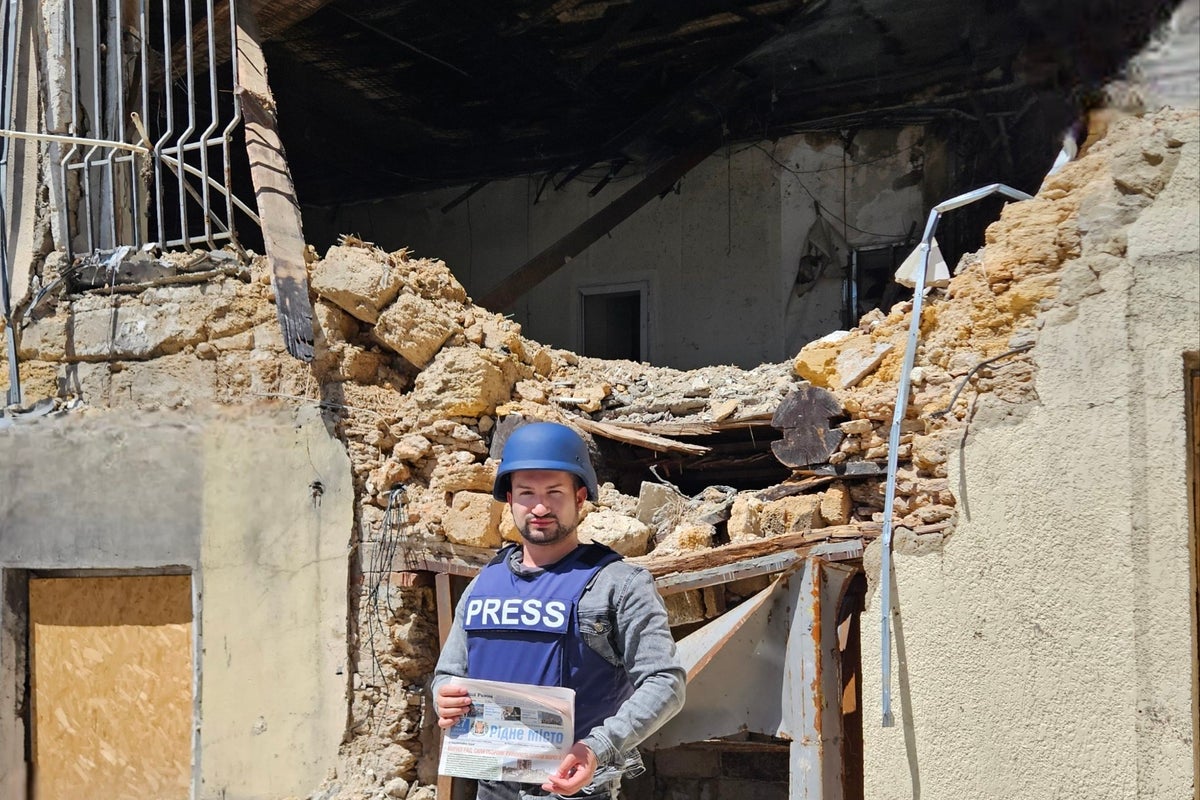
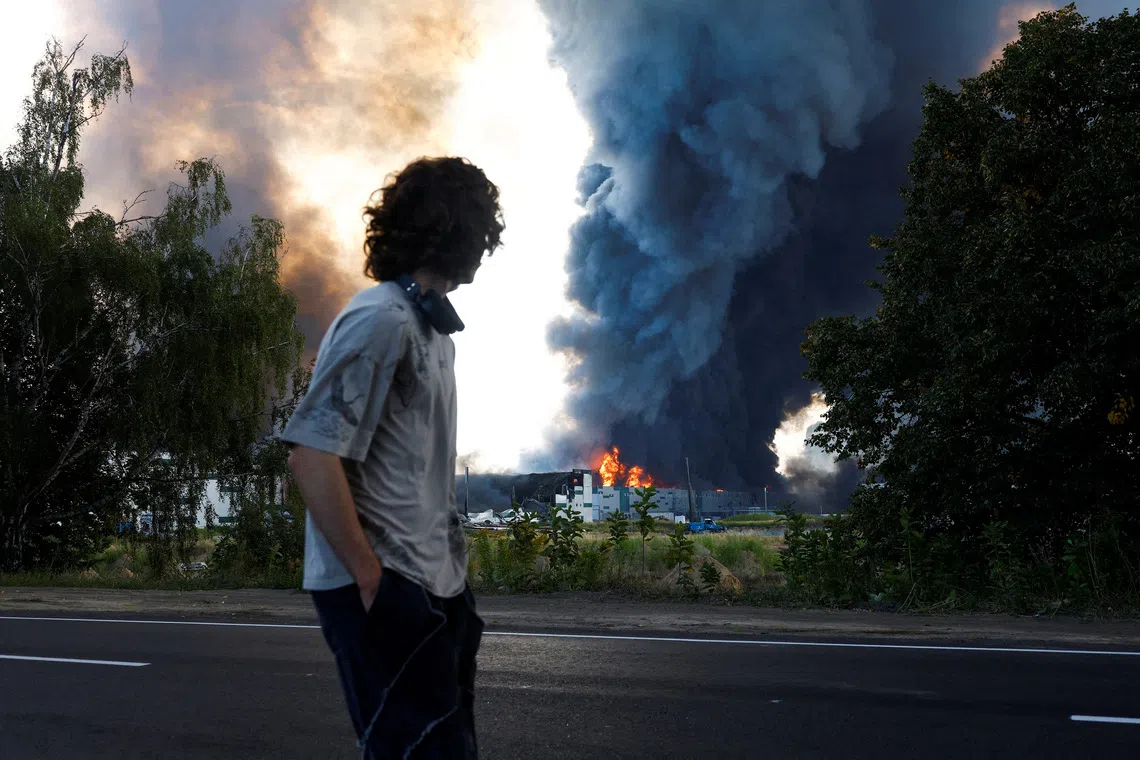
In the weeks leading up to Vladimir Putin’s invasion of Ukraine, the headlines in a Kyiv newspaper looked much like they would anywhere else.
asserted
they → lead → newspaper
There was some debate over whether Russia would actually attack its neighbour.
asserted
Russia → be → neighbour
On 24 February 2022, everything changed as Russian tanks rolled across the border.
asserted
tanks → change → border
Businesses closed or relocated, martial law saw hundreds of thousands of working-age men recruited for military service, and around one million people fled the country in the first week.
A brave few stayed behind to keep a record of what happened as the missiles rained down.
asserted
missiles → close → record
Local journalists observed and asked questions as their communities were torn apart by the war.
asserted
communities → observe → war
“In one day, most of our journalists became war correspondents, especially in the frontline areas,” says Oksana Brovko, CEO of the Association of Independent Regional Press Publishers of Ukraine (AIRPPU).
asserted
Brovko → become → Ukraine
It was the environment which changed, in February 2022.”
asserted
which → change → February
Brovko has spent the last four years organising support for Ukraine’s battered regional media industry.
asserted
Brovko → spend → industry
In the early days, she says, that comprised delivering bulletproof vests, first aid kits, generators and charging stations, so that reporters could continue to work.
uncertain
reporters → say → vests
Since then, AIRPPU has helped more than 180 outlets with material support, grants and business modelling to ensure they stay in print.
asserted
they → help → print
In July alone, Brovko says, eight local media outlets were destroyed by Russian missiles or drones.
asserted
outlets → say → missiles
Upwards of 300 publications have closed since 2022, she adds.
asserted
she → close → 2022
UNESCO reported last summer that around 28 per cent of Ukrainian outlets had closed their doors since the start of the invasion, with 37 per cent of newsrooms partially or fully evacuated.
asserted
cent → report → newsrooms
Internews International assessed that regional media has only seen a “clear deterioration in operating conditions” since then, exacerbated by the suspension of foreign aid programmes since Donald Trump took office.
asserted
Trump → assess → office
Mobilisation has seen newsrooms shrink from an average of 10 to 20 reporters to just three to five, Brovko says, while the evacuation of residents has cut into subscription revenues and the relocation of businesses has dried up advertising money.
asserted
relocation → see → money
Nearly three-quarters of editors said a lack of funding was a primary challenge last year, up from 58 per cent a year prior.
asserted
lack → say → cent
Almost half said staffing was a major concern, with mobilisation now the main cause of reporters leaving, ahead of stress and burnout.
asserted
reporters → say → stress
Those journalists have crucially been among the first to parse and share the conflict as it moves through their communities.
asserted
it → parse → communities
The 0629 outlet from Mariupol was on the scene speaking to witnesses when Russia bombed a theatre sheltering civilians on 16 March 2022.
asserted
Russia → speak → March
Vhoru continued publishing from Kherson even through nine months of Russian occupation.
asserted
Vhoru → continue → occupation
Okana says their work is vital.
asserted
work → say → ?
“They are writing history right now, and in 50 years we’ll come back and we will learn history – European history – from these newspapers, which I receive every week from the colleagues on the front line.
asserted
I → write → line
But the strain of the conflict also threatens the other functions of a free press.
asserted
strain → threaten → press
It took decades from Ukraine’s independence for the media to unshackle itself from government ownership, and the country is still negotiating a new relationship with its anti-corruption bodies.
asserted
country → take → bodies
Brovko says the media plays an essential role in scrutinising the work of local government.
asserted
media → say → government
And, as well as the war, reporters also face pressure from local officials to rein in their investigations.
asserted
reporters → face → investigations
“From one side, we fight with Russia, because we work under missiles, in a broken environment,” she says.
asserted
she → fight → environment
“From another side, it’s the local government ...
asserted
it → ’ → side
we start to be visible, and we start to feel pressure from local authorities, from local businesses, from local politicians.
asserted
we → start → politicians
She says the challenge going forward will be to move out of this constant struggle for survival and towards a new resilience.
asserted
challenge → say → resilience
“It’s important to remember that sometimes you need to fight for independence.
asserted
you → ’ → independence
Sometimes you need even to die protecting that.
asserted
you → need → that
But at the same time we need to remember that the future is not just to think about survival, but also about the future.”
asserted
future → need → future
AIRPPU has partnered with OpenAI and the World Association of News Publishers to facilitate the adoption of artificial intelligence in newsrooms.
asserted
AIRPPU → partner → newsrooms
The topic is sensitive in the industry, but Brovko believes that using AI to automate routine tasks and administrative so that the reporters can spend more time on the front lines gathering news.
asserted
reporters → believe → news
“This programme will provide Ukrainian publishers with access to international expertise, practical tools and hands-on support that will help them turn those opportunities into tangible results.
asserted
them → provide → results
And most importantly – it should give journalists back time to do journalism,” she says.
asserted
she → give → journalism
Trudova Slava, a digital and print newspaper in Zaporizhzhia, said in a statement shared with The Independent: “Our newsroom is small, but we serve five communities in Zaporizhzhia region, most of whose territories are inaccessible to journalists because of the fighting, while our communities are dispersed across Ukraine and abroad.
asserted
communities → say → Ukraine
“We need AI to continuously monitor social media and other sources, helping us find important stories, people and issues that we might otherwise miss.”
uncertain
we → need → that
The Kremenchuk Telegraph said they planned to use the tools to help analyse large volumes of documents, asset declarations, court decisions, public procurement records and other open data, to generate leads for investigation faster than sifting through information manually.
asserted
they → say → information
 The Aporia