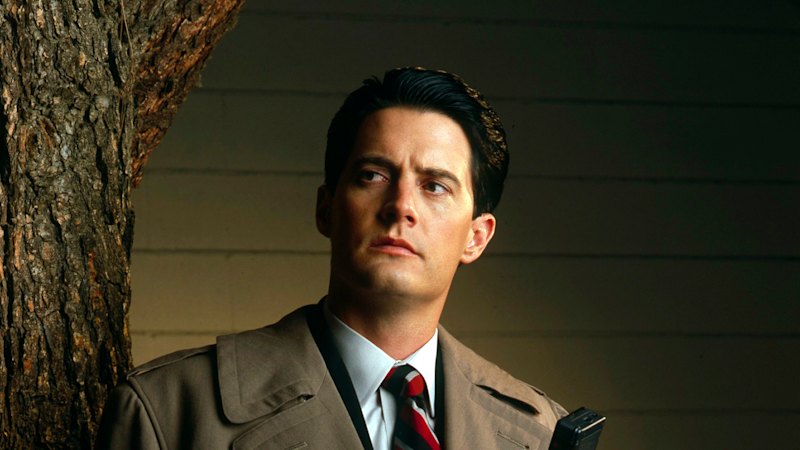
In another world, Kyle MacLachlan might have been known for straight up and down leading man roles – the handsome lead of a worthy drama, say, or the dashing love interest in a romantic comedy.
uncertain
MacLachlan → know → comedy
He has the looks for it, and the talent.
asserted
He → have → it
But in this timeline, MacLachlan is best known for playing – there’s no other way to put this – absolute oddballs.
asserted
MacLachlan → know → oddballs
The kind of characters who seem normal at first blush, but are revealed to be something much darker, more eccentric, more deviant.
asserted
who → seem → blush
Take Blue Velvet (1986), David Lynch’s surreal, simmering and at times darkly funny story of violence, voyeurism and an amyl nitrite-inhaling psychopath that effectively launched MacLachlan’s career.
asserted
that → take → career
In it, he plays Jeffrey Beaumont, a young man whose discovery of a severed human ear on a suburban lawn propels him into an unsettling world that lurks beneath the sunny surface of his home town.
asserted
that → play → town
MacLachlan brings a wide-eyed earnestness to the role that makes his descent into darkness all the more troubling.
asserted
descent → bring → darkness
It’s this same earnest quality in the face of strangeness that makes him so compelling as Special Agent Dale Cooper in Twin Peaks.
asserted
him → ’ → Peaks
Lynch, it seems, recognised something essential about MacLachlan as an actor: he is someone an audience will trust.
asserted
audience → seem → actor
And no matter how strange things get, they will go wherever he leads.
asserted
he → get → ?
How MacLachlan ended up in this peculiar niche is the subject of his new memoir, Fictional Selves, written with Jon Sternfeld.
asserted
ended → end → Sternfeld
When I log on to our video call to discuss the book, we immediately run into technical problems: MacLachlan can see me, but I can’t see him.
asserted
I → log → him
After futzing around with the settings for a few minutes, we decide to push on with the interview.
asserted
we → futze → interview
“Oh, shoot,” he says, sounding genuinely apologetic that he can’t fix a problem that is almost certainly my fault.
asserted
that → shoot → problem
“Well, I look great.
asserted
I → look → ?
I’ve got a cool sweater on.
asserted
I → get → sweater
I’ve got wireframe glasses.
asserted
I → get → glasses
He’s drinking a flask of coffee and calling from somewhere in the bowels of the Today Show studios in New York, in between filming two segments.
asserted
He → drink → segments
He’s feeling what he describes as “a sense of terror” about the book’s release, because Fictional Selves is a catalogue not just of his successes and the things he’s proud of, but a frank assessment of his failures and mistakes too.
asserted
he → feel → failures
“It doesn’t pull any punches,” he says.
asserted
he → pull → punches
The memoir, he says, came about partially from a place of regret.
asserted
he → say → regret
When his father died of cancer in 2011, MacLachlan was left with a sense there was so much more he wanted to know about his inner life, so many things he wished he’d thought to ask.
asserted
he → die → life
His father, he says, came from “a different generation”.
asserted
he → say → generation
Talking about his emotions – especially anything difficult or uncomfortable – was something he just didn’t do.
asserted
he → talk → emotions
Now that MacLachlan is a father himself (he and Desiree Gruber have been married since 2002; their son, Callum, is 18)
asserted
son → marry → 2002
, he’s determined not to repeat the same pattern.
asserted
he → ’ → pattern
He wanted to tell the story of his life – unvarnished, in his own words – so that one day, his son could read it and know exactly who his father was.
uncertain
father → want → it
Fictional Selves begins with his vertiginous ascent from community theatre in Seattle to landing the lead role in a Hollywood movie that, when it was released, was meant to shake blockbuster cinema to its foundations.
asserted
it → begin → foundations
That movie was David Lynch’s Dune (1984) and it was an unqualified commercial and critical failure, almost killing MacLachlan’s career before it had even begun.
asserted
it → kill → career
Still, he and Lynch hit it off: they both grew up in the Pacific Northwest (MacLachlan in Washington, Lynch in Montana), had similar childhoods, similar values.
asserted
they → hit → childhoods
Lynch gave him the Blue Velvet script to read while Dune was shooting.
asserted
Dune → give → script
MacLachlan initially turned it down, but couldn’t get the dark, unsettling tale out of his mind.
asserted
MacLachlan → turn → mind
“I was immediately drawn in and enthralled in the story,” he says.
asserted
he → draw → story
“I identified with Jeffrey – I would have these curiosities, I would have this fascination with this dark side of things.
asserted
I → identify → things
The world [Lynch] had created was so frightening, enticing, relatable, surreal.”
asserted
Lynch → create → [
Also, he was out of work: “There literally was nothing else that was available to me to do.”
asserted
that → do → me
When Blue Velvet was released, it became a critical darling and MacLachlan was anointed an actor to watch.
asserted
MacLachlan → release → ?
“It’s been a bit fraught, my relationship with fame,” he says.
asserted
he → say → fame
“I had enough of an experience [with Dune] to distrust it and to not give it value.
asserted
I → have → value
I still feel that way.
asserted
I → feel → ?
…and 42 more, not listed.
 The Aporia