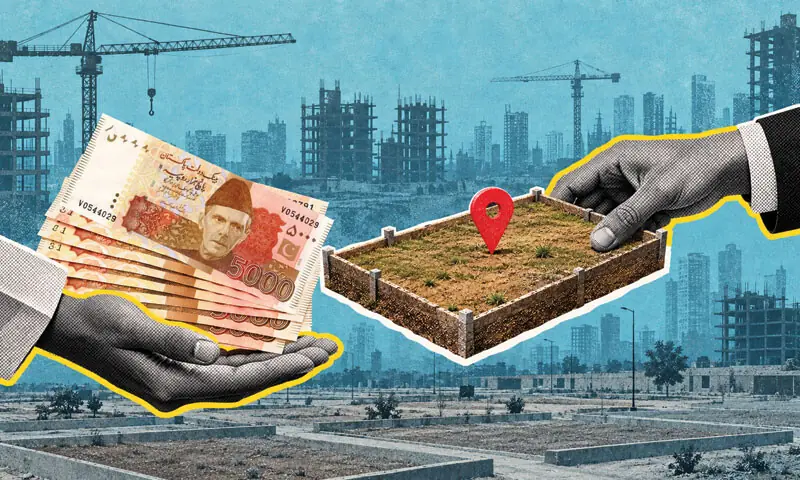
Every month, Idrees sends money home from Dammam in Saudi Arabia.
asserted
Idrees → send → Arabia
His wife pays the children’s school fees, the electricity bill and the cost of his parents’ medicines and buys food, fuel and clothing.
asserted
wife → pay → food
She puts aside what she can.
asserted
she → put → ?
Other months, she manages enough to feel they are getting somewhere.
asserted
they → manage → enough
When they have saved enough, a relative suggests buying a plot.
uncertain
relative → save → plot
It would be theirs, he says.
asserted
he → say → ?
Idrees can already picture taking his wife and children to see it, pointing out the boundaries and telling them that, one day, they might build a house there.
uncertain
they → picture → house
For now, it would be something to hold on to while Idrees keeps working abroad, as proof that the years away from his family are building towards something.
asserted
years → hold → something
A plot feels solid in a way a bank balance may not, particularly to families that have watched inflation eat into their savings and the rupee lose value.
uncertain
rupee → feel → value
It can take years of money put aside and it can be passed on to children.
asserted
it → take → children
When Idrees’ family buys, the price recorded on the property documents may be lower than what they pay.
uncertain
they → buy → what
His wages came home through a bank, but the full value of the purchase may never appear in the records.
uncertain
value → come → records
Multiply that gap across transactions and the question becomes much bigger than one family’s choice of where to save.
Pakistan’s property market may be worth Rs7 trillion a year, yet much of its real value remains invisible.
uncertain
much → multiply → value
As families pour their savings and remittances into plots, a weak mortgage system, under-valued transactions and a cash-heavy economy are turning property into the country’s default savings vehicle and diverting capital away from productive investment…
A RS7 TRILLION MARKET WE BARELY MEASURE
The plot Idrees’ family buys may have two prices: the one on the paperwork and the one they pay.
uncertain
they → pour → paperwork
Pakistan records the former.
asserted
Pakistan → record → former
No national database captures the latter across residential, commercial and agricultural property, or how buyers settle the bill.
asserted
buyers → capture → bill
We estimated the market’s value using publicly available data.
asserted
We → estimate → data
Administrative records for fiscal year (FY) 2023-24 show 1.695 million documented property transfers.
asserted
records → show → transfers
Combining federal withholding-tax collection, provincial stamp duty and mutation data, official valuation tables and the estimated gap between official and market values, we put the annual property turnover at about Rs7.1 trillion, which is close to 6.7 percent of FY24’s gross domestic product (GDP).
asserted
which → combine → product
The estimate draws on two starting points.
asserted
estimate → draw → points
Federal collections under sections 236C and 236K, given assumptions about the mix of filers and non-filers, imply a taxable property universe of about Rs3 trillion.
asserted
collections → give → trillion
A second anchor comes from provincial recorded or deputy commissioner (DC) values, at about Rs2.54 trillion.
asserted
anchor → come → trillion
Official valuations usually sit below what buyers pay, though the gap varies by locality.
asserted
gap → sit → locality
Transfer taxes reward under-declaration and valuation tables struggle to keep pace with the market.
asserted
tables → reward → market
Adjusting each base with explicit recorded-to-market ratios gives an estimate of Rs7.1 trillion, assuming a discount of 35 percent between the market value and the arbitrary DC value that exists in a parallel universe.
asserted
that → adjust → universe
Then comes the harder question, which is how much of this is paid in cash?
asserted
much → come → cash
No dataset records how the full value of each transaction is settled, so we modelled it.
asserted
we → record → it
In the modelled scenario, 75 percent of the recorded value moves through banks, while only 20 percent of the premium above it does.
asserted
percent → model → it
On those assumptions, about Rs2.81 trillion is bank-settled and about Rs4.28 trillion, roughly 60 percent, moves through cash or cash-like channels.
asserted
trillion → settle → channels
Around 85 percent of that cash sits in the gap between the declared value and the real one.
asserted
percent → sit → value
That is more than Rs4 trillion in estimated payments over a year, whose full value may never appear on the property documents.
uncertain
value → estimate → documents
Rs4.28 trillion is an estimate of cash or cash-like payments over a year, not a stock of currency buried beneath Pakistan’s plots.
asserted
trillion → bury → plots
Sellers may spend, deposit or reinvest what they receive.
uncertain
they → spend → what
We cannot assume that every rupee stays outside the banking system, or that none goes on to finance a business.
asserted
none → assume → business
The more consequential finding is that the transaction records may miss a vast property market that can operate without the full price of its assets being recorded, or the way they were paid for being known.
uncertain
they → miss → assets
That is where the property story becomes bigger than just property.
asserted
story → become → property
Over the last three decades, more than 200,000 families in Karachi alone have seen their savings vanish as project developers either disappeared or projects were stranded.
asserted
projects → see → Karachi
Families take enormous risks, but such risks are not captured in any real estate database or any statistical handbook.
asserted
risks → take → database
Even when the building is completed, the arrangement puts the greatest risk on the buyer.
asserted
arrangement → complete → buyer
The family pays before the flat exists.
asserted
flat → pay → ?
…and 108 more, not listed.
 The Aporia